







Novel medical-grade CBD pharmacy opens in Colorado, first of its kind in U.S.
Inside an unassuming yet sprawling industrial building nestled within the high plains of Watkins, about a 30-minute drive southeast of Denver International Airport, step into Kazmira Therapeutics’ “hemp bay,” as it’s affectionately called.
Stacked and lined on pallets and metal shelves are dozens of cloth bags weighing upward of 170 pounds each.
They’re filled with raw harvested hemp, including from Colorado farms — tri-colored, dense flower buds; stalks; leaves and all — waiting to be moved into an adjacent manufacturing facility. There, the plant will undergo a closed-loop, 29-step purification process wherein only pure, medical-grade cannabidiol (CBD) will remain, the primary non-psychoactive compound found in hemp.
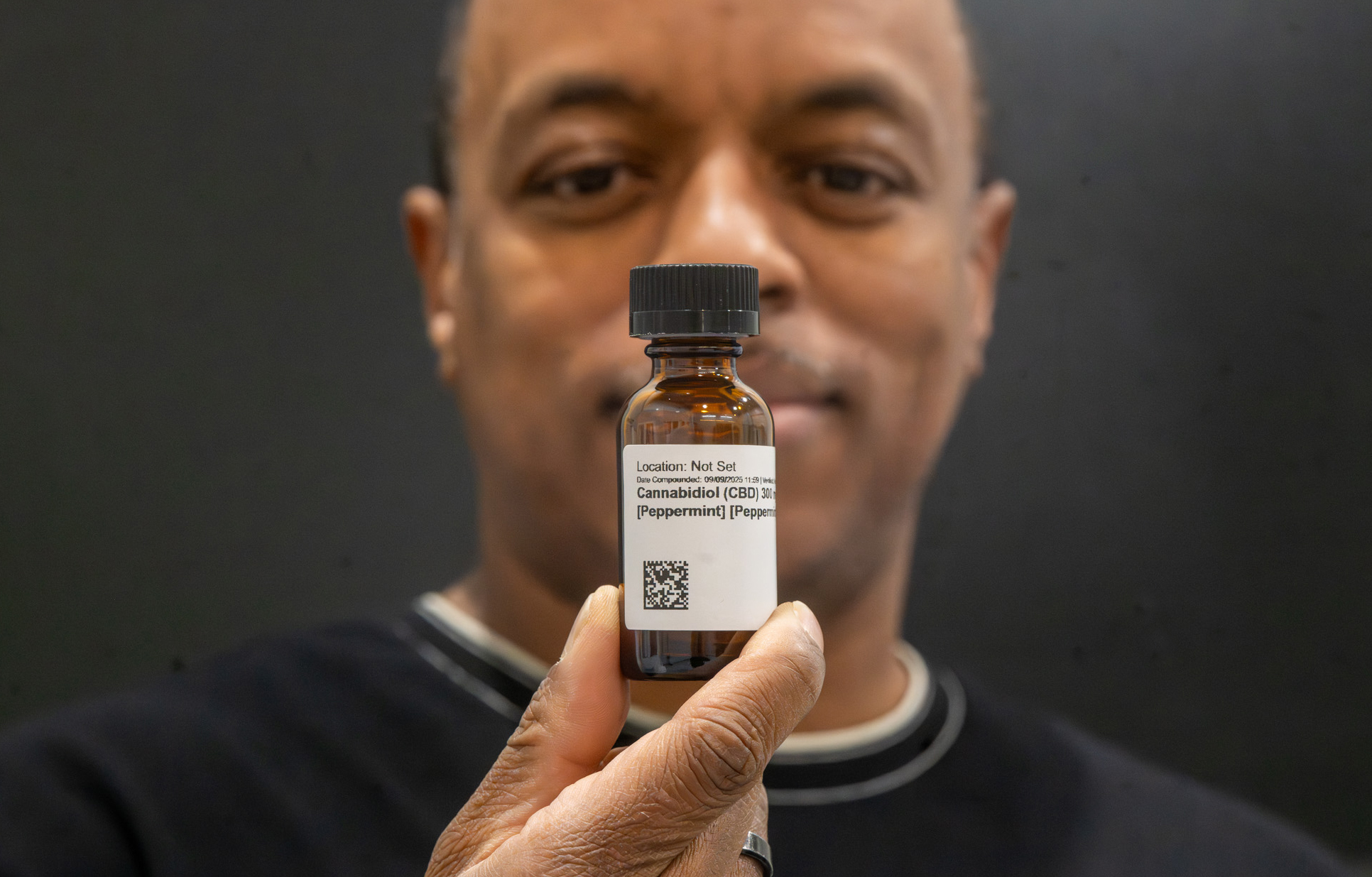
Eventually, a clinician will prescribe this pure CBD to their patient as an individualized, compounded cannabinoid formulation as part of their medical treatment. It is mixed and prepared by a licensed pharmacist on site at Kazmira Pharmacy.
The pharmacy, operated by Kazmira Therapeutics and officially launched in January, is the nation’s first — and sole — licensed, prescription-only CBD compounding pharmacy. It specializes in pure compounded CBD, with no trace of tetrahydrocannabinol (THC), the psychoactive component found in hemp.
Kazmira Pharmacy is currently dispensing and shipping CBD medications to patients across Colorado, said co-founders and co-CEOs Priyanka Sharma and her husband, Pulak Sharma.
Previously, CBD was only available as a low-dosage, over-the-counter-style supplemental product, mainly sold in topical and edible formats.
“What we’ve done is leverage the compounding pharmacy route and pharmaceutical innovation to take that cannabidiol as a purified product and put that into high-dosage-strength products that have therapeutic benefit,” Priyanka Sharma said.

The effects of ultra-pure CBD have been studied on a variety of health conditions, including anxiety, insomnia, chronic pain, and as an adjunctive therapy for people with substance use disorders and for people struggling with symptoms of substance use disorders, she said.
“(Clinicians are) looking at getting the patient to have a successful outcome with the medical condition that they’re dealing with, versus what you would see as far as an over-the-counter product. … This is purely medical-grade product, and (we’re) restoring clinical trust and education of the provider for cannabidiol, which had not been done before,” she said.
SERENDIPITOUS LAUNCH INTO CBD
The Sharmas were newlyweds living in Minneapolis in 2015 when two things happened simultaneously: The couple was seeking a venture they could begin together, and Pulak’s mother began complaining about having trouble sleeping.
At the time, Priyanka was still earning her doctoral degree in chemical engineering and Pulak, who holds an MBA, was working at product manufacturer 3M.
After the couple traveled to Denver for an event, Pulak returned home to Minnesota with a bag of Colorado hemp in his luggage. Priyanka worked with her parents, who own a technology company that develops purification technology, some of it for the oil and gas industry, to create a pure CBD prototype that Pulak began administering to his mother to help her sleep.
“That led her to feel relief, at least for her sleeping issues,” Pulak said.
Quickly after that, the Sharmas returned to Colorado and interviewed local hemp farmers to assess the landscape of CBD at the time.
Colorado “was the epicenter of all of it,” Pulak said of the industry.
And brands were already looking for CBD products to sell.
“Looking back, that was this first wave of acceptance of plant medicine that I’ve seen,” Priyanka said.
Recognizing a gap in the market, the Sharmas relocated to Colorado, founded Kazmira Technologies and began supplying pure CBD to several household CBD brands.
Before 2018, hemp was included in the Controlled Substances Act’s definition of marijuana. This made cultivating, distributing or possessing marijuana or its derivatives, including hemp, illegal.

But the Agriculture Improvement Act of 2018, also called the 2018 Farm Bill, removed hemp from the definition of “marijuana” and defined what hemp was. The bill meant hemp and its derived products containing 0.3% or less of the delta-9 TCH compound were no longer regulated as Schedule I controlled substances. However, hemp remained subject to regulation by the U.S. Department of Agriculture and the U.S. Food and Drug Administration.
During the COVID-19 pandemic, the FDA reviewed whether CBD products could be sold as dietary supplements or should be regulated as a drug. In early 2023, after a four-year review, the agency announced CBD could not be regulated as a supplement and asked Congress to design a regulatory pathway for the chemical compound.
“Priyanka and I — we had some dark days. There were dark days of like, what are we going to do?” Pulak said of their business.

After years of trying to find more answers as the FDA reviewed the matter, the Sharmas decided it was time to pivot to prescription-based compounding, the only federally legal pathway available for CBD. It ensures consistent dosing, purity and physician oversight, Pulak said.
About two years ago, the Sharmas decided to offer their ultra-pure CBD product as a prescribed medication.
“The lack of a clear FDA pathway — whether CBD would be regulated as a drug or an (over-the-counter) supplement — created real challenges for companies trying to operate responsibly,” Pulak said. “That uncertainty affected us in very concrete ways, including financially. We learned very quickly that trying to get regulations for CBD as a supplement or (over-the-counter product) was going to be a fool’s errand, and instead invested heavily in building assets: licensed facilities, quality systems, compliance and clinical infrastructure for CBD as a compounded medicine. It meant higher upfront costs and longer timelines, but it also allowed us to build a durable, patient-focused model.”
Today, Kazmira Pharmacy is operating at a time when hemp and marijuana laws continue dominating news headlines and debate remains over the plants’ safety and efficacy.
In the fall, Congress and President Donald Trump amended the definition of hemp. The action closed the “Farm Bill loophole,” effectively banning over-the-counter hemp-derived CBD products containing more than 0.4 milligrams of THC beginning in November 2026.
Because Kazmira has always produced ultra-pure CBD, the company does not now have to react to this regulatory change. Their CBD product can be distributed nationwide, Pulak said, without having to rely on legal or wellness loopholes.
“In many ways, the ongoing regulatory shifts have reinforced our core belief that treating CBD as medicine, not a supplement or OTC, is the enduring path for CBD,” he said.
Priyanka added that the FDA has not yet acted on any kind of regulatory pathway for CBD, and it’s unclear now, years later, what the agency will do.
“We had to pivot the company to becoming this entirely pharmaceutical-grade operation. But looking back, seeing we’re able to track outcomes of patients that are on this therapy, not relying on anecdotal evidence of what this could or could not do, it’s the best spot for CBD to be in to have an enduring platform for patients,” she said.
The pharmacy will also help legitimize CBD’s use as an effective medicine, and prescription-only CBD could offer successful alternative treatments to patients who haven’t responded well to others, the Sharmas said.
HOW IT WORKS
A clinician first assesses and considers their patients’ medical condition, then prescribes CBD medication through Kazmira Pharmacy, just like any other prescribed product.
A licensed pharmacist then prepares the individual medication at the pharmacy. Kazmira uses verified FDA-registered active ingredients and follows strict Colorado and federal 503A compounding standards, its website states. The medication is then packaged and securely shipped to the patient.
Kazmira does not create bulk-compounded medicines and does not sell retail CBD products. The pharmacy’s LegitScript Healthcare certification recognizes the company has met widely recognized standards for health care compliance, transparency and patient safety, according to its website.
The Sharmas are working with state pharmacy boards across the country to obtain licensure and expand Kazmira Pharmacy, with plans to open in 20 or more additional states. Arizona, Florida, Texas and Utah are targeted for 2026, according to a recent news release.
“Ultimately, over this year, there will be people in states that start losing access to some of the hemp products they were using … That is absolutely going to happen,” Priyanka said. “However, I think if the industry can look toward innovation that benefits the patient, I think we’ll find that we can all play a role in making sure that CBD as an industry continues, but also that we continue legitimizing this with customers.”
For more information, visit kazmirapharmacy.com.
