







Mark Kiszla: The mountain doesn’t care. It laughed at skier Lindsey Vonn’s plans for a fairy-tale ending in Italy.
CORTINA D’AMPEZZO, Italy – Every ski racer has a plan until the mountain wrecks ’em at 60 mph.
American downhiller Breezy Johnson was sizzling Sunday, screaming down the mountain to win a gold medal.
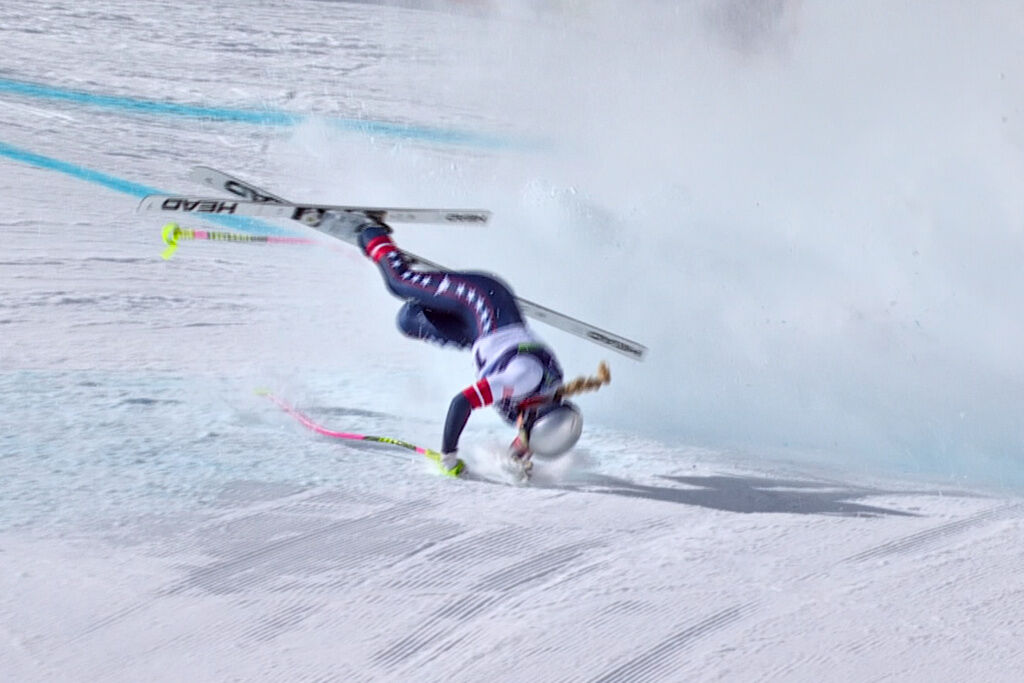
But what will leave the impossible-to-erase marks on our memory from this race are the agonizing shrieks from teammate Lindsey Vonn, as she lay crumpled on the snow after a crash so violent it forced Johnson to cover her eyes.
“I can’t imagine the pain she’s going through,” Johnson said.
But witnessing Vonn’s gruesome wreck gave Johnson a horrific sense of déjà vu that rattled her bones. This sneaky dangerous downhill course in Cortina has also eaten Johnson up, spit out her broken body and tortured her soul.
“It’s not the physical pain,” Johnson said. “We can deal with physical pain. But the emotional pain is something else. I wish (Vonn) the best. I hope this isn’t the end.”
Want to make the mountain laugh?
Tell it your plans for a comeback story, with a complete outline of your fairy-tale ending.
On a shredded ACL from a serious injury before Vonn’s final World Cup downhill prior to these Olympics, the 41-year-old American tapped her poles three times at high noon in Italy and hurtled from the starting gate.
While wearing bib No. 13, Vonn went down like she had been shot exactly 13 seconds into the race. She twisted out of control on the landing of a jump, rag-dolling down the hill and doing a face-plant, before landing awkwardly on her back. The massive destruction was caused by a tiny error of allowing her right ski pole to get momentarily snagged on a gate at speeds well above the legal speed limit.
The reaction in the stadium to the wreck was instantaneous and nothing short of gut-wrenching. The crowd made the involuntary sound of being punched in the stomach with a fist of steel. That collective gasp quickly gave way to the eerie silence of 15 minutes, until a helicopter arrived on the scene and airlifted Vonn to a nearby hospital for a broken leg that required surgery.
“The silence was deafening,” observed International Ski and Snowboard Federation president Johan Eliasch, the flat tone of his voice evoking the vibe of a doctor with a lousy bedside manner. “It’s tragic. But what can I say? It’s ski racing.”
Damn, this sport is cold.
And unforgiving.
Crashes on the World Cup downhill circuit are almost as common on the mountain as après-ski drinks.
For an elite racer, it’s not a matter of if there will be a trip to the hospital for bad news on the MRI, but when … and how often.
Colorado native Mikaela Shiffrin is the GOAT on the slopes.
But a brutal tumble during a giant slalom race in November 2024 left her with a puncture wound and psychological scars roughly akin to PTSD.
“A lot more (skiers) experience this type of trauma response than you might imagine,” said Shiffrin, during a press conference on the eve of an Olympic downhill she vowed to watch with keen interest.
Well, when this February morning in the Dolomites dawned as gorgeously as a classic Giovanni Segantini painting, I happened to ride the gondola with a friendly dude named Connor Watkins.
Then I watched him anxiously climb the 125 steps of a giant metal structure to the downhill finish line of the vertigo-inducing Olimpia delle Tofane, a ski run that appears to run in fear from the snarling tiger teeth of the Tofana Peaks above the downhill course.
“It’s going to be a heater of a race,” Watkins had declared.
His prediction reminded me of an old NASCAR term: Checkers or wreckers, which is defined as win or go bust. Get the checkered flag. Or wreck trying.
Watkins loves the sport, but is far more than a ski-racing aficionado.
He’s the boyfriend of Johnson, a 30-year-old U.S. ski team vet who had fallen short of her immense potential because the mountain has repeatedly and wickedly turned her every which way but loose.
“First and foremost, watching “Breeze” race is nerve-wracking. I want her, more than everything, just to be safe. But you also want her to win,” Watkins told me. “So I struggle with those emotions.”
How real is the anxiety of watching a loved one ski 60 mph on a razor’s edge?
Watkins pointed to his smart watch.
“My heart rate is pushing from 130 bpm, up to 140 and sometimes 150, when she races,” Watkins said. “You’ve got to take those fears and turn them into a plan.”
What a relief it was when everything went according to plan, and Johnson struck gold in Cortina.
Watkins sniffled back tears as his girlfriend stood on the medal stand and the national anthem played.
This felt like sweet redemption to a skier who has endured too many grisly injuries to count. So we’ll keep it to the abridged version, which includes the tibial plateau fracture and a torn ACL, not to mention a different devastating knee injury suffered on this same Italian downhill course during a training run in 2022 that wiped out Johnson’s chance of skiing at the Beijing Winter Games.
“I do know what it’s like to be here (in Cortina), fighting for the Olympics, and have this course burn you,” Johnson said. “To watch those dreams die was one of the most heartbreaking moments of my life.”
Love for the downhill is a burning thing.
Sometimes you torch the mountain.
And sometimes the mountain sends you down in a ring of fire.
Comeback stories in ski racing often end at the hospital rather than on the medal stand.
If an Olympic downhiller doesn’t look fear in the eye, while picking up the pieces of her broken body, the cumulative effect of those crashes can crush a skier’s soul.
“Sometimes you just have to keep going, because that’s the only option,” Johnson said. “If you’re going through hell, you keep walking.”