







Aurora councilmembers discuss Regional Navigation Campus, ADA requirements
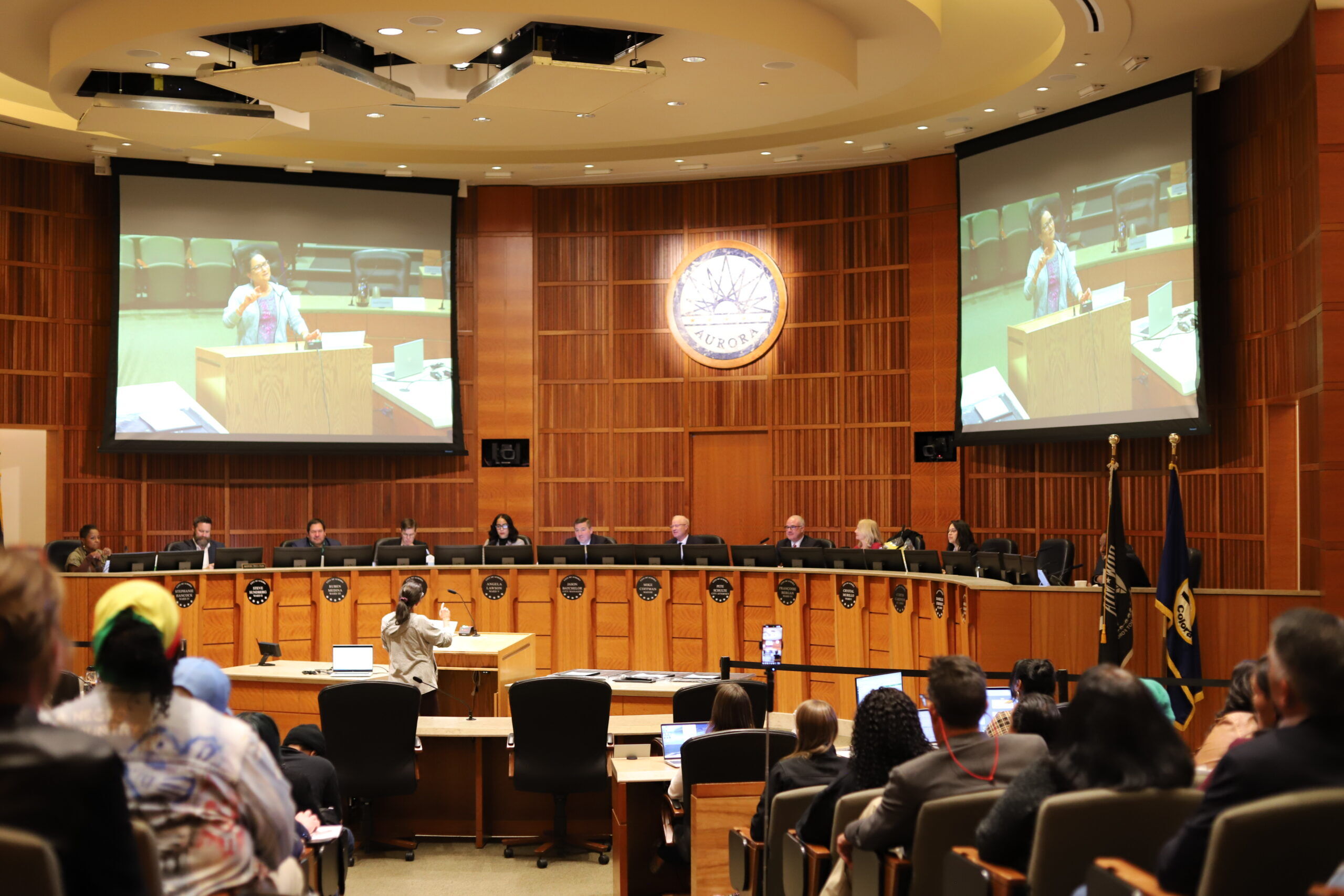
The Aurora City Council tackled several major city topics at a Saturday winter workshop, moving forward with ADA accessibility improvements for the council chambers, addressing concerns about the Regional Navigation Campus and debating a new impact fee for businesses.
In recent meetings, members of the public have spoken to the council during public comment about improving ADA accessibility in the council chambers, which are currently not compliant with ADA standards.
Talk about improving the chambers started in 2021, when officials conducted a space study for the Aurora Municipal Center.
In 2022, officials allocated $750,000 in ARPA funds for the design and construction of ramps to the council floor and accessible seating.
A final design was completed in 2023 but the City Council deferred construction in February 2024, asking for a full ADA study across the city before moving forward.
In December, an ADA review found the council chambers out of compliance with current standards, Deputy City Manager Laura Perry said.
To implement the existing design would cost about $975,000, Perry said Saturday. Construction would also require a full closure of the chambers for about eight months.
Officials also recommended additional updates to the design, Perry said, which would likely cost about $100,000. Once the new design is ready, in about four to six months, construction will begin, she said.
Councilmembers on Saturday discussed in-person meeting alternatives, including moving meetings to the Aurora Public Library in the interim, but did not make a final decision.
Perry also updated councilmembers on the Regional Navigation Campus, which is still undergoing construction and has raised several concerns over the last month.
The navigation campus — formerly a Crowne Plaza hotel — at 15500 E. 40th Ave. has been in the works for more than a year after the city purchased the building in May 2024 for $26.5 million.
The 600-person facility opened Nov. 17 under operator Advance Pathways.
In recent council meetings, concerns about the living quality on the campus have come up. In January, Perry informed the council of plumbing issues in tier one and tier two. Those issues have been fixed, she said Saturday.
Pet kennel construction and ongoing construction on tier three are projected to be complete by the end of the month, Perry added, saying they still anticipate other construction and maintenance issues to arise due to the building’s age.
Long term, she said, the city intends to construct an outdoor recreation area for guests and add respite beds.
Stephanie Keiper, the city’s homeless services manager, pointed to early successes at the campus in terms of numbers.
As of Dec. 31, Advance had enrolled 10 people in its Workbridge Affiliate Program, in which residents of the campus help keep the inside and outside clean, Keiper said. They also had 94 guests enrolled in case management services.
From the day the navigation campus opened to Dec. 31, the campus day center served 1,081 different people, she added. They have also served 55,700 meals.

In November, when the campus first opened, 159 people on average stayed on the campus each night. In the first month, only the low-barrier tier one beds were open.
Throughout December, the campus’s tier one beds slept about 264 people on average each night. Tier two, which provides more private sleeping space and requires people to be actively involved in case management, had 10 people per night on average. Tier three, which requires people to be working and sober and provides hotel room-style sleeping arrangements, had five people, Keiper said.
Preliminary January numbers showed an average of 280 people per night in tier one, 46 in tier two and four in tier three, she said.
In December, 36 people moved from tier one to tier two, Keiper said. None moved to tier three.
Advance has guest grievance forms through which people have reported concerns including stolen medication, food allergy accommodation needs and a need for senior-specific resources, Perry said.
Some people have provided positive feedback as well, notably saying they can finally sleep at night and access consistent medical care, she added.
Mayor Mike Coffman said Saturday that he was proud of the city’s work to get the campus up and running.
“Because of the cold weather, we opened it prematurely,” Coffman said. “It’s a tradeoff for the building not being ready, but you’ve navigated it very well.”
Also Saturday, the council discussed the possibility of adding transportation impact fees for non-residential land uses, which would be phased in over the next two and a half years, according to Perry.
The council did not formally approve anything Saturday, but debated the pros and cons of such fees, which would target non-residential developers. There is already a transportation impact fee for residential developers, and Perry pointed to fairness and a need for infrastructure funding as reasons for widening the fee’s applicability.
Under the recommended fee plan, new fees would phase in starting July 1 for any new land-use applicants, Perry said. The council could choose how to phase those fees in, and Perry recommended charging 25% of the full rate through 2028, then charging half the full rate until the 2.5-year mark.
Maximum rates the council could choose to charge per square foot would be $16.47 for retail and shopping centers, $9.60 for offices, $4.93 for industrial, $1.43 for warehouses, $1.04 for mini warehouses and $5,706.81 per room for hotels.
Councilmembers and staff will continue to look into the possible fee and meet with members of the public and business community to figure out how best to address it.
The full Saturday winter workshop can be watched on Aurora’s YouTube Channel.


Denver moves to codify quarterly financial updates to the City Council
Deborah Grigsby
deborah.smith@denvergazette.com
Updated 3 hours ago
The Denver City Council unanimously advanced a proposed ordinance on Tuesday that aims to codify quarterly general fund reporting to the council from the city’s Department of Finance. The council currently does not receive regular budget updates, relying instead on...

Deborah Grigsby
Reporter

Colorado Title Board rejects challenges to graduated income tax ballot measure
Marianne Goodland
marianne-goodland@denvergazette.com
Updated 1 hour ago
The state body that determines whether a ballot measure contains a single subject has rejected challenges to eight versions of the push to change Colorado’s flat rate to a graduated income tax, thereby increasing the taxes on higher income earners....

Marianne Goodland
Reporter

Lakewood City Council urges residents to keep zoning changes
Sage Kelley
sage.kelley@denvergazette.com
Updated 4 hours ago
Lakewood’s long-running zoning fight is headed for a spring showdown at the ballot box, spearheaded by a new resolution from the City Council. The Lakewood City Council amended and confirmed a resolution on Monday expressing the councilmembers’ desire for residents...

Sage Kelley
Reporter

President Pro Tem Sen. Dafna Michaelson Jenet to resign from Colorado Senate
Marianne Goodland
marianne-goodland@denvergazette.com
Updated 2 hours ago
A top Democrat in the Colorado General Assembly is resigning to take a new job. President Pro Tem Sen. Dafna Michaelson Jenet of Commerce City, who has served in the General Assembly since 2017, will become the director of the...
Marianne Goodland
Reporter

Denver marriage marathon challenges Friday 13th taboo
Deborah Grigsby
deborah.smith@denvergazette.com
Updated 3 hours ago
There’s a lot of superstition around Friday the 13th, especially for those getting married. However, Denver Clerk and Recorder Paul López argues the traditionally spooky date could be “love’s luck break.” For the 14th consecutive year, Denver’s clerk and recorder...
Deborah Grigsby
Reporter

JBS strike could trip up Greeley’s economic surge
Hap Fry, Special to The Gazette
hap-fry@gazette.com
Updated 2 hours ago
GREELEY – The upward trajectory of Greeley has been hard to match by other Colorado communities in the here and now. The city is on the verge of experiencing dramatic growth and change. Greeley is in the midst of developing a...

Hap Fry, Special to The Gazette
Reporter

Laura Clellan named sole finalist for Colorado Parks and Wildlife director
Marianne Goodland
marianne-goodland@denvergazette.com
Updated 5 hours ago
The Department of Natural Resources announced Monday that Laura Clellan, who is currently serving as acting director of Colorado Parks and Wildlife, is the only finalist for the job. Clellan has been acting director of CPW since Nov. 25, when...
Marianne Goodland
Reporter

Colorado lawmakers seek faster warrant response from social media firms
Sage Kelley
sage.kelley@denvergazette.com
Updated 8 hours ago
Proponents argue legislation would prevent school shootings Colorado officials on Monday claimed that the Evergreen High School shooting could have been prevented if social media companies had been required to respond faster to warrants — and they are pushing legislation...
Sage Kelley
Reporter

A fight over seeds and bees: Colorado Democrats target neonicotinoid pesticides
Marianne Goodland
marianne-goodland@denvergazette.com
Updated 1 day ago
Colorado lawmakers are weighing new restrictions on a class of pesticides after Gov. Jared Polis signaled support for a Democratic-backed bill aimed at protecting pollinators — a proposal that has raised sharp worries from farmers who rely on treated seeds...
Marianne Goodland
Reporter

Denver, other DMVs to close this weekend for statewide tech upgrade
Deborah Grigsby
deborah.smith@denvergazette.com
Updated 12 hours ago
The Colorado Division of Motor Vehicles will temporarily close all of its locations for three days, beginning late in the evening on Friday, Feb. 13, while it completes statewide technology upgrades. The planned updates include the public e-services platform, myDMV,...
Deborah Grigsby
Reporter
PREV
PREVIOUS

Denver police found justified in shooting of rod-wielding burglar
Two Denver police officers were found justified in the fatal November shooting of a burglar who approached them with a knife sharpening rod. Officers Michael Vasquez and Whaylen Phares were deemed to have acted in a proper manner in defending themselves against what they perceived to be the immediate threat of 37-year-old Joseph Suddreth, who […]

Trump administration plans to hold back grant money from Colorado, 3 other states
The Trump’s administration is planning to withhold some public health and transportation money from a group of Democratic-led states, including Colorado. The other states are California, Illinois and Minnesota. Full details have not been released, including whether the states could take any steps to avoid losing the funding. Colorado has sued the White House or […]