







Supermarket chain H Mart hopes to revive mineral water bottling in Manitou Springs
A major U.S. grocer has acquired the vestiges of a historic industry in Manitou Springs with the hope of bringing it back to life.
H Mart, an Asian supermarket chain based in New Jersey with nearly a hundred locations across the U.S., bought the Ute Chief Mineral Water Company building on the west end of Manitou Springs for $1.6 million in February of last year, according to El Paso County Assessor’s Office records.
The purchase has gone unannounced by the company. Brendon Choi, the general affairs manager for H Mart in Aurora, said the company was exploring ways to re-drill the well on the property to bring back access to mineral water. If successful, he said H Mart plans to “revive” the former bottling plant.
“It’ll highly depend if the well will operate or not,” he said.
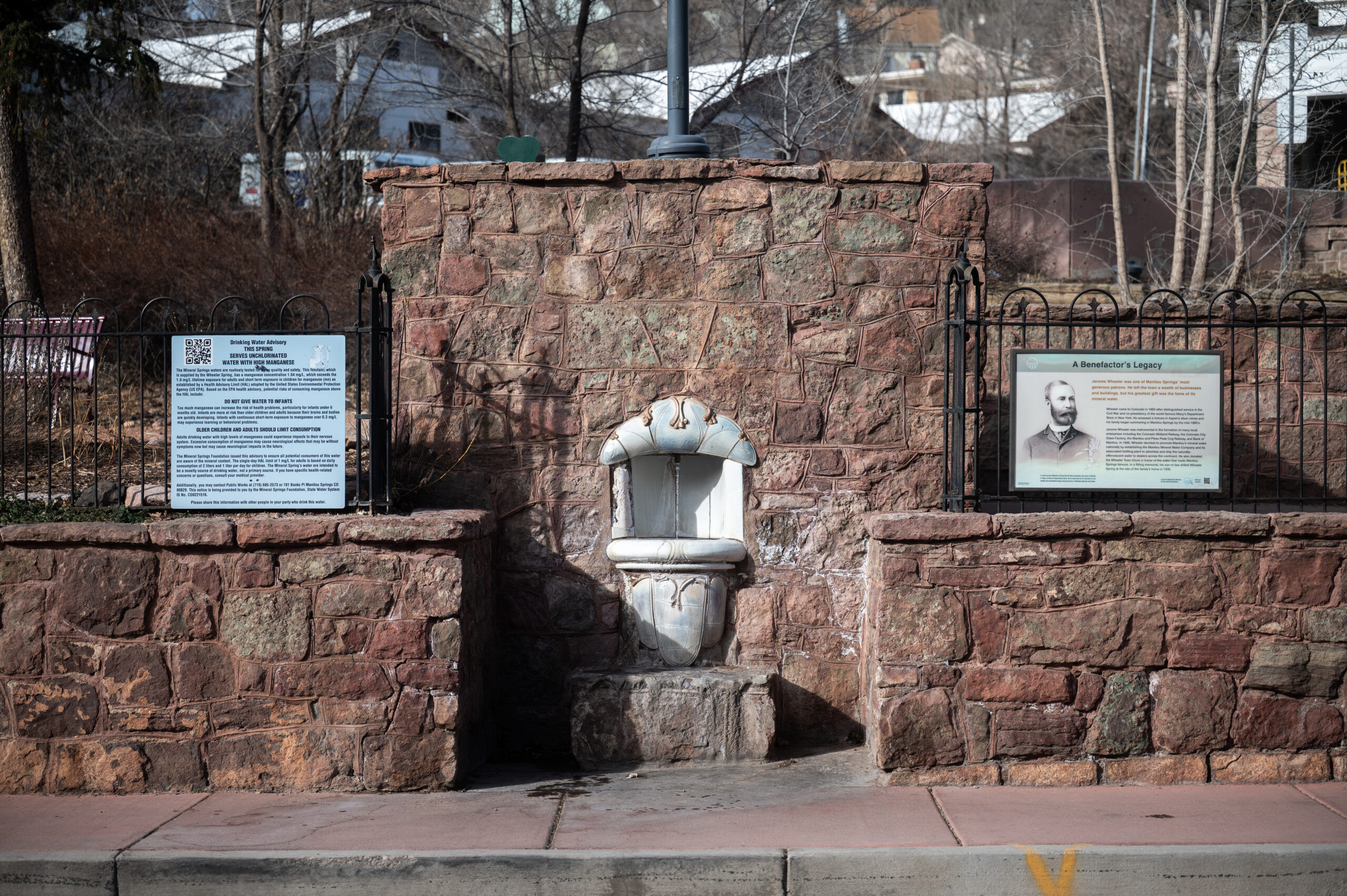
The eight public-access mineral springs in Manitou are maintained by a non-profit called the Mineral Springs Foundation, in conjunction with the city and private landowners. President Doug Edmundson said that the on-site mineral spring at the Ute Chief was capped under the advice of previous foundation leadership using hundreds of pounds of concrete.
He believed a well needs to be redrilled to access the spring, then a new pipe would need to be directionally drilled under Manitou Avenue to connect to the bottling plant.
“H Mart is taking its time to get its ducks in a row,” he said.
At its peak, Ute Chief was shipping millions of mineral water bottles across the country. The bottling plant has been disused for 75 years, cycling through successive owners with big plans but meager results.
Bubbling springs
The original bottling venture was founded during Manitou Springs’ heyday as a wellness destination at the turn of the 20th century. Manitou Springs sits on a karst aquifer, a complicated geological formation formed when water dissolves bedrock. Much of the system is artesian, meaning the water within is trapped under pressure.
Artesian pressure in Manitou Springs can be dramatic where springs break the surface, said Edmundson. The gaseous, screeching Stratton Spring on the corner of Manitou and Ruxton Avenue is a good example. Carbon dioxide is mixed in with the trapped water, causing carbonation as fizzy as soda in some locations.
Before the city’s founding, the mineral springs would bubble up naturally, draining into Fountain Creek over large mineral deposits. Several of the milky-white deposits can still be seen today where runoff from the diverted springs returns to the watershed.
The area’s unusual water features attracted interest from entrepreneurs, who transformed the valley at the foot of Pikes Peak into a health resort town in the 1870s.
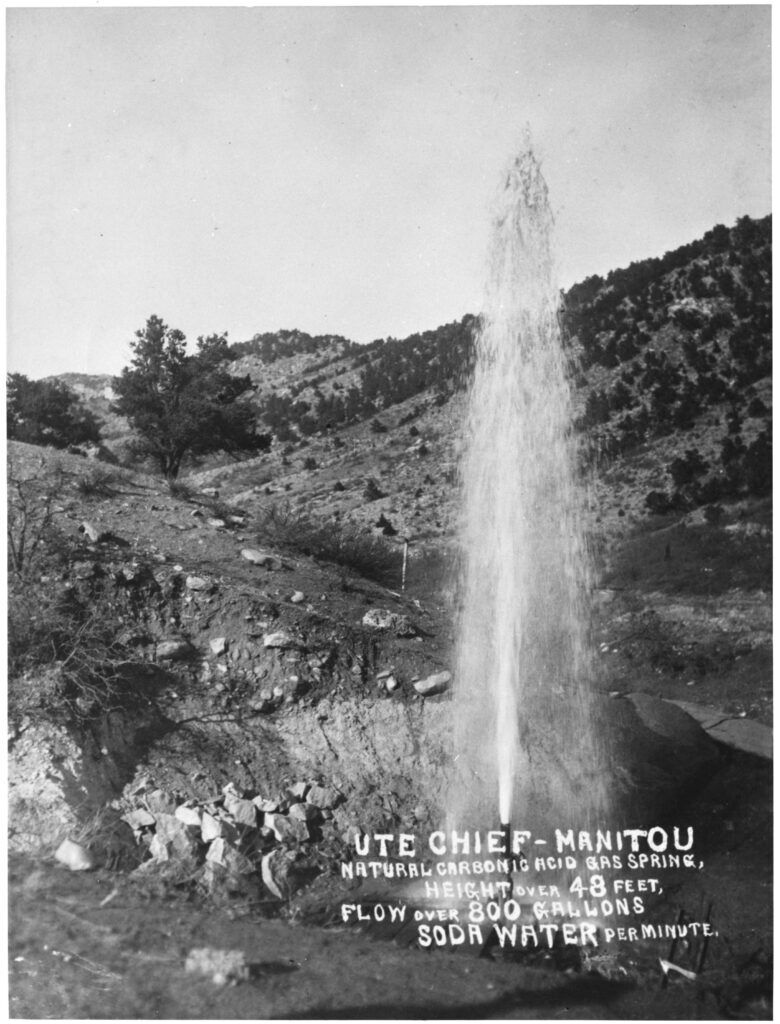
In the 1890s, Jacob Schueler set up what would become the town’s second mineral water bottling company at the base of Ute Pass. The company had multiple springs to bottle from, including the now-capped “Ute Gusher,” which shot 40 to 50 feet in the air.
According to local historian Sharon Cunningham in her book Manitou: Saratoga of the West, about 4 million bottles of mineral water shipped out of Manitou Springs on freight cars in 1893. Schueler’s company bottled naturally carbonated “table water” as well as “ginger champagne.” The company claimed a wide range of health benefits from the water, soothing everything from dispepsia to diabetes.
As the name suggests, Ute Chief heavily appropriated images of and ideas about the Ute people, whose historical territory included present-day Manitou Springs. Outside one of the plant’s buildings, a statue of a Native American caricature still crouches.
The original plant burned down in 1944. New owners eventually rebuilt at the same location with more modern equipment, according to previous Gazette reporting.
Manitou Springs’ time as a health resort town waned after World War II, as did demand for bottled mineral water. By the 1980s, Edmundson said that the springs that survived had been relegated to a local curiosity.
While some other springs tapped for their supposed health benefits across the country were completely lost, destroyed or left to grow stagnant, the high-pressure artesian springs at Manitou eventually broke out of attempts to contain them.
“They were only abandoned in the sense that they were not being used,” said Edmundson.
“Medicine water”
The bottling plant remained insolvent through much of the 20th century. The latest attempt to turn a profit tried to capitalize on international markets.
In 2003, a New York pharmacist named O Yoon Kwon bought the plant and the nearby Shady Dell Motel for about $1 million. Later court documents reveal Kwon’s reported business model: exporting bottles of mineral water to Korea to sell at a 1,500% upcharge.
At the time of purchase, Kwon said he wanted to market the mineral water as a health tonic.
“I’ve been looking around the world for this kind of water since 1984,” Kwon told The Gazette in a 2003 telephone interview from his pharmacy. “This isn’t going to be just for drinking. This is going to be for the good of your health.”
Kwon, 89, could not be reached for this article.
The enterprise soon ran into problems. According to court documents from a 2007 lawsuit, Kwon entered a business arrangement with a subsidiary of Korean cosmetics company Hwajin in 2005.
Hwajin, with an “outside salesforce” of 75,000, had a sales model analogous to Avon and Mary Kay in the United States. The idea was to export Ute Chief water to sell at $15 a bottle. The Hwajin subsidiary, Moolsan, would pay Kwon $1 a bottle. Moolsan paid $1.5 million for distribution rights and an advance order.
Moolsan’s president testified in the lawsuit that the plan was to overtake 20% of Korea’s mineral water market by word-of-mouth about the benefits of its “medicine water.”
Kwon’s company shipped over 300,000 bottles of water to Korea, but Manitou Springs water did not prove as popular in Korea as it had in the turn-of-the-century United States. The company said it only sold about half of the new inventory, while the other half was given away in promotional efforts. It failed to provide actual evidence of the claimed sales, according to court documents.
The venture was also allegedly fleeced by a middleman. A man named Young-Gil Jee set up the original contract between Kwon’s company and Hwajin, allegedly giving different copies to each. Kwon received $1.5 million, but the Hwajin subsidiary paid $2 million. Jee pocketed the difference, court records claim.
Despite the rough start, Moolsan tried to order a second batch of mineral water in 2007. Kwon’s company claimed miscommunication and a delay from installing new equipment. The order was never filled.
HwaJin sued Kwon’s company for breach of contract, but the district court eventually ruled in favor of Kwon.
By 2011, the plant was still active but struggling after failures to capture other markets like Chile. Employees told The Gazette the plant was unable to fix broken equipment. At some point between then and now, the Mineral Springs Foundation helped fill in the spring access well.
The plant was not sold again until H Mart’s acquisition last year, according to El Paso County Assessor’s records.
Why H Mart?
H Mart’s Choi did not comment on why the company was pursuing the reopening of the Ute Chief, saying the decision was “up to the ownership.”
O Yoon Kwon may have had a connection to the family that owns and runs H Mart. The transfer of the bottling plant last year was recorded as a “Related Parties/Business Affiliate” sale, which can happen between relatives or a corporation and its subsidiary.
The registered agent for Kwon’s company, Manitou Springs Mineral Water, Inc., became Joong Gab Kwon in 2023, according to business registration data on the Colorado Secretary of State’s Office website. His listed mailing address is the H Mart Aurora location.
Joong Gab Kwon appears as a defendant in a 2002 labor lawsuit in New York, where he is described as the brother of a man who owns a grocery store through Han Ah Reum, Inc. That company would become H Mart when founder Il Yeon Kwon began expanding the business nationwide in the early 2000s.
H Mart doesn’t currently have a presence in the Pikes Peak area, though the company has been eyeing Colorado Springs for a store location for several years. In 2022, an H Mart-associated entity bought 2.6 acres for $1.8 million, El Paso County Assessor’s Office records show. The market value of the land, which sits between Interquest and Voyager Parkways in the mixed-use development of Victory Ridge, is slightly more than $2 million.
In the time since, the project has stagnated at the Pikes Peak Regional Building Department, which said in a Facebook post last August that plans were rejected and sent back for revision but never resubmitted.
Choi told The Gazette last year that the company still planned to build a location in the future.
H Mart has not yet revealed any of its potential business plans for the Ute Chief bottling plant. According to the company’s website, H Mart sells one carbonated mineral water product from a Polish company called Muszyniank.
Manitou Springs Mayor Natalie Johnson said she had not heard of any applications to the city regarding the bottling plant.
The building remains shuttered and protected by a fence, with no signs of recent activity.