







Ancient biblical coins talk; here’s what they’re saying
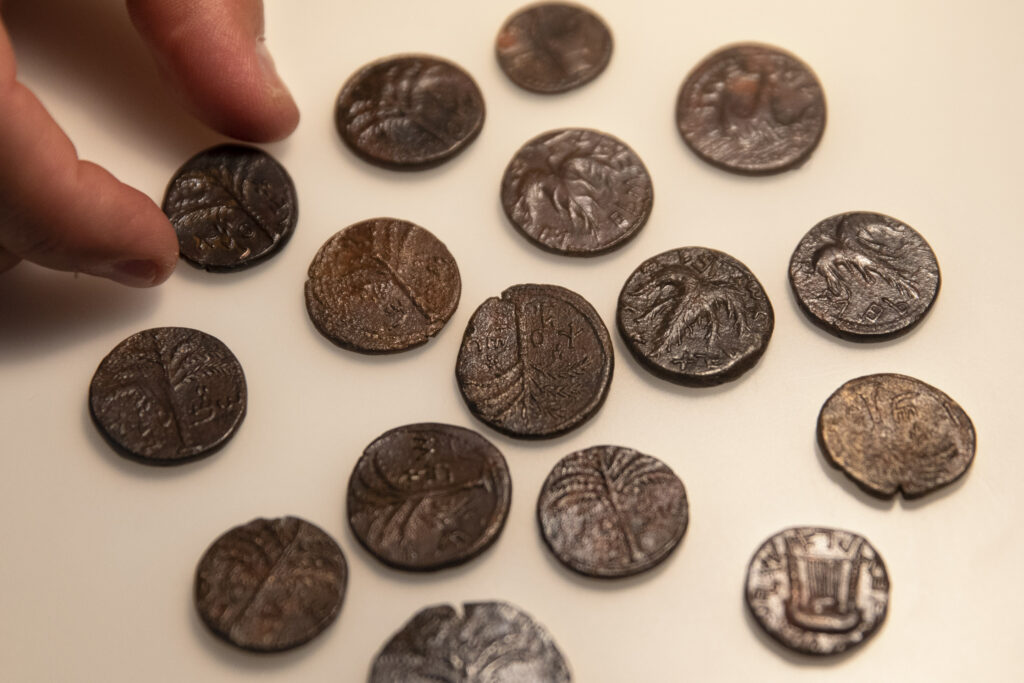
With the penny being ushered out of circulation early in the 21st century, theologians, historians, archaeologists and numismatists continue to glean insights from coins of the first century, when Jesus Christ walked the Earth and his followers promulgated the new religion after his crucifixion between 30 and 33 A.D.
Though pieces such as archaic Greek drahms and medieval denars are not part of the contemporary monetary system, the artifacts remain as valuable relics that reveal how society functioned in a past that’s often hard for today’s civilizations to imagine.
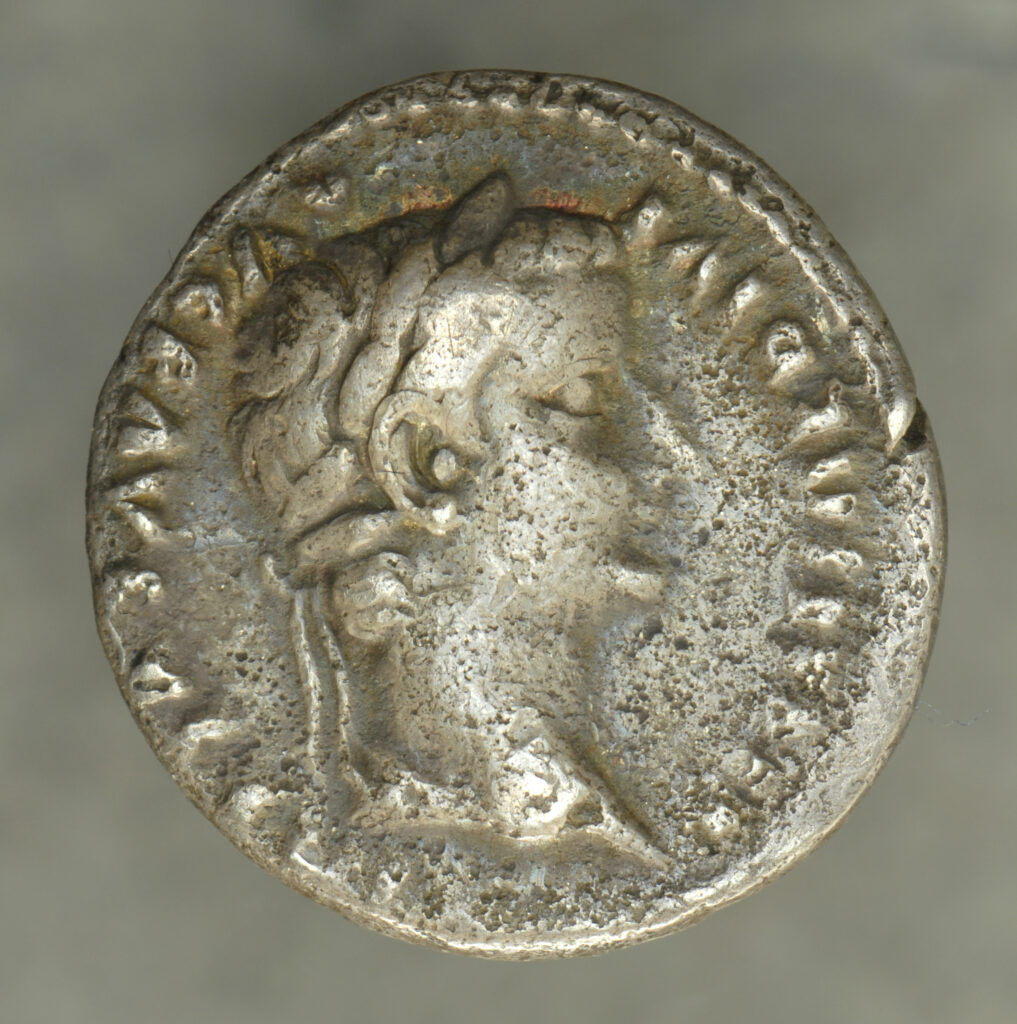
Think of carrying in your mouth a Roman denarius, a silver coin about the size of a dime that as a laborer you would have earned as a day’s wage for working 10 hours, while walking for miles to the marketplace because textiles were so expensive that garments did not have pockets.
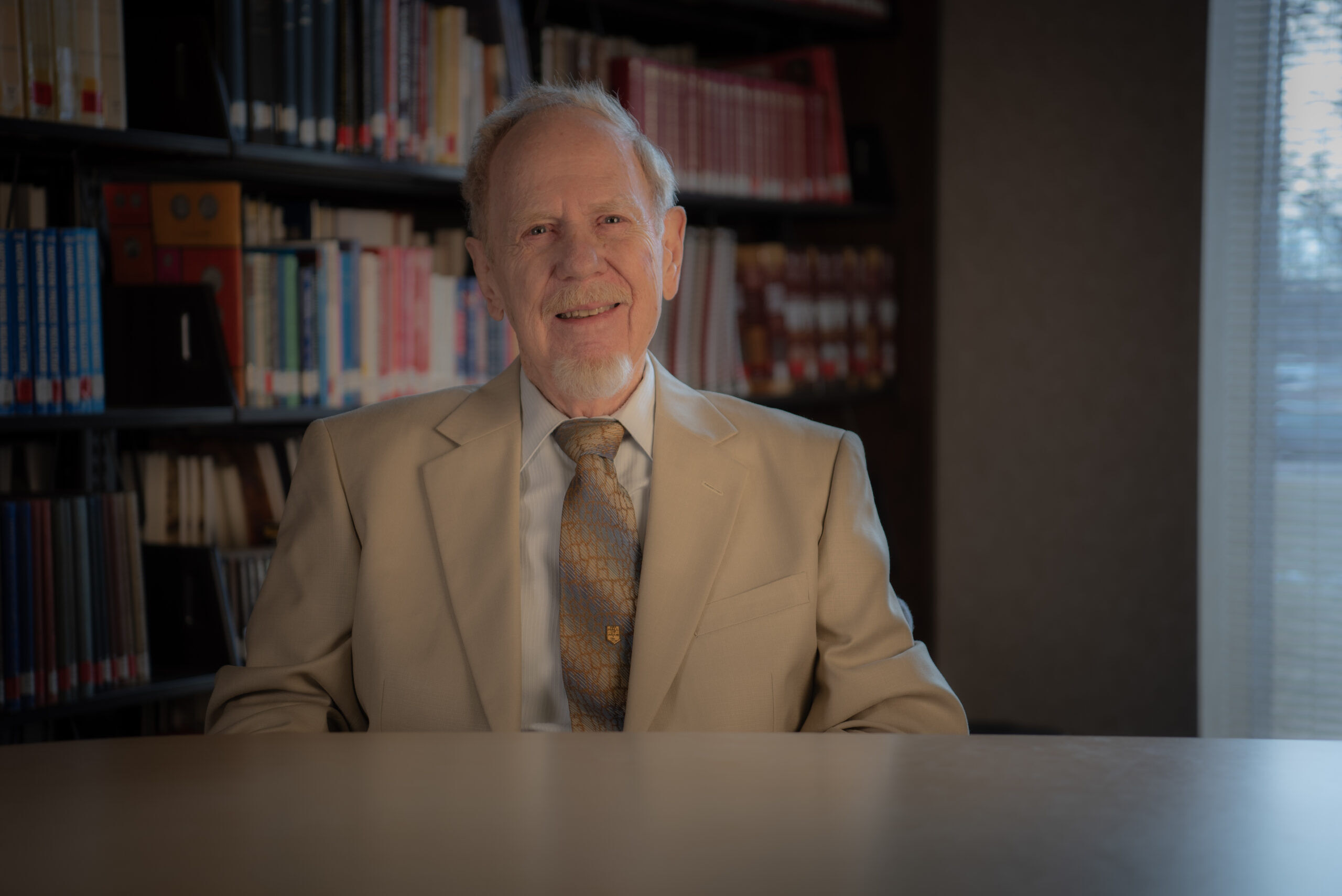
“Ancient coins are highly touchable storytellers – miniature time capsules,” writes Colorado Springs resident Kenneth Bressett in his book “Money of the Bible,” released in 2013 by Whitman Publishing. “When we decipher their inscriptions, we begin learning their language…”
Over his 97 years of life, the third-generation printer by trade has authored 21 books along with editing an annual update of “U.S. Coins,” or the industry’s “Red Book.” He’s considered one of the nation’s foremost experts on the study of coins, paper currency, medals and tokens, which embody the subject of numismatics.
Beyond folklore, documents and items that told and retold accounts of the day, coins provide accurate clues about not only the life of Jesus but also the decades following his death, when the writings that became the New Testament were produced, Bressett said.
Moreover, “Coins reinforce stories in the Bible,” he said.
Coins yield insights beyond what other historical materials show, Bressett said, because unlike storytelling and data that may or may not be able to be proven, coins offer a reliable look back. “If you got something that’s a coin, and you know it was authentic, you can’t refute that.”
Coins referenced in Bressett’s book “Bible Lore and the Eternal Flame,” published in 2022 also by Whitman, are “good documents of what went on at a time when 80% of the people were illiterate and couldn’t read,” he said.
Six of the 16 rulers of Roman-controlled Judea in the first 70 years after the birth of Christ issued coins with their likeness on them, Bressett writes. Some can be seen at the Money Museum inside the American Numismatic Association’s headquarters at 818 N. Cascade Ave.
As Bressett sits in the library of the organization that was founded in 1891 and chartered by Congress in 1912, he speaks of his research that has led him to theorize that in order to spread Christianity, early church fathers “made compromises” in history. For example, Bressett thinks what is accepted as the birth year of Jesus Christ is off by about four years and happened in October, not December.
“That’s backed up by knowing when certain Roman emperors lived, and when the tax was due,” he said. “Mary and Joseph had to go to Bethlehem to the birthplace of Josep, to pay the tax, which was factual.”
Another cool fact: The annual tax mandated for Jews to fund temple repairs as described in the book of Exodus was one-half shekel for every man over age 20. The shekel, which originally referred to a unit of weight of representing about half an ounce, is still the major currency in Israel and Palestinian territories. Since 1986 it’s been called the New Israeli Shekel.
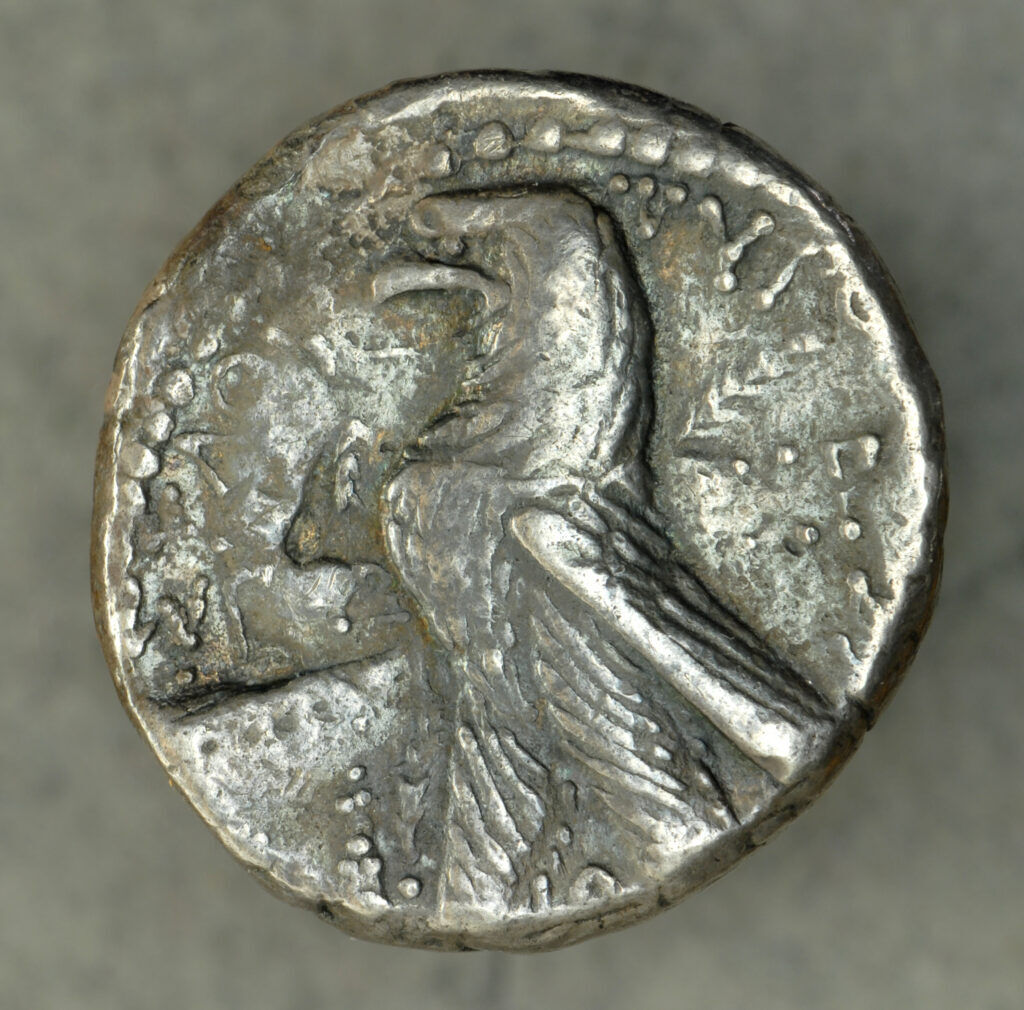
Shekels, also known as tetradrachms, were the only foreign coins authorized for use by the Jews during Jesus’ lifetime, Bressett notes. They most likely were the coins described in the Bible as the “thirty pieces of silver” paid to Judas Iscariot for the betrayal of Jesus, he noted.
Coins functioned differently in the first century and often were used to spread the news of the day, said David Kotter, dean of the School of Theology who also teaches courses in the New Testament at Colorado Christian University.
For example, Roman Emperor Vespasian issued Judaea Capta, meaning “Judea captured,” in 70 AD as commemorative coins to publicize and celebrate the victory over Judaea and the second Jewish temple by his son, Titus. It was the largest single minting at the time, Kotter said.
People buried pottery jars full of coins underneath floors where they lived, which often would survive fires and wars and centuries later were discovered by archaeologists.
“Coins are super helpful for dating when we do archaeology,” said Kotter. “When we find a coin, we know the historical context we’re in; they’re durable because they’re metal.”
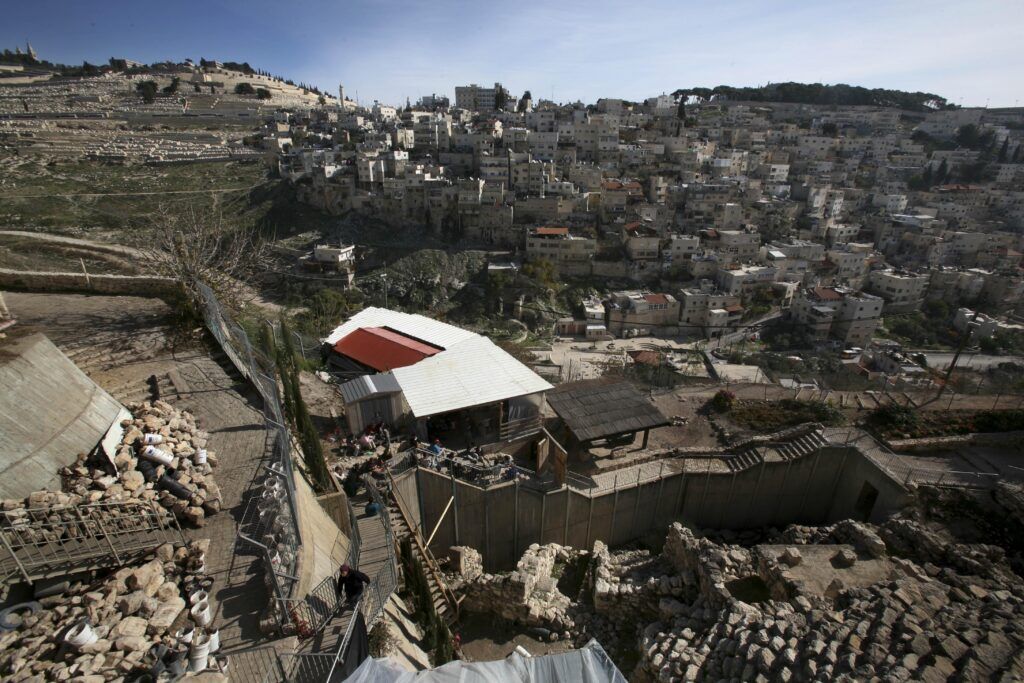
During a Colorado Christian University-sponsored biblical archaeological dig in Israel, Kotter and a research partner found the foundation of a city that had a 16-foot fortification wall that they say proves the story of David and Goliath was not just an exaggerated legend but an actual point in history. The event became recognized as one of the top 10 discoveries in the Jewish homeland.
GOLD, SILVER AND MORE
Hundreds of years before Christ’s birth, coins evolved as part of the barter-and-trade economic system in many cultures. Gold coins were the most sought after because “you could make jewelry out of it, and people loved to show off their jewelry,” Bressett said. “Also, it was stable and always there.”
Silver was more plentiful and cheaper, he said, and copper was the least valuable but the most practical.
Paper money had not yet been invented in the first century, and designs on silver, copper, bronze and gold coins primarily depicted rulers, animals and current events, Bressett said. “If there was a new emperor of Rome, he had new coins with his picture instead of that jerk he just murdered.” A tradition that has not carried on today, Bressett chuckled.
A specific silver shekel struck in 148-147 BC is famous for commemorating a peace treaty.
“Hidden in the design is a hand holding out a laurel sprig – an olive branch of peace,” Bressett said. “It was added to pass on a message that might have been lost in history otherwise.”
Workers earned Roman denarius, also known as “tribute pennies.” What is thought to most likely have been a Roman denarius with the portrait of the Emperor Tiberius was shown to Jesus during his Sermon on the Mount, when people tried to entrap Jesus into being disloyal to the Jews or the Roman authorities by asking him if he thought it was legal to pay taxes to Caesar, the Roman dictator.
Jesus delivered the memorable phrase, “render unto Caesar what is Caesar’s and unto God what is God’s,” meaning followers of Christ should pay taxes to the Roman government while also serving God.
Skilled artisans called minters or coiners worked under the guidance of the king and the district leader to carve designs into hardened metal and used sledgehammers to imprint images, according to Bressett.
Jesus and other biblical figures name seven types of coins in the Bible. Each story supplies a famous lesson as familiar as a simple math equation.
“The coin is more than if I pulled a quarter out of my pocket and showed it to you; it’s a deeper point,” Kotter said. “The coins make big statements.”
A silver coin appears in a fish’s mouth after Jesus told his disciple Peter to cast a line into the water and haul in a fish that would contain a coin sufficient in value to pay the required temple tax for both of them.
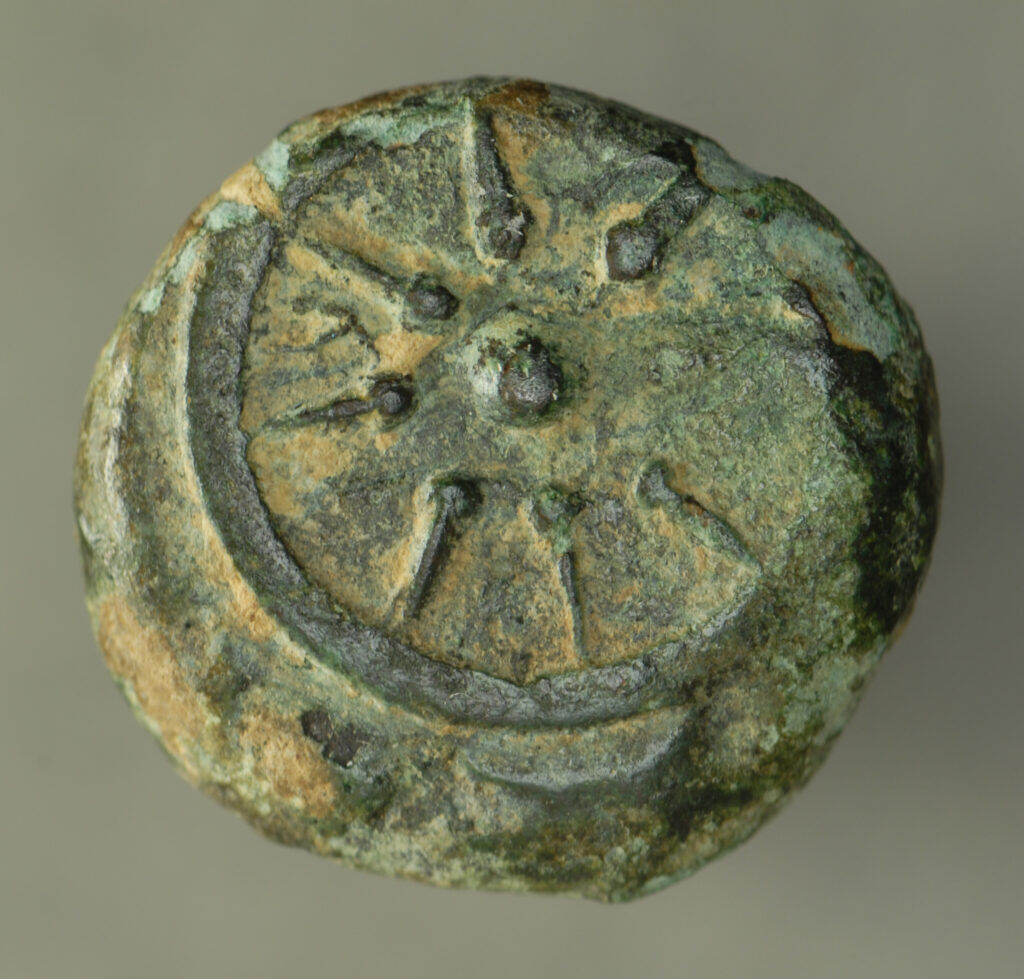
Mark and Luke speak of an impoverished widow who gave two bronze leptons, or mites, the smallest denomination, to the temple treasury, which was all she had. Jesus told his disciples she contributed more than anyone because it constituted her livelihood, emphasizing God values sacrificial giving over the wealthy who contribute from their surplus.
Teachings about money also appear prominently in the Old and New Testaments, handing down timeless messages on giving, sacrificing, blessings, its true meaning, where one’s allegiances should lie, material versus spiritual wealth, supporting the church and God’s covenant with his people.
About 15% of Jesus’ tenets are about money, according to biblical scholars, with an often-cited verse from 1 Timothy warning: “For the love of money is the root of all evil…”
Studying money from a biblical perspective is enmeshed in Kotter’s role as a visiting scholar with the Research Institute for Faith, Work & Economics, a think tank based in Washington, D.C.
Money itself is not portrayed as intrinsically evil but rather interpreted by biblical scholars to suggest that obsessive greed for money can lead to straying from God and spiritual damage, Kotter said.
That idea is fortified by Jesus’ Sermon on the Mount, with the often-repeated phrase, “No one can serve two masters; for either he will hate the one and love the other … You cannot serve God and mammon,” referring to money, possessions or anything a person values more than God.
“Money is an expression of our hearts,” Kotter said. “We get what we want with our money, whether sinful or godly things. Money talks; it’s the X-ray that shows the true heart of what people value.”
Kotter references the Sermon on the Mount in which Jesus says, “Do not store up for yourselves treasures on earth, where moth and rust destroy, and where thieves break in and steal. But store up for yourselves treasures in heaven … For where your treasure is, there your heart will be also.”
“Jesus is not saying he doesn’t want people to be rich,” Kotter said. “He’s saying you’re doing it badly. Make sure you’re really rich in things that will last. Wealth brings temptations that we might not otherwise have.”
The Bible does not promise that people will become wealthy as a reward for being faithful, he said.
“When Joseph and Mary had to flee Bethlehem to Egypt to save the life of the baby Jesus because King Herod was trying to kill him, they were dirt poor. How did they fund the trip? There were wisemen who gave them gifts of gold, frankincense and myrrh,” Kotter said. “Here you have poor people, and God cares for them according to his plan, and you have wisemen that God gave wealth to, to care for his plan.”



We’re looking for Denver’s best ice cream shop. Submit your nominations.
Daniel Boniface
dan.boniface@denvergazette.com
Updated 5 hours ago
The mild winter has already got us thinking about ice cream. So, we’re on the hunt for Denver’s best ice cream shop. The Denver Gazette’s Ice Cream Shop Bracket is launching next week, pitting the best of the best against...

Daniel Boniface
Reporter
Colorado history told through poetry, spoken word by poets laureate
Linda Navarro
linda-navarro@denvergazette.com
Updated 4 days ago
Young poet and social justice activist Amanda Gorman, the first National Youth Poet Laureate, was just 22 when her “The Hill We Climb” launched the literary art back into a major worldwide spotlight with her 2021 Joe Biden inaugural poem....

Linda Navarro
Reporter

Little-known legend of Colorado Nick to be celebrated at Colorado Springs Pioneers Museum
Seth Boster
seth-boster@denvergazette.com
Updated 6 hours ago
For years in Colorado Springs, Scott Boyer had been learning little by little about a tattoo artist in local lore who went by Colorado Nick. His real name was Leonard Newell Wisner, Boyer learned. And in learning this he learned...

Seth Boster
Reporter

Friends forever: Broadway superstars Denver-bound to sing praises of legends
John Moore
john.moore@denvergazette.com
Updated 1 day ago
Sutton Foster and Kelli O’Hara will honor Carol Burnett and Julie Andrews with tribute concert joined by Colorado Symphony I remember seeing Sutton Foster’s utterly charming breakout role as Millie Dillmount in the 2002 Broadway musical “Thoroughly Modern Millie” and...

John Moore
Reporter

After Colorado’s big snow this week, two more chances for winter storms in the forecast
Spencer McKee
spencer@outtherecolorado.com
Updated 3 days ago
Following a week of heavy snow in Colorado’s high country, more snow is on the way in upcoming days. Per National Weather Service mapping, large swaths of the San Juans and peaks near Aspen have gotten more than 36 inches...

Spencer McKee
Reporter

With new book, Colorado climber turns the page on horrific chapter
Seth Boster
seth-boster@denvergazette.com
Updated 3 days ago
In her hospital bed on the morning of May 8, 2017, Melissa Strong asked her husband, Adam, for a pen. She could barely grip it; her fingers hardly resembled fingers, more like dark and swollen nubs after tense, reconstructive surgeries...
Seth Boster
Reporter

The Braun brother arrives
John Moore
john.moore@denvergazette.com
Updated 2 days ago
For this tight-knit basketball brood representing the Nuggets and Roadrunners, it’s family first It’s wild to think that Christian and Landon Braun, two tightly bonded basketball brothers from Burlington, Kan., play their home games about 1,000 feet apart in Denver....
John Moore
Reporter

ABA series screening soars ‘above the rim’
John Moore
john.moore@denvergazette.com
Updated 3 days ago
‘Soul Power’ gathering brings players, fans, family and media to sold-out Sie FilmCenter for nostalgic look back at Denver’s renegade basketball past “Bring back the ball!” That was Hall of Fame coach George Karl’s message to the NBA at Wednesday’s...
John Moore
Reporter

Rocky Mountain National Park to continue reservation system while other parks won’t
Seth Boster
seth-boster@denvergazette.com
Updated 4 days ago
While some of America’s most popular national parks are dropping reservations this summer, they will still be required at the most popular one in Colorado. Rocky Mountain National Park has announced its timed-entry reservation system for the peak season from...
Seth Boster
Reporter

Long-dreamed Ute Pass Trail to expand in hills west of Colorado Springs
Seth Boster
seth-boster@denvergazette.com
Updated 4 days ago
For more than 20 years, El Paso County has worked to build a trail roughly following a historic route of tribal people ー a seasonal hunting route now defined by U.S. 24 through the foothills between Manitou Springs and Teller...
Seth Boster
Reporter
PREV
PREVIOUS

Friends forever: Broadway superstars Denver-bound to sing praises of legends
Sutton Foster and Kelli O’Hara will honor Carol Burnett and Julie Andrews with tribute concert joined by Colorado Symphony I remember seeing Sutton Foster’s utterly charming breakout role as Millie Dillmount in the 2002 Broadway musical “Thoroughly Modern Millie” and thinking, “This must be what it was like for audiences who saw Carol Burnett’s breakout […]

Little-known legend of Colorado Nick to be celebrated at Colorado Springs Pioneers Museum
For years in Colorado Springs, Scott Boyer had been learning little by little about a tattoo artist in local lore who went by Colorado Nick. His real name was Leonard Newell Wisner, Boyer learned. And in learning this he learned the man was buried at Evergreen Cemetery. Boyer came to an unmarked grave. “Here was […]