







Another TABOR fight: Democrats plan to redirect residents’ refunds to K-12 spending
Colorado voters could decide this fall whether billions of dollars that would otherwise be returned as refunds under the Taxpayer’s Bill of Rights should instead go to public schools under a ballot measure unveiled Thursday by Democrats.
Supporters say the proposal would address chronic underfunding in K-12 education, while critics argue it takes money away from taxpayers and amounts to sidestepping the state’s constitutional spending limits. Supporters have insisted that schools are underfunded to the tune of billions of dollars, while one study says revenue and spending by schools have significantly grown in the last few years, with a noticeable shift toward non-instructional spending.
Under the proposed ballot measure, the amount the state could retain beyond the Taxpayer’s Bill of Rights cap would equal what Colorado spends on K-12 education — about $4.7 billion in general funds in the 2025-26 budget year.
The ballot measure would likely eliminate TABOR refunds for the next 10 years, with those dollars going to K-12 education, estimated at around $2 billion.
It is yet another fight over TABOR, the landmark 1992 constitutional change approved by voters that, at its core, requires the public’s nod before the state or local governments can raise taxes. There have been efforts in the past to significantly overhaul or repeal TABOR. Like the current one, the past efforts argued for redirecting the revenue toward education.
Supporters of TABOR have argued that it keeps the growth of government spending in check, while critics have said it has precluded governments from funding priorities.
The latest fight is also happening amid a big push to increase taxes by changing the income tax brackets and levying higher rates on the state’s top earners.
Senate Bill 26-135 is sponsored by state Democratic Sens. Jeff Bridges of Greenwood Village and Cathy Kipp of Fort Collins. In the House, the bill will be carried by Democratic Reps. Jennifer Bacon of Denver and Meghan Lukens of Steamboat Springs.
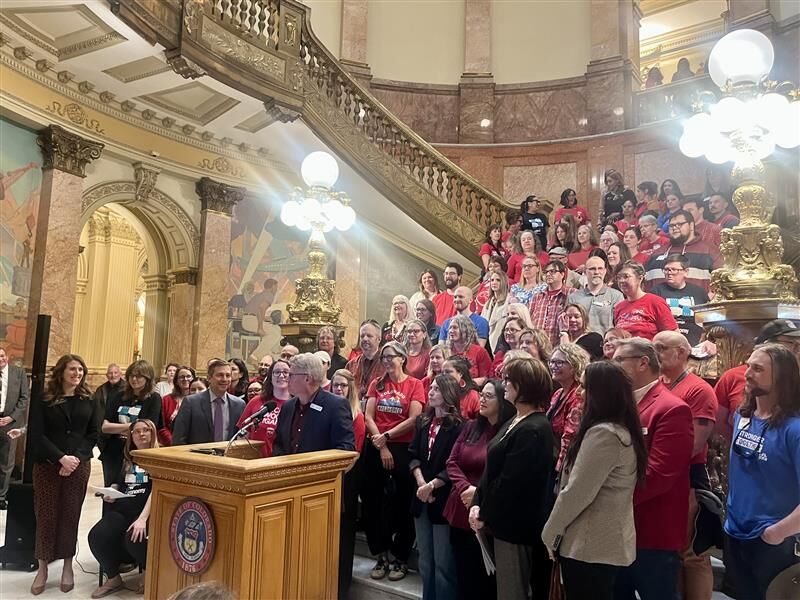
Backers unveiled the proposal Thursday amid a group of about 50 teachers from around the state, led by Kevin Vick, president of the Colorado Education Association, the state’s largest teacher union.
“We’ve all seen firsthand that Colorado’s public schools are chronically underfunded,” Vick said, which he attributed to an “outdated” revenue cap established under TABOR in 1992 that limits how much revenue the state can retain and invest.
Vick said schools are underfunded as much as $4 billion, and as a result, the state is ranked near the bottom nationally in teacher pay and retention. Students are learning in overcrowded classrooms, with fewer counselors, special education teachers and resources available, he said.
The bill is unlikely to earn a single Republican vote among the Colorado General Assembly’s 34 GOP members, but that’s not likely to impact the bill’s chances of passing, given the overwhelming Democratic majorities in both chambers.
While she’s an advocate for K-12 education, Sen. Barbara Kirkmeyer, R-Brighton, a fellow member of the Joint Budget Committee, said she doesn’t like what she sees.
“This is just another example of misplaced priorities at the Capitol,” she said in a statement Thursday.
Democrats keep asking taxpayers to give up more of their TABOR refunds in the name of education, but the truth is that the state already has the money, she added.
It’s not a lack of resources — it’s a lack of political will, she said.
In 2000, education made up 40% of the state general fund. Today, it’s down to 27%, she said.
“Instead of taking more from working families, we should demand that the government put schools back where they belong — at the top of the priority list.”
Vick, the union official, said the measure will help the entire state budget because, when education funding is removed from the TABOR cap, it will reduce pressure on Medicaid, behavioral health, infrastructure, roads and public safety.
That matters in a year when lawmakers are facing an $850 million general fund shortfall in the 2026-27 budget, and some lawmakers, including Bridges, have said they will not be able to escape making cuts in state programs, and K-12 education could be one of the areas policymakers turn to.
Bridges said the Joint Budget Committee, of which he is a member, sees the choices that have to be made between classrooms and health care.
The ballot measure would allow the state to invest billions into schools so long as the state economy remains strong, Bridges said. When Colorado’s economy grows, the investment in education grows along with it, which he called responsible budgeting.
Fiscal rules haven’t kept up with K-12 costs, such as teacher salaries, health care, and school construction, all of which rise faster than inflation, proponents of the bill said, adding that, even as the economy grows, the ability to continue investing in K-12 education doesn’t keep pace.
This is another end-run around TABOR to take away taxpayer refunds, said Jon Caldara of the Independence Institute.
He pointed to two previous efforts to boost education funding — Amendment 23 in 2000 and Ref C in 2005.
“How many times do we have to be fooled before voters understand they keep paying for the same (things) over and over again?” he said. “At some point, shame on us for being sold the same bill of goods and hiding behind children to raise taxes and cover Medicaid growth.”
If the legislature reined in its spending and didn’t give out so many special interest tax breaks to corporate interests — such as on “green” energy — there’d be plenty of money for important state programs, Caldara added.
“But they cannot prioritize spending and hide behind children to raise taxes and destroy TABOR. It’s the same old scam, just another year,” he said.
The 2026 effort follows multiple attempts by lawmakers and K-12 advocates outside to find a way to direct, generate or allocate more money for public education.
In the 2025 session, the annual school finance act was amended to add a “Kids Matter Fund” to the state education fund. That would provide an additional $233 million beginning in 2026-27 and more in future years. The amendment received bipartisan support, including from Bridges and then-Senate Minority Leader Paul Lundeen, R-Monument.
The bill saw unanimous support in the state Senate and near-unanimous support in the House.
It will be the second time voters have approved a ballot measure specifically designed to increase K-12 education funding, following 2000’s Amendment 23, which required allocations to be increased by the rate of inflation beginning in the 2011-12 school year.
What’s taken place between then and now was Referendum C in 2005, which gave the state a five-year timeout from the spending limits of the Taxpayer’s Bill of Rights through fiscal year 2009-10.
Revenue freed up under the higher Referendum C cap, about $3.7 billion over five years, was intended to fund K-12 and higher education, health care and transportation. Instead, the money largely helped stabilize the state budget in those areas, preventing cuts rather than providing significant new funding.
A 2025 report from the Legislative Council showed the five-year timeout lasted three years; the Great Recession of 2008 eliminated the last two years.
At the time, the beginning of the recession sent lawmakers to the only place they had to cover big budget holes: K-12 education.
By 2010, the state had “borrowed” more than $1 billion, calling it the negative factor, and later, the budget stabilization factor, a “debt” that took 15 years to pay back.
But K-12 advocates said that the funding lost during that time was well in excess of $1 billion — more than $4 billion, they insisted — and with that gap, K-12 funding dipped to 1989 levels.
Meanwhile, a report from the Common Sense Institute from October 2025 identified several major trends in Colorado’s K-12 system, offering a counterpoint to the narrative that schools have been starved. First, enrollment has been declining. Second, student performance had declined, reversing the previous year’s momentum. Third, school funding has, in fact, been trending up by significant amounts.
The report said that, since 2020, total public education revenue, counting all sources, rose by 21% — from $14.5 billion to $17.6 billion. The total spending also climbed by 24% — from $14.6 to $18.1 billion, the report said. That combination — of funding hikes and enrollment declines — means that “total expenditure on instruction and support per student has grown by 48% since 2018, from $11,248 to $16,609,” according to the report.
The report added that as spending grew — expenditure rose to $18.12 billion in 2024, an all-time high representing an increase of $4.2 billion (30%) since 2019 — the share instruction spending had shrank over the decade from 45.9% in 2014 to 41.6% in 2024.
The data reflect a shift in strategy over the last 16 years toward “more non-teacher and administrative staff,” the report said, noting that, from 2009 to 2025, the number of teachers increased by 9.3%, while the student population increased by 7.7%. The number of administrators and non-teacher instruction and support staffers grew by 31.4% and 33.9%, respectively, over that period.
SB 135 is among a variety of ideas floating around the state Capitol and beyond during the 2026 session that seek to find money to pay for priorities.
That includes a ballot measure to change Colorado’s flat rate to a graduated income tax with higher rates on incomes above $500,000, which a coalition called Protect Colorado’s Future coalition is pushing.
