







Historic Colorado town faces spiraling water, administration crises

AGUILAR – “Not a lot happens in Aguilar to crowd out old memories,” Larry Batson observed in a 1984 profile of the town for the Star Tribune in Minnesota.
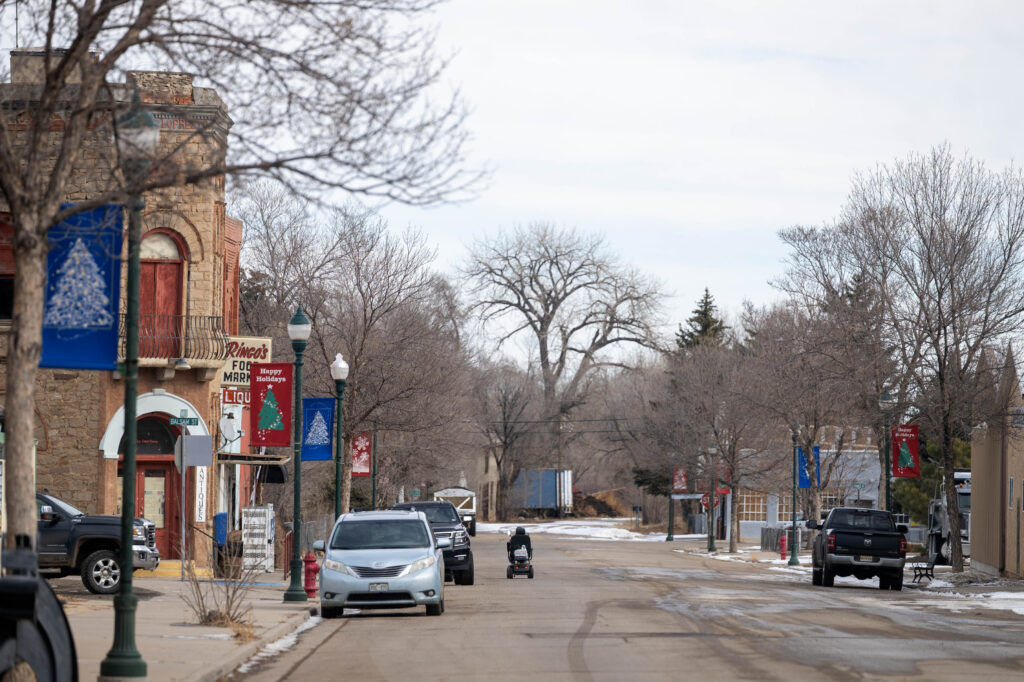
Decades later, Aguilar’s old memories still have plenty of room to roam. Boarded-up facades that wouldn’t be out of place in an old Western movie recall a history with striking miners and Prohibition gangsters. Main Street turns into a dirt road. The population – less than 500 – is aging and decreasing, according to census data.
But in recent times, Aguilar’s creeping decline accelerated in ways that caught residents off guard.
Since the early 2000s, the town has been beset by a compounding infrastructure crisis that the state monitors but has not seen fixed. In recent months, Aguilar has become the subject of a criminal investigation into its finances, leading to the arrest of the town’s administrator on embezzlement charges.
Multiple residents believe the town’s water is unsafe to drink, with official documentation to back up some of their fears. Oversight remains spotty from the county and state on health and safety issues.
“Everything here has been based on lies and corruption,” said Aguilar trustee and mayoral candidate Vernon Thorn.

The municipal election on April 7 comes as the town faces existential challenges that could determine how long a community with a colorful Colorado history survives beyond the state’s 2026 sesquicentennial anniversary.
Hope remains on the horizon, says Colorado Municipal League Executive Director Kevin Bommer.
“I don’t think anyone’s counting them out yet,” he said. “I sure am not.”
Significant deficiencies
Aguilar has more town than it does people.
A common artifact of the state’s historical boom-and-bust cycle, the community’s makeup is typical of parts of Colorado’s mining country that haven’t leaped to another industry like tourism. Aguilar’s Main Street gives the impression of a bustling past, with a couple of buildings that would have been elegant, if not grandiose, back in the day. The Gianella Bank, a two-story sandstone building with a unique, tombstone-esque name and date plaque, has been abandoned for years despite its place on a historical register.
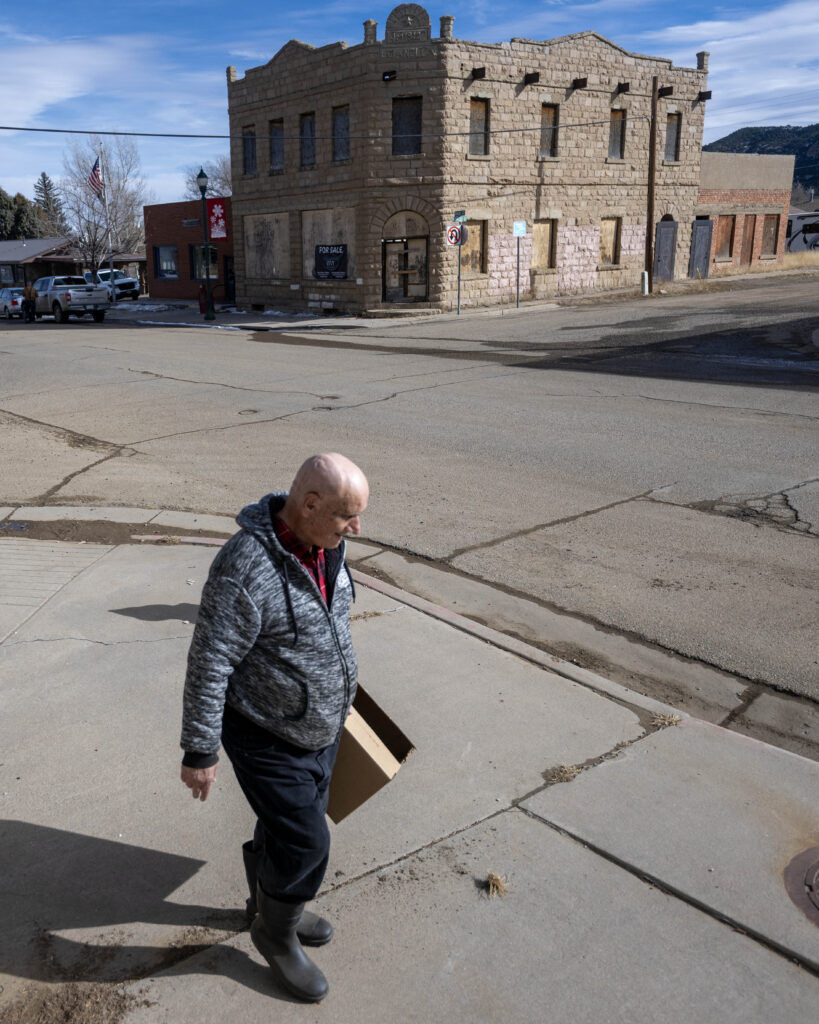
Main Street has plenty of boarded-up storefronts, but there remain a few bright spots: the Aguilar Mercantile, a gas station, a nice Ace Hardware. A weekday morning does not leave the center of town empty: Errands are run, conversations are had.
Just off Aguilar’s main street sits Sue Lawson’s multigenerational home, where younger family members were in and out past the front screen door without comment. Her infant granddaughter lay in a baby swing, glued to a cartoon in the living room.
With a new addition, Lawson said the household was being careful: formula only gets mixed with bottled water, not tap.
“There’s nowhere to get clean water,” she said.
Lawson is one of several Aguilar residents who vocally believe drinking water in the town has been compromised. Their concerns are fueled by years of citations from the state’s water quality agency.
The town has received a drinking water enforcement order from the Colorado Department of Public Health and Environment starting in 2018 and has been under a compliance plan since 2023. In the compliance plan, the CDPHE has mandated improvements to the town’s water storage system. The 2023 report said one storage tank’s condition “may allow potential sources of contamination to enter” and that it “appeared to be unsound and may be close to collapsing.”
Significant deficiencies date back a decade to 2016 in sanitary surveys of the tank, according to the CDPHE.
Brent Temmer, a CDPHE spokesperson, said that town leaders have been meeting with the agency monthly for years and were making “substantial progress” on meeting goals.
But the identified issues remain, with no solid construction schedule yet in place.
Town trustee Thorn said that the trajectory of the state’s oversight has been disappointing, with little in the way of demonstrable results.
“If you can’t show what effort you’re making, are you really making effort?” he asked.
As of a December assessment, the state agency also found risk of contaminants in the town’s other water storage tank due to severe corrosion. The report triggered a notice to residents last month, according to CDPHE records. Contaminants in the compromised water storage tanks could cause “diarrhea, nausea, cramps and associated headaches,” the notice warns.

The town’s municipal water disinfection process is also flawed. In its most recent report, the CDPHE said Aguilar was adding disinfecting chemicals based on manual readings, rather than according to the flow rate at any given time.
The February notice to residents included a head-turning paragraph:
“Results of regular monitoring are an indicator of whether or not our drinking water meets health standards. During the inspection it was identified that we did not complete all monitoring/testing, were not monitoring correctly, or were monitoring at an inappropriate location. Therefore we cannot be sure of the drinking water quality at that time.”
Holding a drinking glass up to the light, Lawson pointed out a white film on the bottom she said came from the tap water. She said she can sometimes smell chlorine coming out of her tap.
“If you put it in a glass, it’s not clear,” she said.
Solution remains elusive
Part of the problem is a multimillion-dollar infrastructure backlog for the small town. At the same time Aguilar urgently needs to invest in its own drinking water, it also needs to address a water court order in a case dating all the way back to 2005. A District Court Water Division 2 judge ordered the town to replace water it does not have the right to use.
The solution was to build an “augmentation pond” that collects water to release during peak use, preventing the town from overstepping senior water rights. The town was legally required to build the pond, but had none of the funds to pay for it.
Aguilar said it would put together the financing for a pond, but the court order has already resulted in some consequences when the town blew past deadlines. Aguilar has been on outdoor water use restrictions for years, according to Thorn. Lush yards and gardens are not a common sight in the dusty high desert town.
Aguilar finally found funding for the pond in grants and loans from the U.S. Department of Agriculture and the Colorado Department of Local Affairs. The total awarded funding was about $6 million. Aguilar contracted with construction company Siete to build the pond and get closer to addressing its drinking water.
Even more problems soon emerged, however, setting off a series of misfortunes for the small town.
“They‘re telling us how well this project’s doing, but there’s no water in the pond,” said Thorn.
‘Little Chicago’ barrels into Prohibition
According to legend, the gangster Al Capone found Aguilar a convenient hideout during his jaunts out West. Capone and almost equally infamous associate Joe “Joe Bananas” Bonanno even attended a wedding here once, according to the Apishapa Valley Historical Society.
It’s not hard to imagine why the town would appeal: Aguilar had a certain reputation during its heyday.
On the outskirts of town, a desolate road’s only opportunity to get a drink was the July 29 Saloon — so named for the date of an Italian king’s assassination by an anarchist. The historical society claims the town had a presence among the Black Hand, an early Italian-American extortion ring.
At the turn of the 20th century, southeast Colorado was in the midst of a coal mining boom. While neighboring communities were built around the mines, Aguilar was already established by ranchers. The town would have had stores that took cash, not company scrip. The stately Gianella Bank, prominent on Main Street, was a symbol of self-determination.
“There were a lot of small mines around, and that’s what brought them to the area, but this wasn’t a mining town, you know?” said Pat Romero, a local history enthusiast who helps run the historical society.
Mining companies orchestrated the kind of exploitation around Aguilar that made it into the history books on labor relations. Just a few miles to the south was the site of the 1914 Ludlow Massacre, in which anti-strike militia and the Colorado National Guard attacked a camp of workers and their families, killing mostly women and children who were caught in a fire as they tried to take cover.
The remnants of abandoned coal camps remain all around Aguilar — at Beshoar, at Berwind, at Ludlow itself.
Aguilar remained rough-and-tumble going into Prohibition six years later — the town’s nickname was “Little Chicago,” according to the Historical Society. In 1930, a Prohibition agent was shot dead on Main Street in broad daylight. A news article of the time was not too sympathetic, suggesting the man’s “impetuosity and his habit of working alone” might have contributed to the ambush.

As the town dwindled, so did its law enforcement presence. Aguilar has a marshal, but the position has long been vacant. The most local authority is the Las Animas County Sheriff’s Office, which covers the state’s largest county by area.
Las Animas County Commissioner Robert Lucero, whose district includes Aguilar, said the county contracts for snow removal, but is otherwise not too involved in the town’s issues. His impression was that Aguilar, despite recent attention, was a “very nice, clean, quiet town.”
“I don’t really know other than what’s on social media,” he said.
Former Aguilar Trustee Angela Adams said it feels like the town is on its own in some ways.
“We were ignored forever,” she said.
CBI: Water funds commingled, embezzled
The first widely publicized indication that things might not be right in Aguilar’s administration came in the form of a Colorado Bureau of Investigation press release in October 2025.
The CBI announced the arrest of Tyra Avila, the town administrator, on suspicion of embezzling thousands from accounts containing Aguilar’s accumulated funding for the augmentation pond needed to get the town in line with its water court order.
According to a Las Animas County arrest affidavit, Avila is accused of paying herself more than $26,000 from the town’s accounts into various personal bank accounts over several years.
The CBI Economic Crime Unit investigation found that millions in federal funds had been commingled in the town’s accounts and used to pay for expenses other than the money’s purpose. During the same period, Siete and the project’s engineering firm say checks from the town started bouncing. Siete stopped work and sued for nonpayment as the pond neared completion.
The news was not a surprise to former town official Adams, a professional bookkeeper who said the town has been running without meaningful financial oversight for years. She said she briefly served as a town trustee in 2024 before resigning due to the high workload.
“Self governance doesn’t work when you have corrupt people,” she said.
Adams said that she and other residents were aware of the financial discrepancies dating back to 2024 and raised concerns with state officials. Accusations against Avila were forwarded to the CBI through the Las Animas County Sheriff’s Office, arrest records show.
Before Avila’s arrest, the town had been on the radar of state regulators. From 2019 until last year, the town did not submit its required yearly financial audits to the state, causing a hold on some funding. Completing the delinquent audits also became a demand in the town’s CDPHE compliance plan.
The audits only resumed last August, while 2024 and 2025 audits are still in the works. For 2023, the financial outlook for the town was poor. Rae & Company CPAs included a lengthy disclaimer of opinion, cautioning the state that Aguilar was unable to provide enough documentation to assess the town’s finances and what was provided had many irregularities. What was included didn’t look good: several key accounts had negative equity or big losses.
The auditor cautioned that the town’s management should consider whether the state of things “raise substantial doubt about the Town’s ability to continue as a going concern for twelve months beyond the financial statement date.”
The Municipal League’s Bommer said that the audit was still a step in the right direction. While Aguilar was not “out of the woods yet,” he said the progress of the past few months meant the town was much closer to addressing its worst issues.
“They’re still trying to get caught back up, and it’s slow going,” he said.
Bommer compared the situation to Hartman, a town of just 30 close to the Kansas border with a water system in complete failure and a nonfunctioning town government. Things could be much more calamitous, was the point.
“Aguilar has leadership committed,” he said. “They obviously have not only help but a lot of people watching.”
The World Journal in Walsenburg reported this month that Aguilar has resumed work on the augmentation pond necessary to clear its water court case, with a wrap up hoped for later this spring. The 2024 audit is also on its way.
Aguilar Day(s) approved, hope remains
Vernon Thorn is Aguilar’s self-acknowledged doomsayer. He’s a frequent social media poster and a common bur at town meetings. He’s been recalled before then reelected. He’s led a protest march. He thinks he might move someday.
“I’ve been accused of causing panic in the people,” he said.
At one end of a spectrum of views, he’s still optimistic about the town where he’s lived for the better part of a decade.
“The town itself, I don’t have a single bad thing to say about the businesses or the people, it’s just the management, and that can be fixed,” he said.

Aguilar residents had lots to say about the town’s appeal, from historical charm to affordability. Adams said she moved there from Denver, seeking cheaper housing and Spanish Peaks views. She said that much of the community’s composition is not willing or able to pick up sticks and go elsewhere. According to census data, the town median income is less than $30,000.
“We have a lot of disabled, we have a lot of elderly and on fixed income,” she said.
Over at the town’s library building, Lill Clark was mopping the community room where groups host events for seniors one afternoon. She keeps the space cozy, tidy and stocked with a strong selection of paperback Westerns. The children’s section was ready for when school let out across the street. She said that Aguilar is not alone -– many of its neighboring towns share the same long-term concerns.
She said the community was resilient.
“The water thing’s going to work out how it works out,” she said.
While the embezzlement case in Aguilar is singular, Bommer said that the phenomenon of infrastructure issues causing financial strife in rural, small-town Colorado is not uncommon.
“Rules and regulations keep getting more strict, which makes it easier or more likely that fiscally challenged utilities are going to risk being out of compliance,” he said.
To pay for upgrades, small communities for several reasons cannot just raise utility bills. Grants are the way to go, but applications are competitive for an uncertain pool of money each year. Bommer said that Aguilar faces an uphill battle in securing more funding out of the many applications.
“It’s a little bit of the ‘Hunger Games,’ because that list is way longer than there is money to fund projects,” he said.
Meanwhile, traditions continue. At its last meeting, the Aguilar town trustees greenlit the 2026 Aguilar Days festival, although it is for one day, Aug. 1, anticipating vendors and a beer garden. Past events have included a car show and history tours.
“In spite of all this stuff, I really like this little town,” said Adams.