







Grief, guilt and the role of government in Aurora | Michael A. Hancock

Every death leaves grief behind. Families mourn. Friends mourn. Communities feel sorrow. That is human. It is unavoidable.
But a city government is not merely a vessel for sorrow. Its duty is not simply to feel. Its duty is to judge carefully, distinguish honestly, and speak with moral clarity.
That is why Aurora City Council’s emerging posture on fatal police shootings is so troubling.
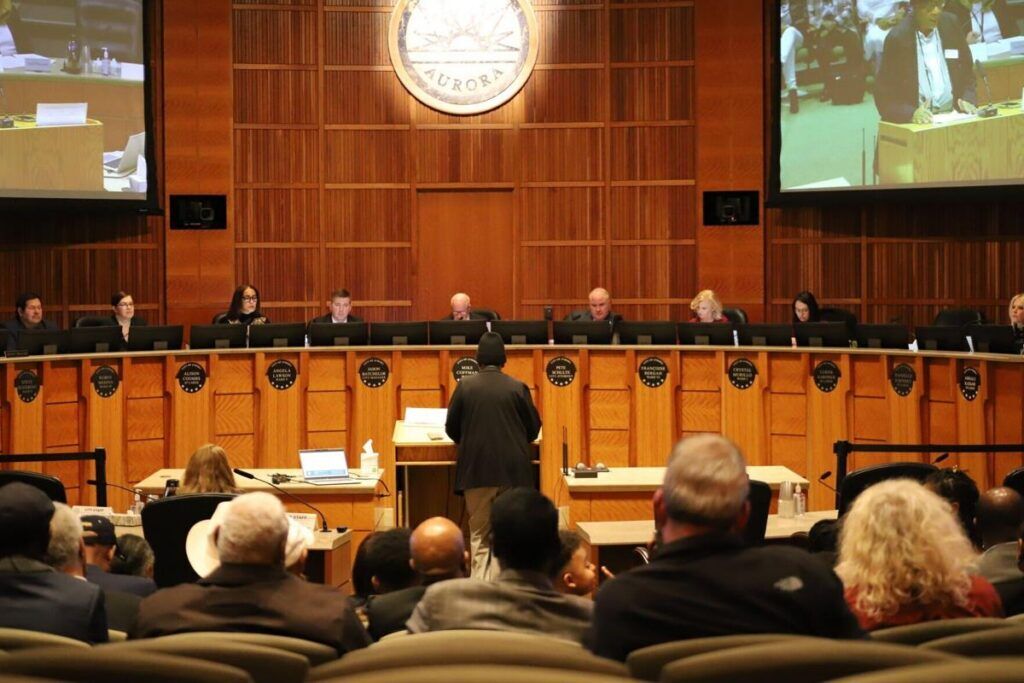
The public safety committee, chaired by Councilman Rob Andrews, has advanced a resolution stating that the City Council “stands in mourning with those who are grieving the loss of a child, parent, family member or friend” after officer-involved shootings. The stated aim is to establish a consistent public stance acknowledging tragedy while avoiding comment on the legal merits of pending cases.
On its face, that sounds humane. It is also deeply confused.
Compassion and judgment are not the same thing. Grief is personal. Government is institutional. A family may mourn every death without qualification. That is what families do. A city, however, has a different obligation. It must distinguish between justified force and unjustified force, between tragedy and wrongdoing, between sorrow and blame.
The proposed resolution blurs those distinctions.
The problem is not sympathy for the bereaved. No decent person objects to that. The problem is the city adopting an official posture that treats all fatal police shootings as essentially the same kind of civic event. Once the government does that, it is no longer merely recognizing grief. It is assigning meaning.
And meaning matters.
The most revealing language has not come from the resolution itself, but from the rhetoric surrounding it. As council member Gianina Horton recently framed the incident in a public video, it was “another young man killed by the Aurora Police Department.” That may sound milder than activist slogans. It is not. It preloads the moral narrative. It places the department in the role of aggressor, the deceased in the role of victim, and leaves hanging in the air the implication that the only remaining task is public lament.
But that is not how justice works.
The law does not judge an officer-involved shooting solely by its outcome. It judges the action in context. Was there an immediate threat? Was the officer or another person in danger? Was the use of force lawful and necessary? Those are not side questions. They are the central questions.
Yet the resolution encourages the public to focus on a different proposition: someone died, therefore the city must mourn. That is sentimentality displacing judgment.
Every death is a loss. Not every loss is an injustice.
That elementary distinction is what this resolution strains to avoid.
Consider the difference. If an officer acts recklessly, maliciously, or unlawfully, then the city may rightly grieve not only the death itself but the corruption of public authority. In such a case, mourning has civic meaning because a wrong has been done.
But if an officer uses deadly force lawfully to defend his own life or the life of another, the moral meaning of the event is entirely different. The death may still bring anguish to those who loved the deceased. It may still be tragic in the ordinary human sense. But the city cannot properly “mourn” that outcome in the same way without implying that justified force is itself a public shame.
That is the sleight of hand here. The word mourn is made to sound neutral, compassionate, and above dispute. In private life, perhaps it is. In public life, it is not. Official mourning carries moral content. It signals that something lamentable happened in a civic sense, not merely that someone somewhere is grieving.
That is why the resolution is not neutral. It is symbolic judgment masquerading as restraint.
Its defenders will say that the resolution does not speak to legal guilt. That it merely acknowledges pain. But one cannot refuse to judge in law while judging in rhetoric. One cannot say, “We are not taking a position on the merits,” while teaching the public that the appropriate civic stance is lament first, distinction later.
Activists are free to speak in moral generalities. Governments should not. Activists traffic in narrative. Government, at its best, traffics in judgment.
Aurora can show sympathy without blurring the line between justified force and wrongdoing. The city can acknowledge the dignity of every human life. It can express sympathy for grieving families. It can insist on a transparent review in every fatal police encounter. It can demand accountability where force is wrongful.
But it must also be willing to say, without apology, that lawful force is sometimes necessary in a fallen world, and that justified force is not rendered unjust merely because its outcome is fatal.
A government that cannot distinguish between grief and guilt will eventually fail to distinguish between justice and injustice.
That is the real danger here. Not that council members feel sorrow. They should. But that sorrow is being translated into official language that dissolves moral lines government exists to preserve.
Aurora should comfort the grieving, investigate the facts, and uphold justice.
It should not confuse mourning with judgment.
Michael A. Hancock is a retired high-tech business executive and a Coloradan since 1973. Originally from Texas, he is a musician, composer, software engineer and U.S. Air Force veteran whose wide-ranging interests — from science and religion to politics, the arts and philosophy — shape his perspective on culture, innovation and what it means to be a Coloradan.