







Denver Botanic Gardens opens a world-class Jaume Plensa art exhibit
‘A New Humanism’ urges peace, celebrates pluralism
On Saturday, as part of this year’s 75th anniversary celebration, the Denver Botanic Gardens opens the first U.S. retrospective of the internationally revered multidisciplinary artist Jaume Plensa.
The indoor-outdoor exhibition titled “A New Humanism” runs through Sept. 7 and includes roughly 30 works by the Spanish artist best known for large-scale public sculptures, as well as mixed media works on paper that compel us not only to look, but also to think.
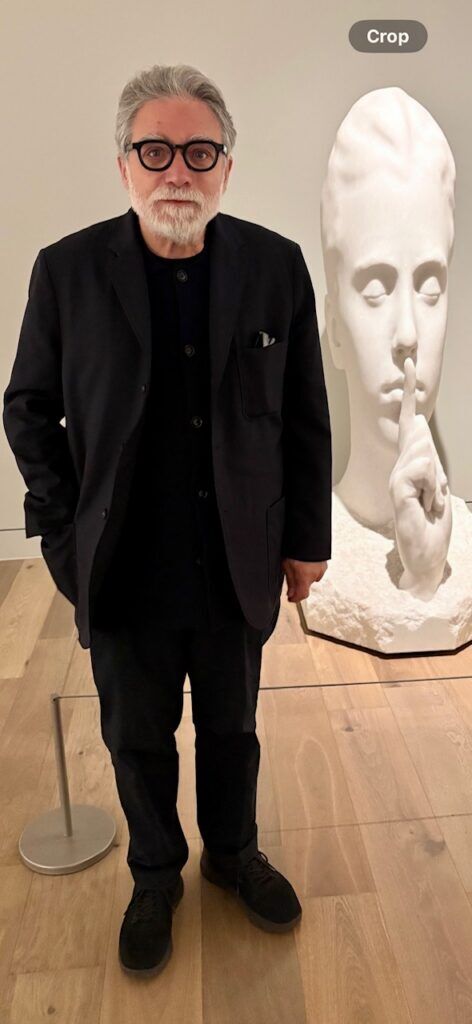
Plensa, who has simultaneous exhibits now showing around the globe, previously visited Denver for the first time to inspect the DBG site. The artist was in the Mile High City again this week to oversee the final installation of his show.
In a one-on-one interview with The Denver Gazette in a DBG gallery, the soft-spoken Plensa, 70, articulated his paradox: “I am a visual artist. It’s funny, I am talking as a sculptor and using heavy materials, but I am always talking about invisibility. The most important things in life are always invisible.”
Three indoor galleries exhibit sculptures and works on paper
Plensa’s art frequently presents dreams as a prominent invisible force. A number of the pieces in the exhibition reference dreams, including “Hortense in Slumberland,” a small sculpture depicting a disembodied human head held in open hands.
“Many times, you can understand reality better when you’re dreaming. There’s a parallel concept in a dream state,” Plensa said. “I always believe dreams are a positive part of our humanity. Sculpture has a tremendous capacity to create invisible dreams.”
Asked what his most prominent personal dream is, Plensa said: “Since always, I’m always saying the same dream. My dream is to imagine a world without war. I never believed war could be a solution to anything, but unfortunately people continue to think war could be a solution. I’m completely against any kind of violence, and unfortunately, we are living in a quite violent world.”
New Humanism defends human rights
In support of his dream for world peace, Plensa has created various artistic iterations incorporating text from the Universal Declaration of Human Rights. A piece in the show consists of a cast aluminum door engraved with text from the Universal Declaration of Human Rights. Above the door, an illuminated lightbulb glows.
“I’ve been working with the 30 articles of the Universal Declaration of Human Rights for years with curtains and doors. The declaration came out in 1948, and unfortunately, we have forgotten it. That’s why this piece is called ‘Forgotten Dream.’ And I’m especially happy it’s here when the world seems so crazy,” he said. “Art is always politics, in some ways.”
The artist depicts the body, suggests the soul
Plensa’s door is installed in the elliptical gallery along with one of the artist’s most enchanting sculptures titled “Sitting Tattoo XI.” Made from polyester resin and steel, a large-scale seated human figure is marked with names of various tarot cards and also the artist’s keywords: beauty, passion, optimism, equity, harmony, inspiration, pleasure, progress, justice, skill, creativity, unexpected change and death. The sculpture suggests invisible forces leaving indelible marks upon a person.
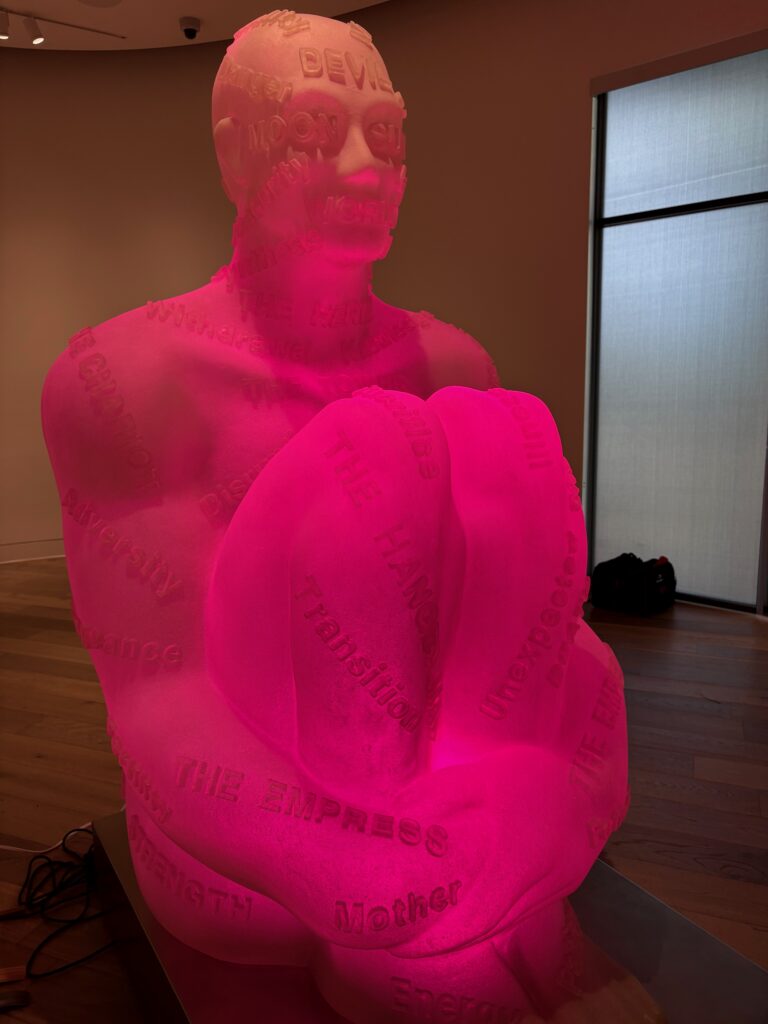
“I’m working a lot with alphabets and with text. Tarot cards are consulted because we are very concerned with the future. Human beings always concerned with tomorrow,” Plensa said. “Tarot has the concept of dreaming about the future.”
The sculpture changes colors, morphing subtly through a vivid inner rainbow.
“This kind of light is talking about my obsession: the dialogue or the relationship between body and soul. Many times the soul is moving inside our body. We could say ‘aura’ or ‘energy,’ but this light is moving very gently inside the body,” Plensa said. “I wanted to fill the space with energy not with objects. This piece has the possibility of making everything around it beautiful.”
The gallery also exhibits the tiny maquette, or model, Plensa made for the sculpture.
“For me, scale is very important. It’s the relationship with everything around. I like to show the maquette as the beginning, the piece I did in my studio.”
A wall labeled with a quote by Plensa proclaims: “There’s no way to truly know another person without first coming to know yourself.”
Three outdoor installations grace the gardens
For Plensa, the new humanism continues his career, now in its fifth decade, of depicting the human figure. The most spectacular installation in Plensa’s Denver show is in the Monet Pond where a pair of his signature large-scale human heads sculpted of steel wire face one another, levitating above the Monet Pond as mallard ducks paddle past, scattering the sculptures’ reflections.
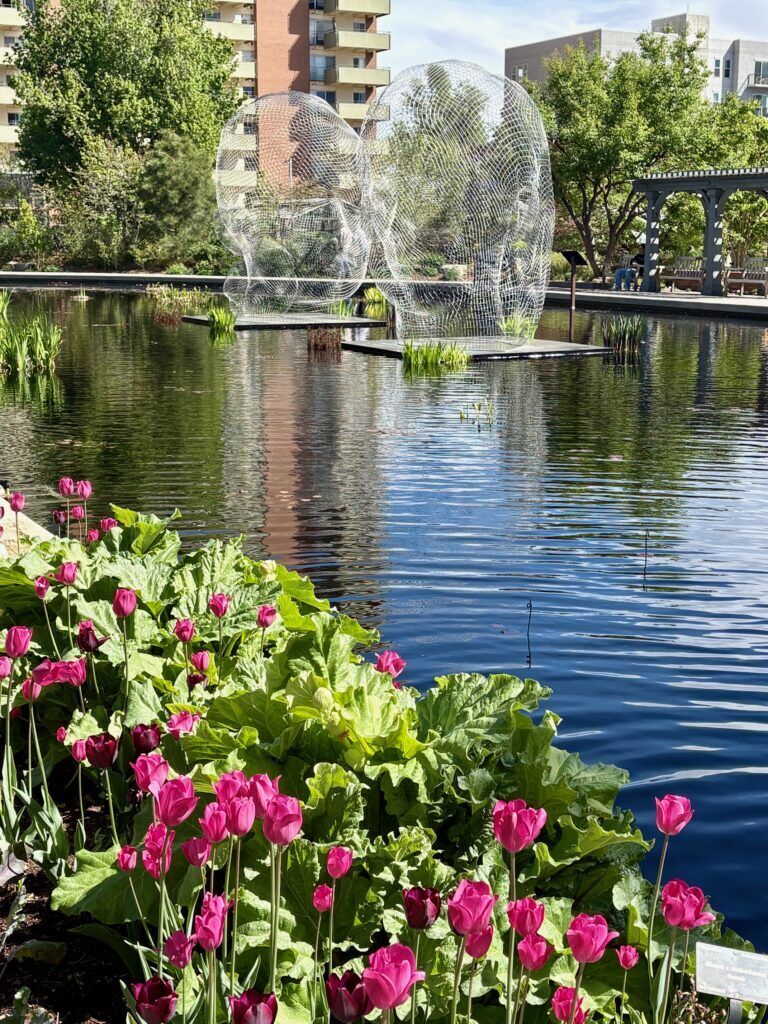
Titled “Julia” and “Lou” the works are roughly 12 feet high by 10 feet wide by 12 feet deep.
“They are in a silent conversation,” said Plensa. “The installation is fantastic.”
“The monumental heads are one of Jauma’s most recognizable motifs,” said Jen Tobias, one of DBG’s lead curators for the exhibit.
DBG installed Plensa’s enormous wire heads so the sculptures come into view as visitors approach the pond.
“There’s a fun reveal,” said Tobias as the almost transparent wire heads seemed to appear suddenly out of thin air, mirage-like.
A young boy ran ahead shouting: “I see a ghost!”
DBG’s Manager of Exhibitions and Art Collections Megan Farlow said: “The most rewarding part of installing A New Humanism is witnessing the awe and surprise of our visitors when they see something of this scale come to life in the gardens. Creating these moments would not be possible without the collective effort of Jaume Plensa and his studio, art handlers, engineers and the entire DBG exhibits team.”
Installing exhibit’s highlight: wire sculptures of huge human heads
Tobias noted that Plensa’s mesh head sculptures were shipped to DBG in pieces.
“They were in giant slices that required putting them together with all these little tiny clips that had to be threaded on individually, so it was very time-consuming,” Tobias said. “We are so lucky to have these here! On one hand there’s the poetry and metaphor and lyrical, meaningful side and on the other hand a mixture of extremely technical logistics to achieve this seamless, magical vision. It looks like those heads just grew there.”
Addressing the challenge of siting the outdoor sculptures at DBG, Tobias said: “They seem both contemporary and ancient in the landscape, almost as if they were excavated. And I always know we have sculpture sited well when they seem as if they’ve always been there.”
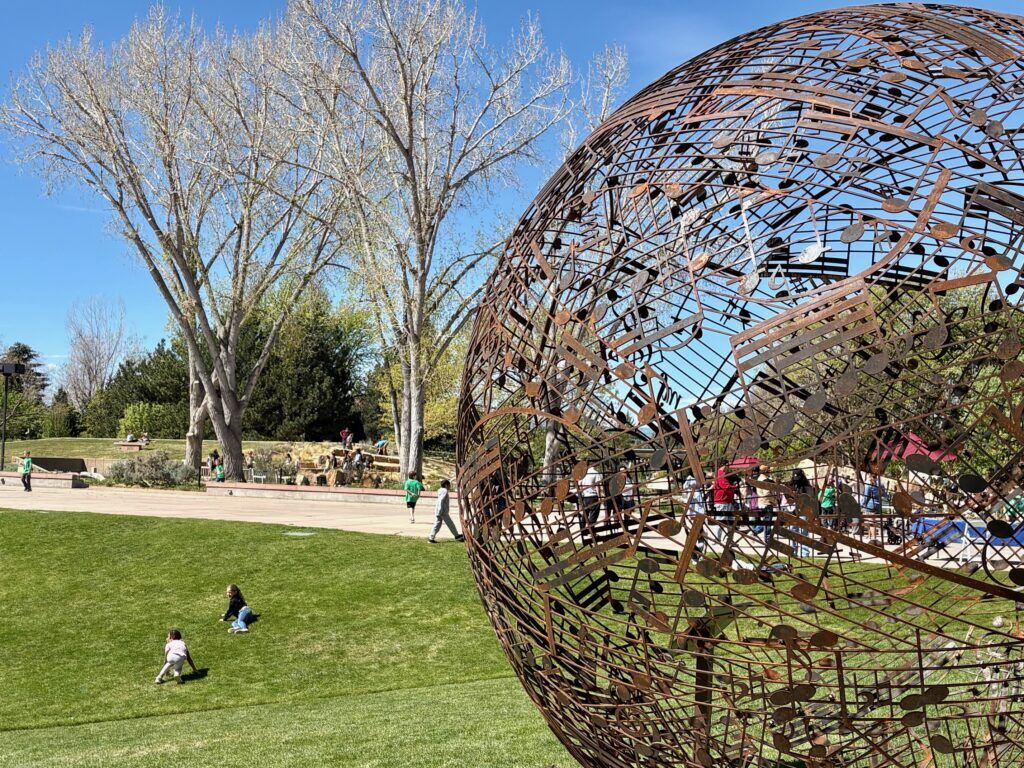
That’s true of “Self-Portrait in Music,” Plensa’s large, lacy sphere of metal musical notes installed in the DBG summer concert venue.
“Jaume draws a lot of analogies between universal and individual experience, so musical notes are given meaning through the context of other notes in the same way as letters are given meaning through the context of other letters and individuals are given meaning through society and culture,” Tobias said.
Portraits sculptured from wood, cast in bronze
In DBG’s Laura Smith Porter Plains Garden, a grouping of Plensa’s towering portrait sculptures form a community of sorts. Plensa carved human faces from enormous oak logs then cast the sculptures in blackened bronze that appears to be wood. Plensa gave his sculptures human names: Julia and Juana, Lora and Hortensia.
The artist said: “My work has a lot of young women because I consider the female capacity to preserve memory and to create the future.”
‘The Language of Connection‘
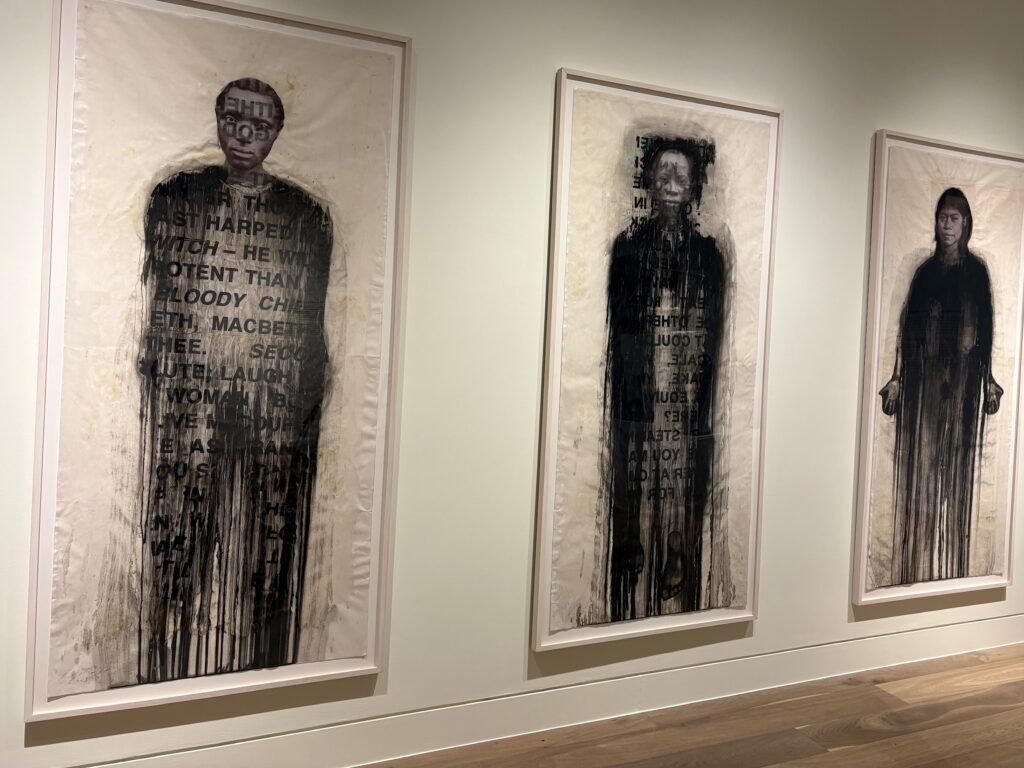
People figure most prominently in Plensa’s subject matter, but he often addresses language, too. Plensa frequently includes text in his artworks, and one of his recurring motifs is his use of multilingual elements.
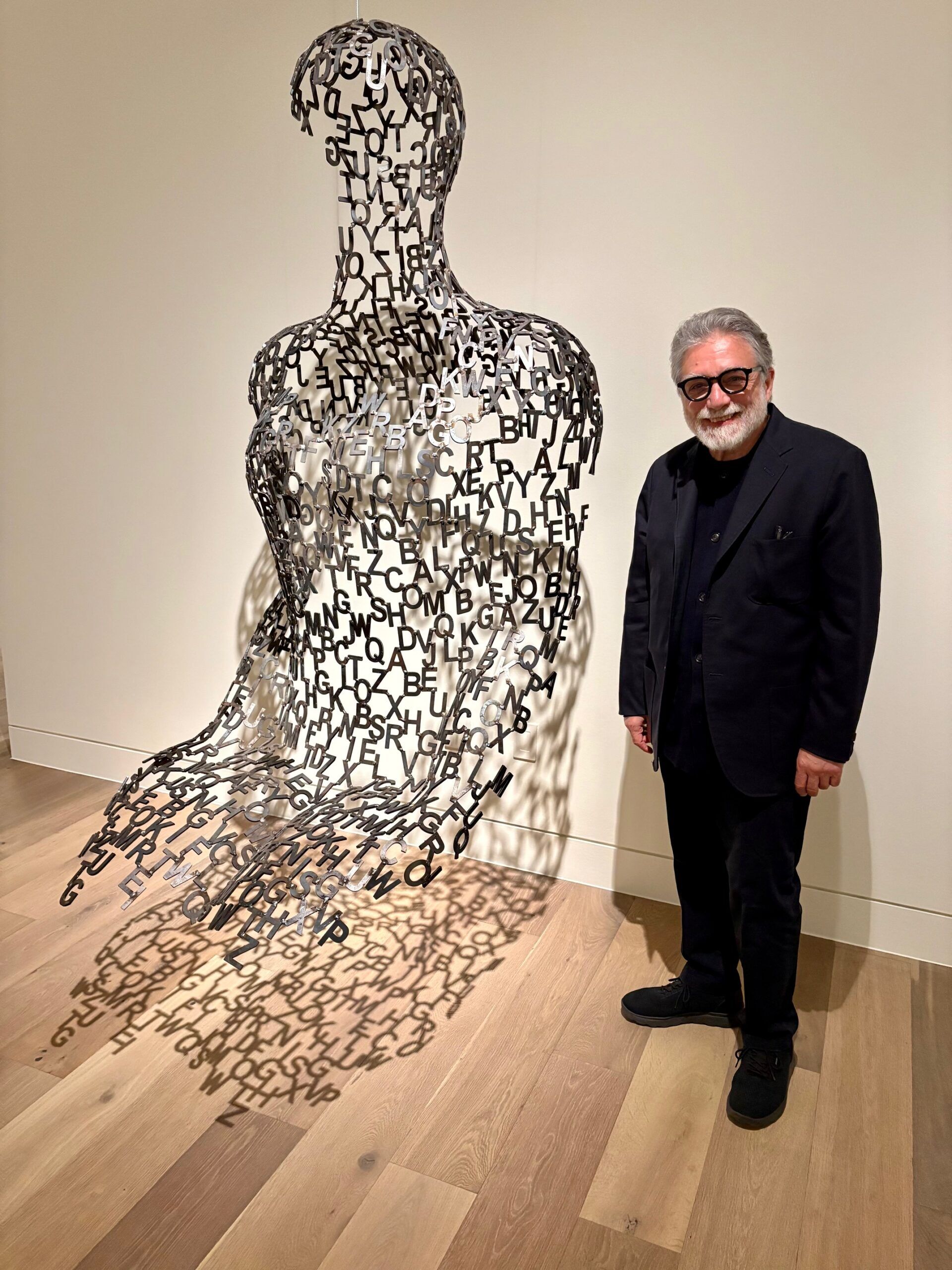
“Talking Continents,” for example, includes die-cut steel characters from eight different alphabets welded together. The grouping of suspended sculptures of people and planets holds court in one of the galleries.
“The alphabet is finally a beautiful portrait of one culture or tradition. It’s an incredibly dynamic effect, the alphabets all together. Again, it’s a celebration of the diversity of our world,” said the artist, noting that the work installs similarly, but never the same, in different exhibits.
“The piece is strongly related to the architecture,” Plensa said. “It’s a dream about if you could fly over the planets in the universe.”
Like many of Plensa’s pieces, the works cast artful shadows.
“The shadows are part of it. I’m talking again about what is real and what is a dream. The shadows have a certain body, a certain physical quality,” Plensa said.
Plensa poses questions without answers
Along with text, Plensa’s art often incorporates punctuation: particularly, the question mark.
“The beauty of a question mark is as an engine that moves us to a certain knowledge,” Plensa said. “Many times, a question mark is like a door. We are creating questions. I’m not interested in the real answer, but it’s very important to put questions forth so people generate ideas.”
Asked what his burning personal questions are, Plensa said: “I question for myself the same questions every generation asks: Who am I? Where did I come from? Where am I going? Every day, arriving in my studio, I have excitement, but I’m still doubting.”
Questioned about what he doubts, Plensa shrugged.
“Doubts and doubts and doubts,” he said. “I think it’s my way to work — never to be sure.”
An artist with a global audience
One thing is sure: Plensa wields his artistic humanism influence worldwide. After seeing his exhibitions mounted around the globe, Plensa and his wife plan to travel next week to India, where the artist will inspect his new installation in Bangalore.
“It has been the privilege of my life to travel the world installing pieces and to share my dream,” he said. “Wherever you are you feel at home. We are so similar. There is always so much to talk about and to share and to enjoy together. I have a lot of pieces around the world in public spaces, and it’s a very democratic way of introducing beauty into the life of people.”
As for enjoying the beauty of his Denver exhibition, Plensa said: “I invite people to come over and find links and connections between their dream and my dream. My main intention is to celebrate diversity in the world, to pay homage to this amazing, beautiful diversity which is humanity. My work is about communities and the individuals. It’s keeping your own individual qualities and also being part of humanity. The center is the person and not the city or the architecture, but the humans creating everything.”
Private revelations in public spaces
Plensa creates most of his figures with closed eyes.
“I love the viewers of the exhibit to close their eyes, as well, and look within. The portraits talk about interiority, this amazing quality of beauty hidden inside the self like a secret garden. This amazing imagination inside,” Plensa said.
One of Plausa’s quotes highlighted in the exhibit summarizes his artistic intention: “An energy flows through my work, grounded in the idea of the human being as an inexhaustible source of hope.”
Plensa expressed his hope for the exhibition: “Working a lot in public spaces, I love to see the reaction of people in front of the work. I hope it helps them to be in quietness and silence. To create silence is my obsession. We live in a very noisy time with messages arriving all the time. I hope people will create silence to listen again to the rhythm of their heart, of their mind, of their soul.”
About his art’s premiere in Denver, Plensa said: “I enjoy very much the exhibition here in this hybrid space. The work in the galleries is more private. The works outdoors is more public. I was so happy to see the outside pieces surrounded by kids running and playing around the sculptures with no knowledge it was art.”