







Metro Denver condo prices span from low to wildly high
But how risky are they for buyers?
At a moment when Denver is facing increasing cost of living, the price tags on condominiums are a tempting route into the housing market.
But how safe a route is that?
The question pops up in a month when condos are in the headlines, both for some high-priced listings, as well as for increased risks from rising homeowner insurance, driving up home owner association fees for mortgagees.
Some specialists say a condo purchase could be a worthwhile move at a moment when many agents expect prices here to stay high, regardless of current swings.
Recent data from the Denver Metro Association of Realtors shows the median home price in the metro area at $590,000. For the median price of a single-family home, the number is $645,000. New numbers are scheduled for early May, but as of last month, those prices were still rising.
Meanwhile, the average multifamily price spanning both condos and townhomes stood at $390,000 in March — up 4.5% over the month previous, and higher than a year back.
“There are opportunities,” Broker and owner Jenny Usaj at Usaj Realty told The Denver Gazette.
Usaj, who handles a number of condo listings, said she believes the traditional advantages of homeownership as opposed to renting still apply to the current market.
“Homeownership is the right answer,” she added. “Get in where you can afford it.”
That said, Usaj flagged a number of warning signs that buyers should watch as they evaluate prices, particularly on condo products.
“The insurance environment has changed the market, with fire and wind dangers. Insurance considerations for a lot of buildings have pushed HOAs up,” Usaj said.
Condo purchases require extra upfront diligence to avoid surprises that pop up late in the buying process, driving up a monthly payment, experts said. Buyers, they added, should double check the financial conditions of the association, looking into the reserves and watching for special assessments, along with the balance of owner-occupied vs. rented units. They should find out if repairs or improvements might be pending.
The red flags
Those worries are the background of problems that have red-flagged condo markets in Sunbelt areas, including Florida, Texas and Arizona — typically with higher concentrations of condos than in Denver.
Industry leaders and policymakers have said the construction defect issues and the legislation surrounding the market in Denver served to curtail the development of condo projects decades ago, and apartment projects have dominated the market in recent years.
The S&P Cotality Case-Shiller Index now reports that Denver has displaced Tampa as the weakest housing market among 20 markets nationally, citing home prices dropping 2.2% over the year, based on February data. That has given rise to some speculation that the weak segment of the national market is moving from other Sunbelt states in the mountain states.
But Washington-based national economist Elliott Eisenberg sees Denver as better placed than the Sunbelt markets further south and east.
“Denver is not as bad as other markets, not as bad as Austin and Miami,” Eisenberg told The Denver Gazette earlier this week.
“Condos don’t appreciate as fast as houses, because you can’t expand the size of a condo,” Eisenberg noted.
HOA costs inject a lack of control into a buyer’s decision-making and affect their value.
But Eisenberg said a lack of supply weighs against some of those concerns, particularly as an aging population gravitates toward lower-maintenance projects.
“Because they’re not being built, there’s not much supply. The population is getting older. Downtown (office) buildings are worthless, and a nice condo downtown might be very appealing,” he added.
Kentwood agent Dawn Raymond, who has represented a number of Cherry Creek projects, including the hugely successful Waldorf Astoria Residences at 2nd Avenue and St. Paul Street, which is currently 70% sold as construction gets underway, said she agrees with that assessment.
A tale of two cities
“In Cherry Creek, we have extremely limited inventory,” Raymond told The Denver Gazette.
She added that without figuring in her remaining Waldorf units, inventory in Cherry Creek North could be around a dozen condos.
That currently includes one unit at 100 Detroit St., offered by another agent, at $16 million for a 7,145-square-foot penthouse.
Raymond noted that her expertise ends outside the Cherry Creek submarket, but that she nevertheless senses from other agents that a lack of inventory affects the entire Denver market.
Such a lack, agents have said, could be making buyers under contract here more likely to negotiate issues rather than cancel. Redfin notes that Denver had shown improvement this year in what agents call the “can-rate.”
Senior mortgage broker Bill Ezell with Synergy One Lending in Englewood said that he isn’t seeing the high rates of cancellations reported in other markets. He puts the can-rate on all contracts in Denver at 8.7%.
But buyer risks are getting added attention downtown — distinctly different than Cherry Creek.
“My impression looking at condos after 2020 was that people who wanted to be in the heart of Denver got turned off by issues of safety and moved to burbs,” Ezell said.
That, in turn, has made the condo market a safer bet in outlying areas, where those challenges haven’t been as prominent.
Those include struggles with issues from the COVID-19 pandemic, including a high office vacancy rate, and an excess of inventory from residential projects that were launched during the pandemic boom. At the height of the pandemic, governments shut down businesses and classrooms, and curbed gatherings. Companies and workers, in turn, adopted remote work.
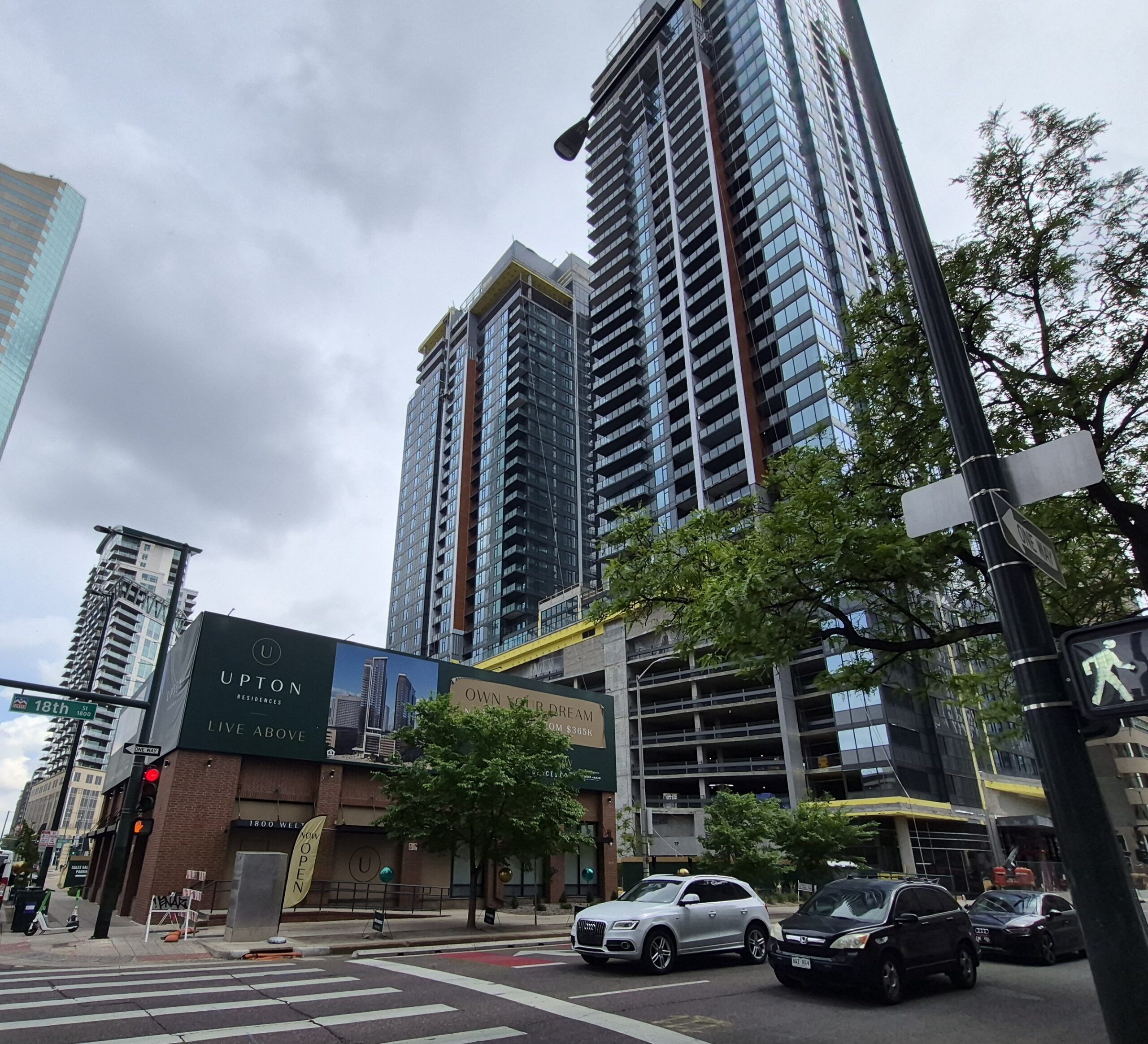
Inventory issues downtown include the Four Seasons Private Residences near Larimer Square, with as many as a dozen, luxury resales in inventory. But a project in upper downtown at 18th and Welton Streets may raise more concern.
Upton Residences is a massive project rising at the north end of upper downtown, at 18th and Welton Streets. It has a whopping 461 units headed for market in two towers, now topped out at 32 and 38 stories.
That number would drastically change condo inventory downtown, where the current inventory is largely composed of resale lofts and smaller condo projects in LoDo, many dating from the 1990s.
Upton Residences would offer studio-to-3-bedroom condos in sleek towers featuring floor-to-ceiling glass, with an additional 18,000 square feet of pool decks, lounges and other amenities, plus 13,000 square feet of ground floor retail.
“Upton will be Denver’s newest high-rise residence in one of the most sought-after locations,” the project’s website states. It calls it an “architecturally-inspired building with designer interiors, lavish amenities and breathtaking city and mountain views … towering above one of the most central and connected neighborhoods in the city.”
Agent remain skeptical
But agents are skeptical about the project’s direction at a moment late in construction — and wonder whether it can continue toward an ownership model.
Compass agent Matt McNeill, one of the city’s most experienced agents on condo products, said a lack of information from the project and its developer is raising concerns.
“I have not heard much about pre-sales. It has been kept very hushed,” McNeill said, adding he wonders whether it might be headed for conversion to apartments.
“It’s a rough market to build new construction, in an odd location,” McNeill added.
The setting lies two blocks northeast from downtown’s recovering 16th Street and is nearer to areas that faced noted challenges during the pandemic.
The Denver Gazette repeatedly reached out for a comment on Upton through its designated spokesperson but received no statement by the time this story published.
The site gives no specific pricing, but units reportedly range from the $400,000s to more than $2 million. A promo on the website’s home page offers “up to $50,000 in curated incentives,” and some references say that some units could be as low as the $350,000 range.
Eisenberg and other authorities said that despite the lack of entry-level product in the Denver market, luxury units with high-six or seven-figure pricing are not necessarily bad for the market now.
“Parts of city are more vibrant than others,” he said. “But you have to have a reason to be there, and Denver has a lot of stuff that’s cool.”
“The stock market has been on fire,” he added.
Despite the concerns over the joint war against Iran, Eisenberg said, a segment of buyers is saying, “I’m feeling happy, I’m rich!”
The need for high-end units
“People don’t believe me, but you have to build high-end units,” he added, noting they tend to reduce stress on the lower end of the market.
“You want them so rich people will take them and rent them. Otherwise, they will outbid the middle class for those apartments. You can’t forget the rich when you want to add supply, whether as rentals or condos or whatever,” he said.
Compass agent Colleen Covell, a veteran market analyst, told The Denver Gazette that condominium risks are an ongoing concern.
Inventory soared following the top of the market in 2022 and early 2023, she noted. She said she hears that some 14% to 16% of deals fall out market-wide but added that cancellation data is not routinely tracked by the agents’ association.

Usaj — the broker who has a unit in Uptown, up 17th Avenue from upper downtown on Washington Street, priced at $434,000 — said that buyers making condo purchases here are protected by a state-authorized contract that contains valuable protections.
“The Colorado state contract has a due diligence period that sets the buyer up for success,” she said.