Pam Grier’s name gets top billing at Alamo

‘I don’t want to miss a second of this,’ legendary film icon from Denver says before Friday’s rechristening of Littleton cinema
At 76 years (and counting), the still-evolving Pam Grier story cannot be tidily reduced to that of a pioneering sex symbol turned feminist icon. She is both of those, to be sure – and yet, so much more.
The woman who put the foxy into “Foxy Brown” is also a thoughtful, emotionally armored gunslinger who survived two rapes (one at age 6), Stage 4 cancer and a systemically misogynistic film industry.
Grier is film’s first female action star. (Translation: Film’s first female total badass.) She is a tireless champion of human rights across the world. She is Denver’s own, having been raised in Park Hill and attending both Denver East High School and Metropolitan State University of Denver.
She is an alumna of the hometown Denver Center Theatre Company, having performed in a 1993 staging of August Wilson’s “The Piano Lesson.” She is a literal cowgirl now running her own ranch in New Mexico. She is well-known to support emerging filmmakers by performing in small films for free. (That’s how she ended up in the 2017 indie comedy “Bad Grandmas” opposite Florence Henderson, “The Brady Bunch” mom – and one of her personal heroes.)
Grier has been underestimated for 55 years and has still somehow emerged triumphant without ever fully surrendering herself.
She is Jackie Brown: Outspoken and unafraid.
When I interviewed Grier in a supply closet at the Sie Film Center in 2012 (that’s a story for another day), she ended by telling me cheekily: “If I say any more, I’ll have to enter witness protection.”
Fourteen years later – ”I am out of the (supply) closet,” she said with a laugh, her powerful word guns a-blazing.
The Pam Grier Cinema
Grier will be home from New Mexico on Friday, when the Texas-based Alamo Drafthouse renames its flagship Colorado location in Littleton as “The Pam Grier Cinema.” In its 26 years, the Alamo chain has named a select few of its national locales after groundbreaking filmmakers, a small and lofty group that includes Spike Lee, John Hughes and Ivan Reitman. This is believed to be the first christening named in honor of an actor.
The (sold-out) celebration of all things Grier will include a rare 35mm double-feature screening of Grier’s two most iconic films: “Jackie Brown” (1974) and “Foxy Brown” (1997) at 7301 S. Santa Fe Drive.
Between films, Nina Henderson Moore (former president of BET Pictures), will chat with Greir about her considerable impact on the industry.
What does it all mean to Grier?
“It might mean that I get to see movies for free,” she said with a laugh, “and maybe my beverages and libation and fried pickles.”

Although Alamo has a location at Sloan’s Lake just up the road from Grier’s Denver East High School, she much prefers that this is happening in Littleton. Before moving to New Mexico, Grier lived in Douglas County, so she considered the Littleton Alamo her home cinema.
“I took my mom there probably five times to see movies when she was in her late 80s,” Grier said. “She’s in her 90s now, and she still loves it. The food is excellent, and it’s all under one roof. Then you can sit around after the movie and talk about Fellini or Scorsese or Coogler or Lee or Denzel.
“It reminds me of when I went to my first movies as a little girl in Denver,” she said of family outings on the bus to the Paramount Theatre and Denver Theatre, which was downtown’s last dedicated movie palace until it was demolished in 1980 (a block from where the Denver Pavilions stands today.)
“Everyone was going to the movies back then,” she said. “I was this little kid looking up at the skirts of the women and watching the men with their children. I loved the smell of the popcorn when you entered the theater. You ascended the stairs and went up to the balcony, and you looked out into this cavernous darkness, and it transported you into another world.”

Childhood mentors
Grier grew up an Air Force brat in Wyoming, Colorado and North Carolina. She talked about Annie Oakley and Calamity Jane as her childhood heroes; then Gloria Steinem, Barbara Jordan, Shirley Chisholm and Bella Abzug just as the women’s movement – and Grier’s film career – were taking full root in the early 1970s.
“These women were trying to get this country to share its equity in communities, churches, politics, everything,” Grier said. Until then, “women were seen as breeders. And what they were expected to do with two or three or four or five or six children at home was to clean the house and cook and shop and potty-train and teach and wear so many hats during the day … but the courts of law and public opinion said that wasn’t a job. And you know what? It wasn’t ‘a job.’ It was many jobs – and women weren’t getting the benefit of sharing in that equity.”
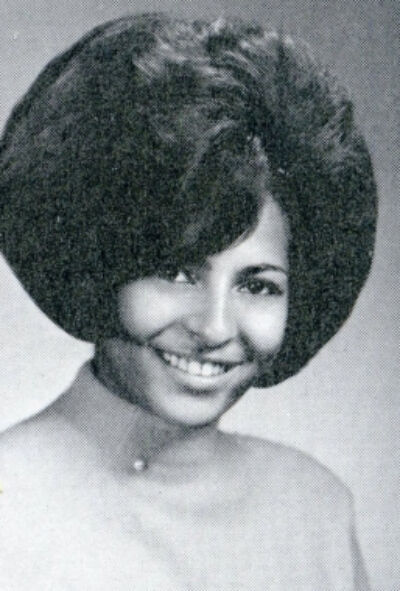
Grier had a perhaps remarkably bucolic time at Denver East High School. “People didn’t have time for racism,” she said. “Racism had already been well-established but, basically, they were letting everyone do pretty much their own thing.” Grier’s mother was a nurse; Pam was studying to be a physician. “The only thing that we were upset about was the Vietnam War, because we felt it was the rich man’s war. It wasn’t the people’s war.
“But as I sat on the floor in my mom’s den in East Denver watching the (1972) Democratic National Convention, what I thought is that we women want our voice heard, because unless we get equal representation and fair pay, we’re not going to make it. We’re going to die. We’re going to have tumors and cancers and exhaustion.”
Grier’s first significant screen appearance was at age 21 in “Beyond the Valley of the Dolls,” a 1970 cult classic written by film critic Roger Ebert. The next year, the pivotal prison film “The Big Doll House” (1971) launched her. The popular action comedy, “Black Mama White Mama” (1973) was seen as a female counterpart to “The Defiant Ones.” Her breakout leading role came in 1973’s “Coffy.” “Foxy Brown,” easily Grier’s most iconic role, solidified her status as a tough action heroine in 1974.
This was the new era of low-budget “blaxploitation” films, which meant that the films featured predominantly Black casts, soundtracks and urban stories tailored to appeal most to Black audiences. The subgenre divided Black Americans for both their empowering representation and harmful stereotyping at once. But it was inarguable that these revolutionary films were offering strong and unprecedented Black protagonists like Foxy Brown who actually were obliterating existing stereotypes by presenting characters in full control of their destinies.
Grier saw larger societal forces at play.
“I could close my eyes and hear the voices of endless women from the heartland, which everyone just flies over,” she said. “Not only did these women work in rural areas, they didn’t have nurses or hospitals or doulas. And once they gave birth, they were back at work in the field trying to sustain their families – especially when so many men did not return from the Vietnam War. That’s when I heard the most pain in the voices of women.
“So I, as a little champion of women, was saying, ‘We’d like to share in the equity. We’d like to be equals – but I didn’t know how to do that.’ And as I got the opportunity to be in films, the conservatives were wanting to make money, while the liberals wanted to send a message.”
But ultimately, the only color that mattered to any of them was green. As in, “Make the green back,” Grier said.
But at that time, while filmgoers did not want to see women wearing a man’s pants, per se, “they did want to see a woman step into a man’s shoes and be capable of protecting herself.”
Enter Foxy Brown, the fearless, stylish CIA operative who avenges her boyfriend’s murder by infiltrating a drug syndicate.
Grier, who learned martial arts growing up on various Air Force bases, knew how to protect herself.
To Grier, the often-overlooked reality of classic films like “Coffy“ was not the pimps who provided the heroin that addicted her character’s sister. It was, in her view, the real-life government forces that allowed criminal underworlds to thrive in urban areas largely populated by Black people in the early 1970s.
“How do you nullify or dismantle or create an impotency in the political areas that are now voting with their rights?” she asked and answered. “By putting cocaine and heroin in leftist societies and making it the cool thing to do. Then you make it against the law so that you can arrest them. Now, they’re felons. Now, they can’t vote, and they lose their passports. That’s how you create a crack in the voting society.
“All of those things in ‘Coffy’ were based on how everyone in East Denver was selling heroin at the time, which is expensive. And you have to ask: ‘How is it getting to Denver? Who’s bringing it in and why?’”
There’s a part of Grier that recognizes she was being used along the way as a tool – both for the film industry and for idealogues. And she’s made peace with that. Coming from a time when wives could not yet have bank accounts or credit cards in their own names until 1974 – and when women could not easily fight back against domestic abuse – Grier saw her films as her way of fighting back.
“It seems like I was a tool in a small way,” she said – a tool for good. “I was able to plant little plant seedlings in my films – not of revenge, but of women’s empowerment.”

Time for re-boot camp
For being 76, Grier has a remarkably full professional plate. There is fresh talk of all things re-boot. “Foxy Brown,” “Coffy” and “Black Mama White Mama.” have all been discussed. “People want to reboot everything I’ve done,” she said. “And I’m like, ‘OK, when do I sleep?’”
There’s also ongoing talk of a “Jackie Brown” stage musical. But most likely to see a second life is an adaptation of her best-selling 2010 memoir, “Foxy: My Life in Three Acts,” which has had a long developmental journey. In 2024, it was finally green-lit for a seven-part streaming series.
“You have to understand that no one was doing biopics in 2010, especially not on the Black West, myself, or stories with military and urban and women’s themes,” she said. But now, “it’s back in play, and it will be,” she added, “as long as I am breathing.”
Breathing, she is – which is its own accomplishment for any septuagenarian.
I asked her what it’s like to essentially become part of the American mythology while still alive.
“I get more shoes,” she said with a laugh, then, more deliberately: “Some say I gave them encouragement. Men who came to my book signings who were victims of incest in their families have told me, ‘Your book helped me tremendously.’ Things that were happening 50 years ago are still happening today. Like 50-year-old men marrying young girls under the age of 12 in some religious sects.
“That said, there is a group of women in India who wear pink saris, and they protect young women from castration and patriarchal abuse. And there are Afghan men who have been building schools for their daughters in secret because it’s against the law for girls to go to school there. And so I see hope.”
But while Grier has not yet left this Earth, she told me – she already has been to heaven.
I asked her what that means, and she said it a second time: “I have been to heaven, John.”
It was a near-death experience. “One of those times when you are sick, and you think you’re not going to live to the next day,” she said.
“When you realize you’ve got a limited amount of time on the planet, then all of a sudden, you have gratitude for everything – the good, bad and ugly,” she said. “I’m still so curious about the world. And when I went to heaven, I said, ‘You know what? I’m coming back. I’m not going anywhere yet, because I would miss all this. I would miss the Alamo Drafthouse naming a cinema after me. I would miss the honors at East High School. I would miss all of these journalists talking to me about what it’s like being a woman of multiculture, fighting oppression, fighting serious attacks and surviving it.’
“So, yes, I’ve been to heaven, but here I am – because I don’t want to miss a second of this.”
John Moore is the Denver Gazette’s Senior Arts Journalist. Email him at [email protected].