







Colorado Boulevard bus rapid transit project invites fierce criticism, support
Critics call it ‘social engineering gone amuck.’ Supporters insist slower traffic would save lives.
A major debate is underway over proposed bus rapid transit changes along Colorado Boulevard, with supporters arguing they would tackle safety, air quality and congestion problems, while critics call it “social engineering” meant to make it so painful that people would abandon cars.
The project — state transportation officials maintain — aims to upgrade the existing RTD Route 40 local bus service to faster, more reliable rapid transit, with buses every five to 15 minutes, while addressing safety problems, congestion and air quality on the corridor between Interstate 70 and Southmoor Station.
One side of the debate insists the plan would make the streets safer and save lives. The other side counters that it would exacerbate traffic woes and further choke commercial activity in downtown Denver, which is already “under duress.”
“The intention is to get people out of cars, and I think it’s social engineering gone amuck,” said Steve Weil, president and chief creative officer of Rockmount Ranch Wear, a downtown institution for more than 80 years.
Elle, a bicyclist and parent who lives near Eighth Avenue and Colorado, said the sidewalks are so narrow or nonexistent in places that she cannot even take her stroller on them.
“I feel a lot of danger even being able to walk my kid or even just cross the street across Colorado Boulevard,” she said. “Slower traffic is honestly something I would really love to see and just being able to have more efficiency in moving our people instead of machines.”
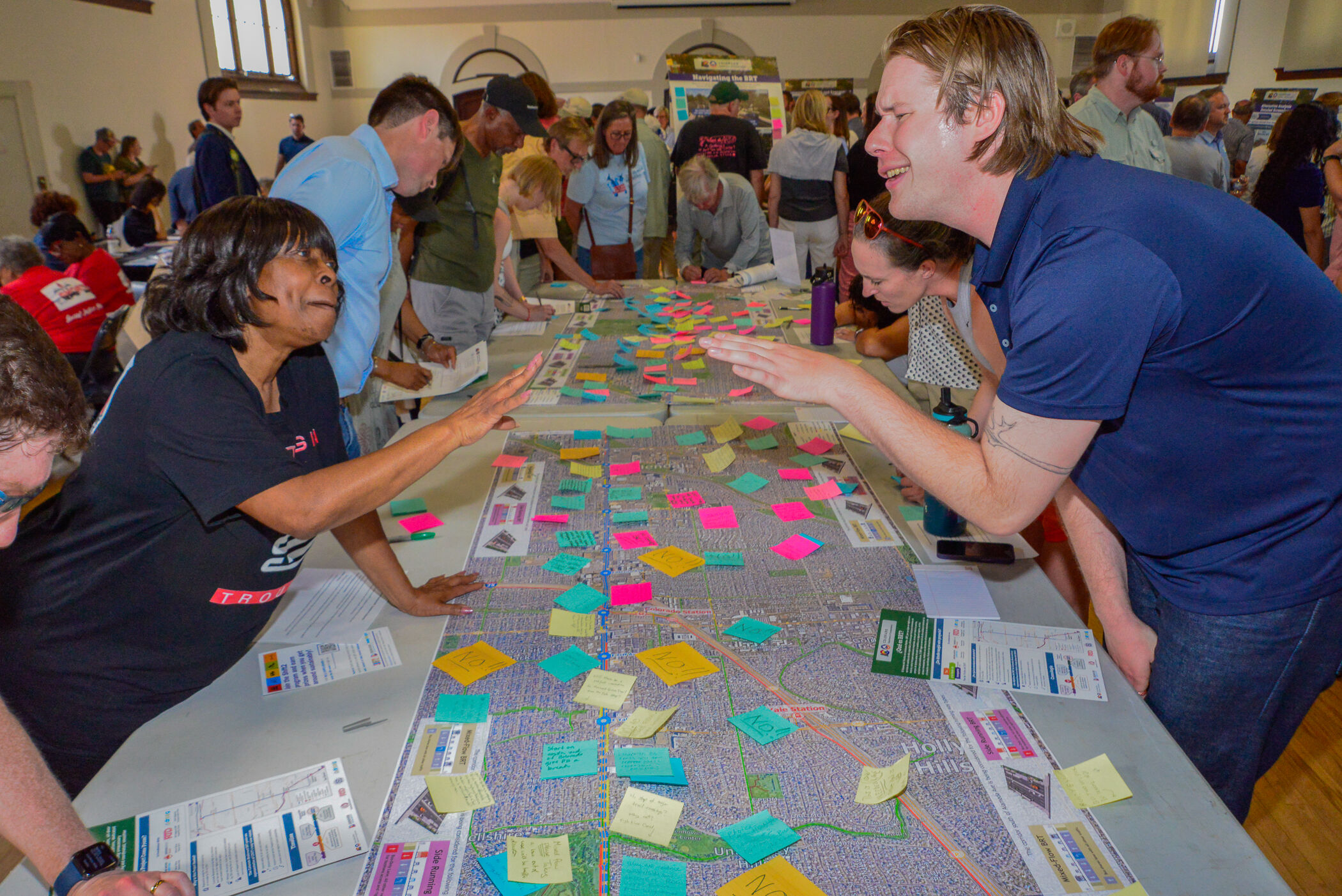
Hundreds of residents, advocates and business owners, along with neighborhood representatives, had packed the Clayton Early Learning Center on May 13 for an open house on the bus rapid transit changes.
The two-hour open house featured displays on four design alternatives, opportunities to speak with project staff and leave comments on large corridor maps at feedback stations. Colorado Department of Transportation officials described the turnout as strong engagement for the alternatives analysis phase of the roughly 6.5-mile project.
Construction is expected to start between 2027 and 2030.
“We feel that bus rapid transit could be a very good solution for Colorado Boulevard because it does help to address a lot of the existing conditions that are problematic, including the safety problem, the congestion problem and the air quality associated with that congestion,” said Ryan Knowles, bus rapid transit program manager for the department’s Region One.
The department intends to maintain automobile and truck capacity through the corridor, which serves as a key connection between Interstates 70 and 25, he said. Planned changes include transit signal priority that benefits all vehicles, signal timing optimizations and completion of missing sidewalks and bike connections, he added.
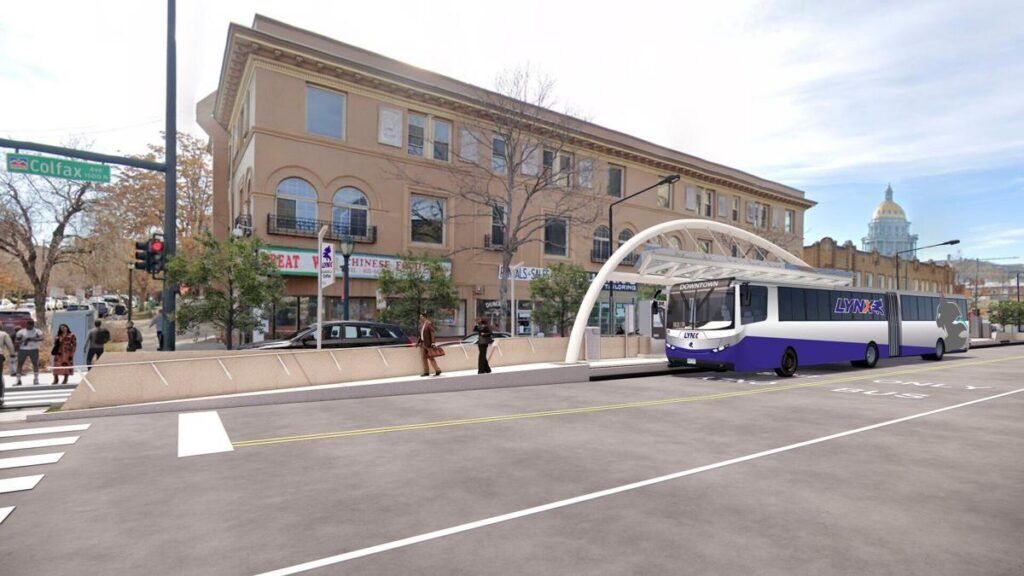
Four alternatives are under review: mixed-flow operations with buses remaining in general-purpose lanes, plus transit signal priority; curbside bus lanes that also function as continuous right-turn lanes for driveways and intersections; center-running and side-running dedicated bus lanes with full repurposing of some general-purpose lanes in portions of the corridor; and no build, which would maintain the existing local bus service with no major infrastructure changes.
‘Viable alternatives to driving’ needed
Public comments at the open house reflected deep divisions.
Some residents worried dedicated lanes would worsen delays for drivers on the busy north-south arterial. Others, notably cyclists, called for more changes.
Drew Tornquist of West Highlands, who does not live directly on the corridor, said he supports the concept despite process concerns.
“I tend to believe that traffic will never be solved until there are viable alternatives to driving,” Tornquist said. “And this is something that I think considers that with the bus and with the bike lanes and with creating a better and safer pedestrian space.”
Tornquist noted the timing of the Colorado Boulevard open house comes as Colfax Avenue BRT construction continues, said it might not be the best timing while people remain upset at the construction delays on Colfax.
Sam, a Congress Park resident and motorcyclist raising a young family, said the corridor already feels dangerous for all users.
“Anything is better than what we have now, but I’d really like to see a full concerted effort of a center-running bus lane,” said Sam, who declined to provide his last name. “I need people to not be dying anymore along this street.”
He argued that decades of prioritizing cars have failed to improve safety and added he worries the changes may not come soon enough for his young child.
Elle, a bicyclist and parent who lives near Eighth Avenue and Colorado, said the sidewalks are so narrow or nonexistent in places that she cannot even take her stroller on them.
She said that separation of pedestrians and vehicles should be paramount because the former are the “most vulnerable road user of all.”
“If they make one wrong move,” she said, “it’s them that gets the most injured and not me.”
While some attendees pushed for more dedicated safety features, the opposition focused on traffic capacity and broader impacts.
The Glendale City Council voted unanimously on May 5 for a resolution formally recommending the “no-build” alternative on the roughly 1-mile segment of Colorado Boulevard through the city.
The resolution says the city supports only the no-build or mixed-flow option after “hundreds of collective hours” of discussion with CDOT, citing worries that other alternatives would cause increased congestion and negative impacts that outweigh projected transit benefits.
‘It will only make traffic worse and that is by design’
Jon Caldara, president of the Independence Institute and former chairman of the Regional Transportation District board in the mid-1990s, offered a more pointed critique in a recent interview.
“Bus rapid transit is a superior form of transit compared to trolleys and rail if they are on an infrastructure that also allows for competition in other vehicles,” Caldara said, citing the US 36 express lanes between Boulder and Denver as a successful example. “What they’re doing on Colorado Boulevard is what they’re doing on Colfax, which is destroying the overall capacity of vehicle traffic on that roadway.”
Caldara called the dedicated-lane approach “cutting traffic capacity in half” and compared it to removing general-purpose lanes for bicycle paths.
“They know it will only make traffic worse and that is by design and they should cop to it,” he said. “They’re trying to achieve making driving in your car so painful that you either move out of town, which is likely to happen, or you start riding transit, which is not likely to happen.”
He also criticized the public input process.
“As far as these meetings go, I say this as the former chairman of the board at RTD,” Caldara said. “These public information meetings are scams under the guise of getting input from the community, but only boosters show up.”
“If left to public input, they would fix the damn roads,” he added. “Ninety-six percent of all commutes happen not on transit. And so what we need to be doing is fixing our roads to make traffic better, not socially engineering people by making traffic worse on purpose.”
Weil of Rockmount Ranch Wear CEO contended that the push comes from “militant extremists,” whom he accused of thinking “they know better for the rest of us how we should be living our lives.” He said the vast majority of people in Colorado like driving — in part “because in many cases we don’t have other options, and that’s being ignored.”
He said he worries about the changes’ impact on downtown’s economic life.
“Most of these routes lead to downtown. Downtown is in a state of extreme duress,” said Weil. “The reduction of car circulation is discouraging many people from outlying areas from coming downtown. There is excess capacity for buses and bikes and a reduced capacity for cars, yet 90% or more of people coming downtown drive.”
“The intention appears to be reduced car traffic and yet we are a car society and this kind of change has not been well received by the majority of the population,” he added. “I think it’s being pushed by a vocal minority that doesn’t understand the reality of Colorado weather and demographics. To expect elderly people or disabled people that cannot ride skateboards or bikes or the bus and inclement weather, in particular, I think is shortsighted. There should be a win-win strategy and instead it’s a win-lose strategy.”
The department is reviewing feedback from the open house and online surveys before selecting a preferred alternative this summer. The Colfax Avenue project remains under construction with segments scheduled to open later this year and full service targeted for 2027-2028.