







Meet the Mr. Rogers of Denver punk rock
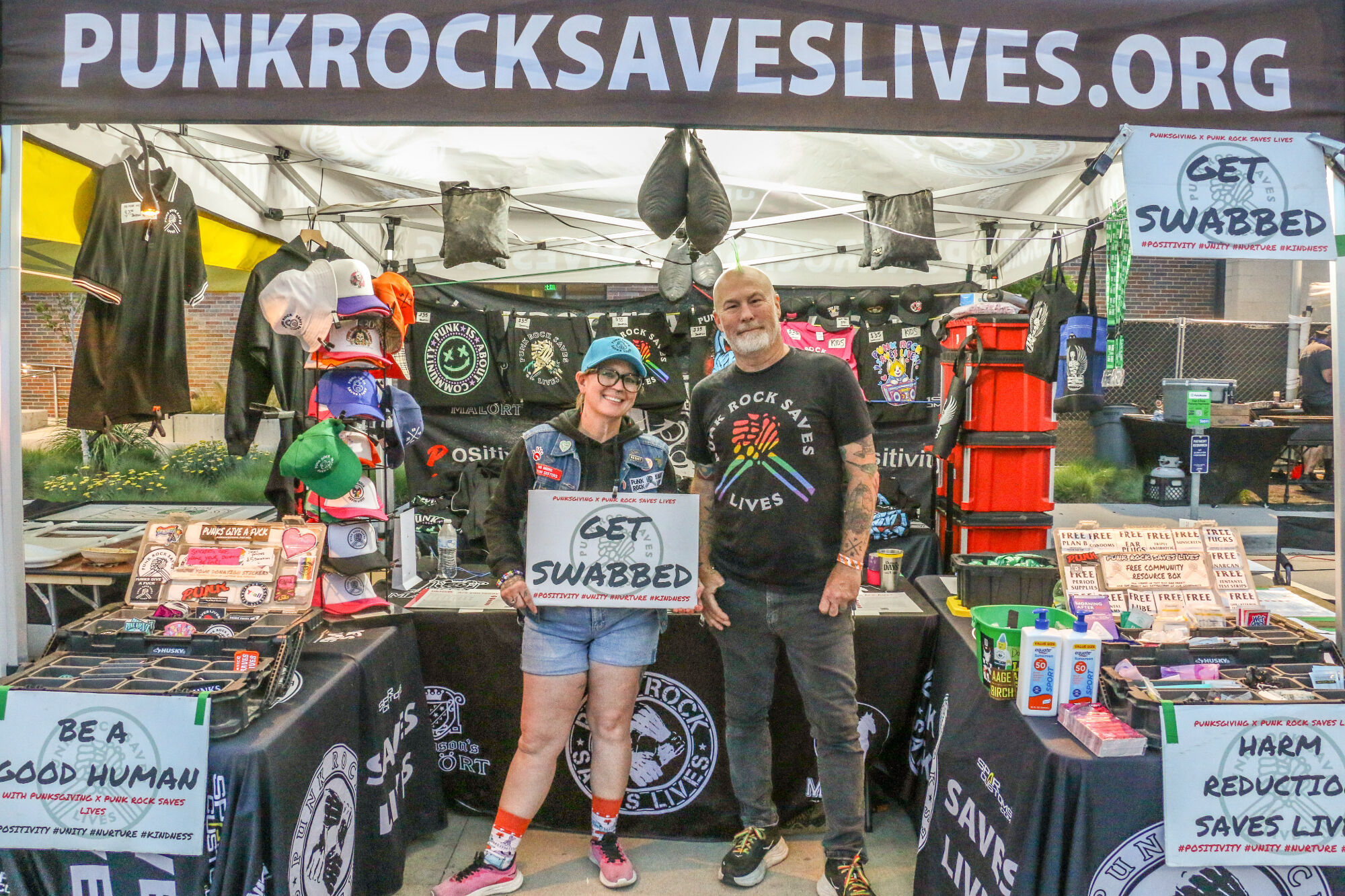
Rob Rushing founded the nonprofit Punk Rock Saves Lives because, he said, “Punks actually give a (bleep)’
Punk rock doesn’t fool me. The safety pins, the mohawks, the spiked leather and the combat boots.
It’s not an act. It’s a statement – and an empathic one, at that. Punk deliberately subverts authority, the social order and mainstream conventions with an aggressive, confrontational sound that celebrates chaos and dearly aspires to shock you.
But … c’mon.
I once wrote that there was enough love at an X reunion concert to give punk rock a bad name. There were more hugs than elbows being thrown in the Ogden Theatre mosh pit that night.
Punk rock is pure, feral love.
Punks (and their ideological ancestors) have played a crucial role in championing every significant rights movement in American history: Labor, women, voting, anti-war, environmental, social justice, LGBTQ. You name it: Punks have been there, fighting the good fight with a sneer and a headbang.
Why? Because, says Denver’s Rob “Rover” Rushing: “Punks actually give a f***.
“People think punks are these abrasive, scary kids, when the truth is, most punks actually care about people and the world around them,” Rushing said. “The mantra of the metal-punk hard-rock mosh pits is that if someone falls down, we pick them back up.”
That’s an allegory. Here’s another one: Punk rock saves lives. For decades, punk has thrown angry, isolated young people a communal lifeline through its aggro beats and radical honesty.
And it literally saves lives.
Rushing is the founder of a Denver-based nonprofit that since 2019 has been called, yes, Punk Rock Saves Lives. It’s essentially Rushing, his wife, Tina Rushing, Denver chapter head Danielle Frost and an army of volunteers in 22 other cities all harnessing the DIY, community-focused spirit of the punk-music scene to provide health interventions and other vital support to anyone who needs it.
Operating directly at concerts and festivals, Punk Rock Saves Lives has added more than 25,000 people to the national bone-marrow registry, one concert swab at a time, since 2019. About 1 in 100 matches with someone who has been diagnosed with a blood cancer, leukemia or lymphoma – which happens once every 3 minutes in America. About 1 in 1,000 eventually provides an actual, life-saving bone-marrow transfusion.
Rushing and his team were again out in force at last week’s three-day, decidedly un-punk Outside Days music festival on the Auraria campus. Those who stopped by the Punk Rock Saves Lives booth found a safe space for anyone who needed one. They found the bone-marrow swabs. They also found safe-sex resources. They found the emergency nasal spray that rapidly reverses an opioid overdose. They found test strips that can prevent accidental overdoses of fentanyl. They found mental-health and suicide-prevention resources. They found earplugs and a quiet space for anyone feeling overstimulated or overwhelmed by the volume of the music or the size of the crowd.
They found the non-profit’s mantra in action:
“Punk Rock Saves Lives isn’t just about physical safety,” Rushing said. “We use the power of community, music and compassion to fight stigma and remind people: You are not alone. You are seen. You are part of this family.”
No wonder they call this guy the Mr. Rogers of punk.
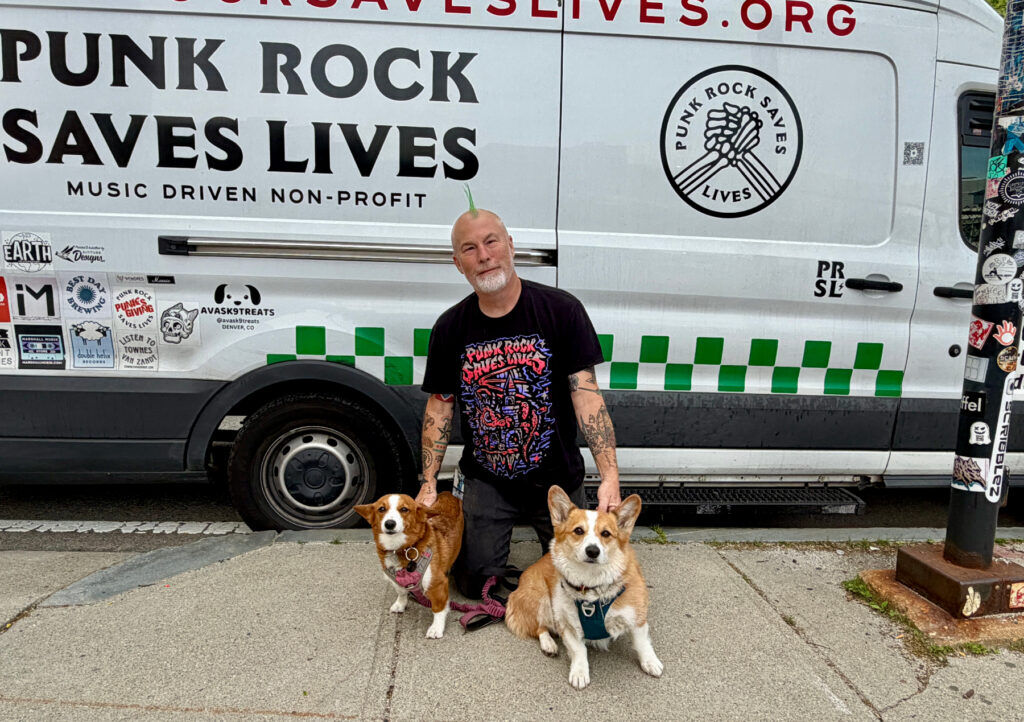
A punk named Rover
Rob Rushing was not always a punk kid. First, he was a choir kid. His pals called him Rover for the position he played on his youth soccer team. But he’s always been a bit of a rover – born in Tennessee, then Atlanta, then Savannah by age 11 or 12.
“Back then, MTV was everything that you could imagine being cool and new,” Rushing said. That meant Duran Duran. The Cars. “The Clash was mixed in there,” he said.
At 14, the choir director’s daughter came back from her first semester at Georgia Tech and presented Rushing with the album that would change his life – twice: “Declaration,” by a Welsh punk band called The Alarm.
“All of a sudden, I had a new favorite band,” Rushing said. “In England, they were called ‘The Clash Junior,’ but their songs were anthemic.”
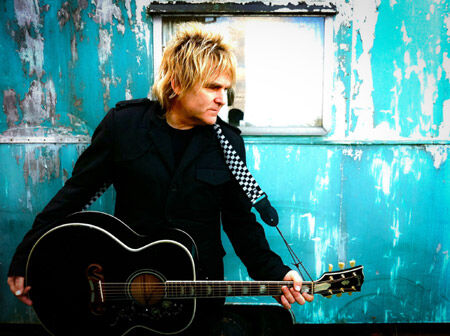
The Alarm’s iconic frontman was Mike Peters, who would be diagnosed with non-Hodgkin’s lymphoma in 1995. It was the start of an extraordinary 30-year cancer journey that ended only a year ago with his death at age 66. Peters transformed his diagnosis into a lifelong mission of hope and global cancer advocacy.
You might see where this is going.
Rushing’s music career began at age 16 working at a Turtle’s record store where Def Leppard was played constantly. But that’s where he also happily discovered a Reno punk band called 7 Seconds.
“The ideas that (frontman) Kevin Marvelli put into punk about equality and non-sexism and standing up for what you believe in and just being a better human mixed well with the ideals that Mike Peters from The Alarm espoused,” he said.
Rushing was off to college at Georgia Southern, where he was picked to be a freshman DJ at the “progressive alternative” college radio station at a time when bands like R.E.M. were forging a new way forward. Rushing and his buddies formed a band called Exit 26, named for the I-16 egress from Savannah to Statesboro.
“There are probably a hundred Exit 26s on highways around the country – and there are probably a hundred bands called Exit 26,” Rushing said with a laugh.
He thought about physical therapy. He studied public relations. But the Rushing of that time was the Peter Pan of Punk (his words). He was singing in a band called Jigsaw when Kurt Cobain and Nirvana blew up – and blew up the model. Grunge was now in.
“Everybody was trying to get signed, even though punk rock was about not trying to get signed,” he said. “Signing was considered selling out.”
Many punk bands of that era have stuck it out – Bad Religion, 7 Seconds, Less than Jake and Bowling For Soup among them. Just not Mile 26. Or Jigsaw.
By 23, Rushing was managing a Sam Goody’s in Nashville, where he was essentially living out the film “Empire Records.” He became a roadie, then a band manager, then a tour organizer.
“I got mixed up with a lot of great bands of that era,” Rushing said, specifically asking me to please mention Nashville’s Staring at the Sun and “probably the best-named band in the history of the world,” a 1994 indie-noise rock band called Lovebucket & Slaphappy Superfly.
Then there was “a 10-year pivot” (divot?) into the world of golf when Rushing ran a small country club in Northern Tennessee. (Yes, he was a professional.) But his true calling came in 2009, when a close friend named Chris Bristow died of an apparent enlarged heart at age 32.
“We’re not supposed to die at 32, and his death was incredibly preventable,” said Rushing, who was left empty. “I felt like I wasn’t doing good or bad in the world. I was just kind of living…”
Two weeks later – a full-circle moment.
“I’m at the golf course. It’s kind of rainy and snowy outside. Nobody’s really there,” Rushing said. “I’ve got the big screen on in the clubhouse, and a documentary starts about Mike Peters from The Alarm climbing Mount Everest to help people with cancer.”
Peters had been joined on his ascent by Slim Jim Phantom of the Stray Cats, Cy Curnin of the Fixx, Glenn Tilbrook of Squeeze and others for what some say was the highest concert on Earth (19,000 feet). It was all arranged by Peters’ nonprofit, the Love Hope Strength Foundation.
“Mike lived with chronic leukemia for 31 years, and he never, ever gave up,” Rushing said. “His entire life was fighting the good fight. And as I’m watching this documentary, my head’s just swimming. I’m like: ‘Why am I not involved in this?’”
Now, get this: At the end of the documentary, there was the obligatory phone number for anyone wanting more information. “And so I called that number – and it was in Colorado,” said Rushing. Which is wild, because Peters’ charity was founded in Prestatyn, North Wales. Turns out, Peters’ co-founder is Colorado artist Shannon Foley Henn, a full-time painter and art gallery owner in Winter Park.
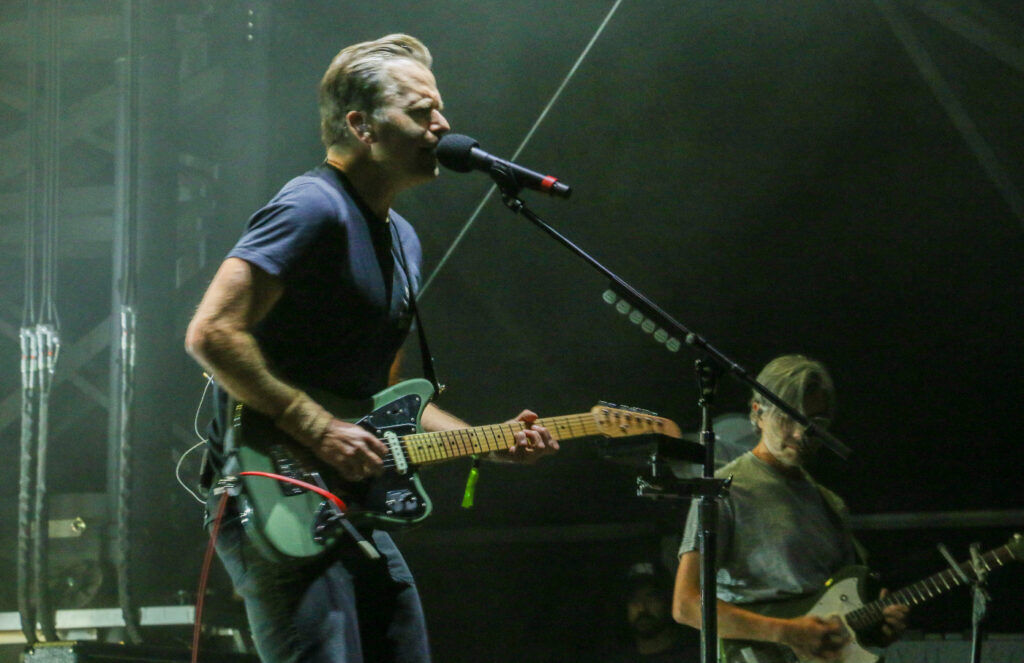
For the next two years, Rushing worked at the golf course by day and replicated the mission of Love Hope Strength by night, collecting cancer-testing swabs at concerts and festivals around Nashville. After Rushing and his volunteers took in 400 swabs at the nearby Bonnaroo Music Festival in 2010, he was asked flat-out: “Have you ever thought about coming to Colorado and doing this for a living?”
His answer: Why, yes.
“I felt that was going to be my calling, and so, I went,” Rushing said – before he even sold his house in Nashville.
His eight years working as an employee of Love Hope Strength were magical for Rushing, who became a staple at Red Rocks, where he swabbed at about 600 shows. “I don’t think that’s an exaggeration; we were there so much,” he said. He also started touring with bands. He’s on the road right now with Anberlin. His wife is doing the same with New Found Glory and Yellowcard.
They met at an event Rushing was swabbing in 2017. “We started dating, and we got married at that same event the following year,” he said.
But by 2018, Love Hope Strength downsized its American outreach programs. Rushing and his wife were the last to be laid off.
“You can bet I was mad,” said Rushing. “I wasn’t mad at the people. I was just mad that they were stopping, because I still fully believed in the mission of saving lives.”
Tina’s response: “We’re not ready to give up.”
And they didn’t. They started Punk Rock Saves Lives.
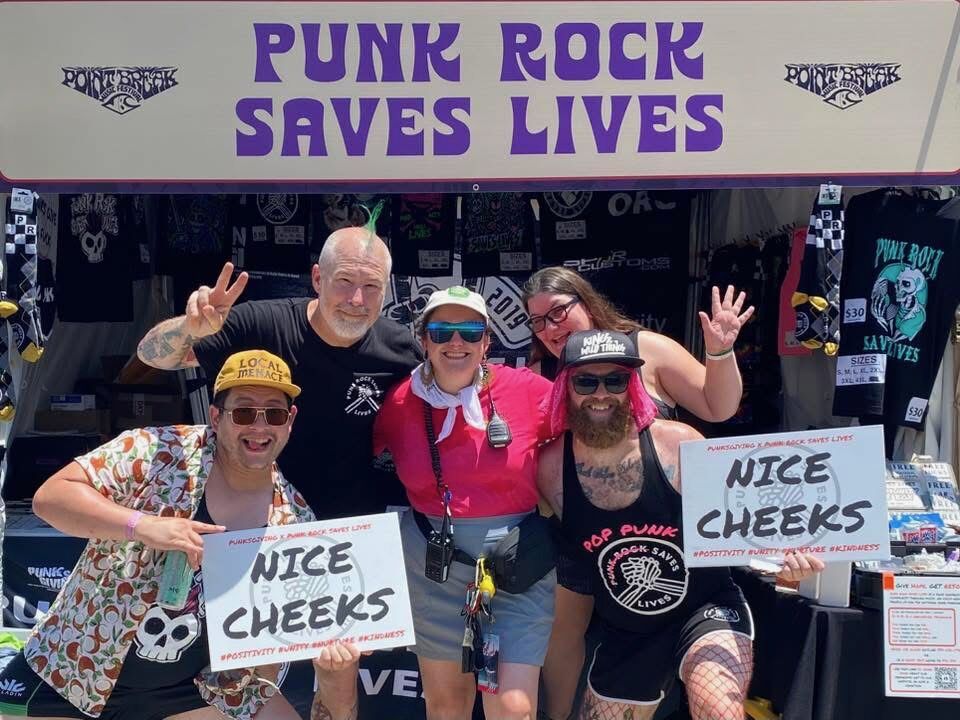
Starting over
Rushing lists the names of a dozen influential punk icons who encouraged him to start his own nonprofit, and backed it up with donations and auction items. Among them were Nathen Maxwell and other members of the Celtic punk band Flogging Molly.
In fact, Punk Rock Saves Lives was born Nov. 1, 2019, aboard Flogging Molly’s Salty Dog Cruise – that’s an occasional floating music festival that sailed that year from New Orleans to the Bahamas and back.
“We set the tone right off the bat that we weren’t just about cancer anymore,” Rushing said. “We were going to also try to be there for harm reduction and mental health – and all of that is still building.”
The COVID shutdown, of course, meant starting over for a second time in 2021. Donations predictably slowed down. Husband and wife took real-world jobs to get by. Weekly group Zoom calls with influential punk musician friends made plain the financial and social damage all that isolation was doing to people’s mental health. That only steeled Rushing’s resolve to get back to work quickly.
Lollapalooza 2022 in Chicago was the first festival to invite back Punk Rock Saves Lives. The Rushings jumped at the chance, “and basically this is what I’ve done ever since,” said Rob.
The first regional chapter of Punk Rock Saves Lives was started by a volunteer in Milwaukee. Today, the organization has a presence in 23 cities and owns three vehicles parked around the country according to great geographic strategery to cut down on travel expenses.
The RV’s engine has blown four times now. But on this day, Rushing is driving from Denver to Worcester, Mass., in a Ford transit van with two corgis named Walter and Thelma. They were en route to join up with Anberlin’s 20th anniversary “Never Take Friendship Personally” tour on Saturday. Rushing packed all the supplies he’ll need for the upcoming Van’s Warped Tour and Point Break Festival as well.
It’s not a glamorous life. Though Rushing has called Colorado home for 16 years, he figures he sleeps only about 60 nights a year in Denver. The rest are on the road – and not in hotels.
“People think what we do touring with bands and festivals is incredibly glamorous,” he said, “but that’s just not the case. Our only goal is to get to the venue in time, set up our table, do good by people by offering the services we offer, leave, find a rest stop to pull over and sleep in, and then get on to the next venue.”
Rob and Tina are the only paid employees – although “volunteers are in the thousands.” That they’re making a difference in 23 towns, he said, “is incredible. It’s a testament to the ideals that we wanted this effort to stand by – positivity, unity, nurture and kindness.”
It costs about $300,000 a year to pull off, including travel, materials and vehicle repairs. Although separated from Love Hope Strength, Peters’ parent charity kicks in about $25,000 a year as a show of continued mission solidarity.
When Peters died in April 2025, Rushing said, “I lost someone I considered my best friend, my mentor and my hero in one shot.” Not to mention: “My favorite singer since I was 14.” Rushing and Tina were invited to attend the funeral in Wales, but it came right in the middle of a tour of the American northwest.
“Mike being the crazy, awesome workaholic that he was,” Rushing theorized, “I told the Alarm people that if I had taken time away from swabbing people, then Mike would reach down from the clouds and punch me in the face.” Not one Alarmist disagreed. “Everybody was like, ‘No, Rob, you’re doing the right thing.’”
Still, this is hard work. Rushing is now 56. So, I asked: Why do you do it?
“I have always had a feeling that I was supposed to be the person in the middle, the mediator, the helper,” he said. “I grew up on Mr. Rogers. I grew up on ‘Sesame Street.’ I grew up being taught that helping people is the right way to do things. Somehow, we’ve taken a turn in the world where that’s now somehow a weakness. But I don’t believe that in any way, shape or form. I only dig in deeper every day and try to be a better human. And, hopefully, I can drag a few people along with me.”
Remember that mantra about punks helping someone who falls get back up?
“That’s literally the rule of the pit,” said Rushing. “And that should be a rule of life.”
John Moore is the Denver Gazette’s Senior Arts Journalist. Email him at [email protected].
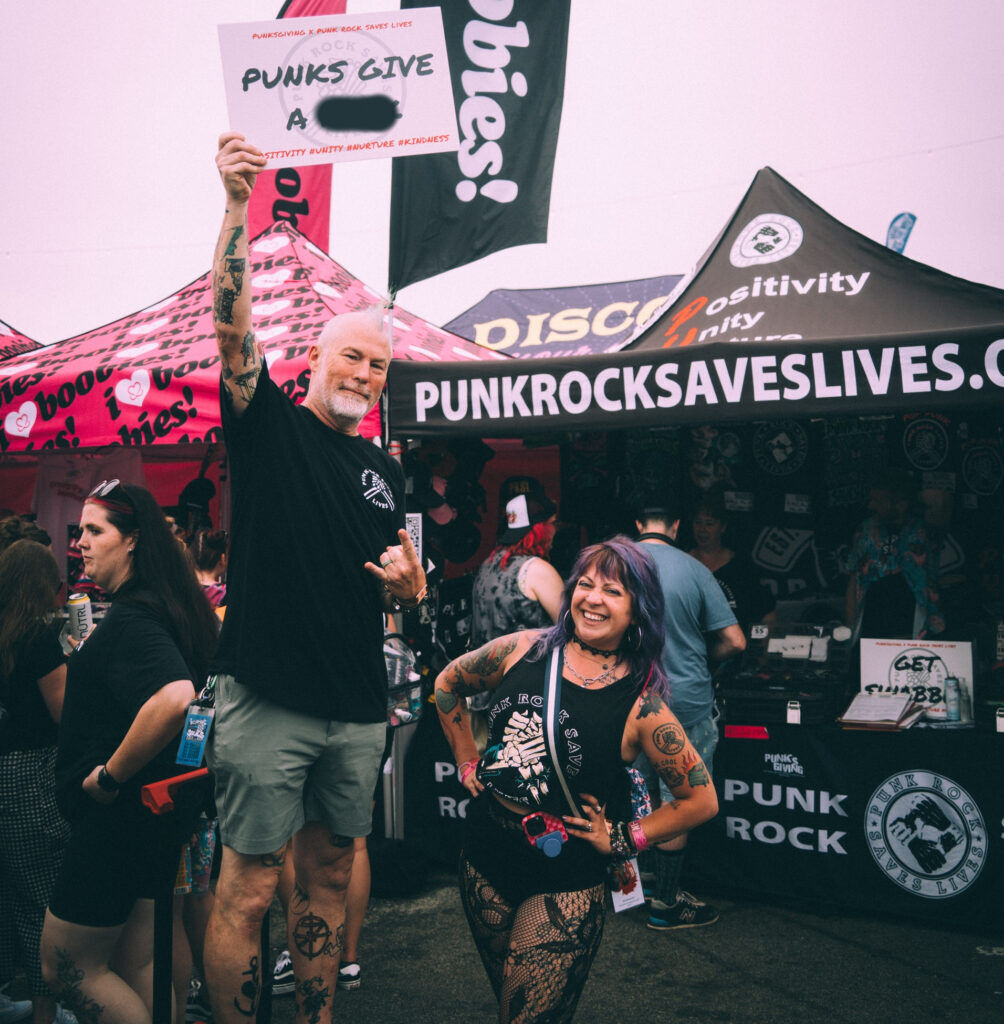

Punk Rock Saves Lives
- Website: punkrocksaveslives.org
- To get swabbed: Have a kit mailed to you at dkms.org
- To volunteer: cervistech.com
- Coming up in Denver: The third Punk Rock Saves Lives Music Festival, July 10-12, at Ratio Beerworks, 2920 Larimer St. Twenty bands; lineup to be announced next week. Tickets $50 at eventbrite.com
- To donate: givebutter.com/punkrocksaveslives