







Colorado’s Domenico a principled jurist for 10th Circuit | Jimmy Sengenberger

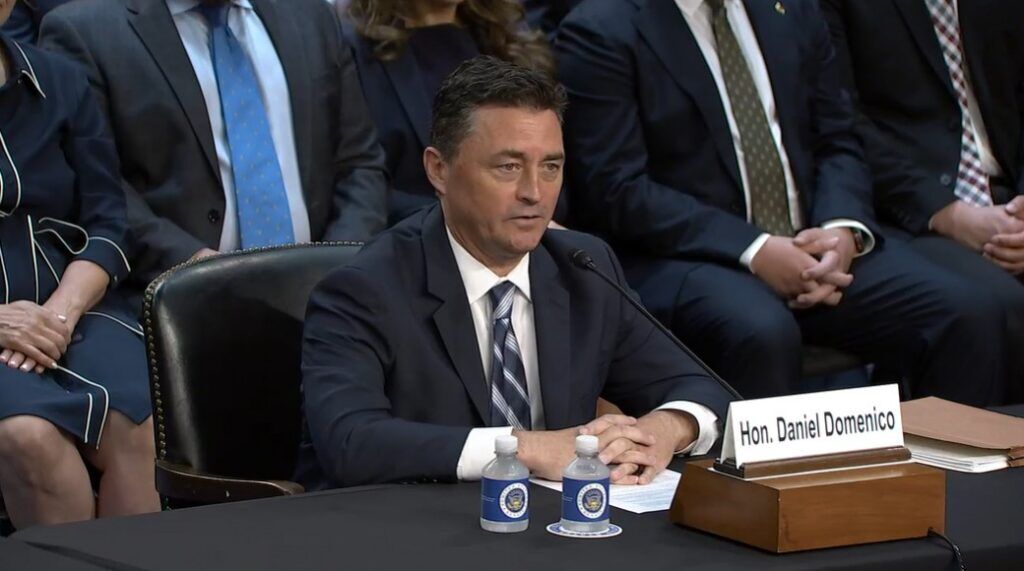
On Wednesday morning, U.S. District Court Chief Judge Daniel Domenico showed precisely why President Trump’s decision to nominate him for the 10th Circuit Court of Appeals is a wise move.
“The way he handled himself in that hearing room was as good as I’ve seen,” said Professor Carl Tobias of the University of Richmond School of Law, a national expert on judicial nominations. “He strikes me as being very restrained, thoughtful and not rushing to judgment.”
Throughout the hearing, Domenico demonstrated the judicial temperament and deliberative approach characteristic of his tenure on the bench since 2019.
If confirmed, he would replace Chief Judge Tim Tymkovich, for whom he once clerked before succeeding him on Colorado’s federal district court. Earlier, he served nine years as Colorado’s solicitor general, defending the state’s positions under administrations of both parties: Governors Bill Owens, Bill Ritter and John Hickenlooper.
The hearing lasted only 45 minutes, with questions from just two Democrats and three Republicans because, as Tobias put it, Domenico “turned out not to be terribly controversial.”
No Democrat offered vigorous opposition, either. Even home-state Sen. Michael Bennet only entered a written statement into the record. As of deadline, a request to Bennet’s office for his statement went unanswered.
Domenico fielded inside baseball questions from Republican Sen. Mike Lee on the Supreme Court’s major questions and nondelegation doctrines. He deftly handled Sen. John Kennedy’s hypotheticals on internet regulations, suggesting if a statute doesn’t reach the conduct, that might be “a reason for (Congress) to consider amending” it rather than the judiciary stepping in.
He drew political questions from Democratic Sens. Dick Durbin and Richard Blumenthal — staying unflappable, reasoned and apolitical in the face of pointed interrogation.
Blumenthal repeatedly pressed Domenico about January 6 and the 2020 election, which he’s asked of every Trump judicial nominee. Domenico invoked Justice Ketanji Brown Jackson’s refusal to answer similar political questions during her confirmation for the U.S. Supreme Court. He denounced violent actions of individuals on January 6, particularly against police officers, while explaining that any “broader characterization” is “a matter of public debate,” not something for a judge who might hear related cases to discuss.
Tobias called the answers “more straightforward than a lot of others” who toed “the party line.”
When Kennedy revisited the issue, Domenico put it to bed, calling January 6 “a dark day… violence and vandalism that I think every American would condemn.”
The hearing, though, wasn’t really about politics. It was about temperament.
“That’s the beauty of Domenico,” Tobias said. “You can’t tell exactly what his politics might be. I know he’s somewhat conservative, but I don’t think he is a fire-breather.”
That especially showed when pressed on his record. Discussing the Fifth Amendment to the Constitution, Durbin asked whether Domenico believes the word “person” applies only to citizens, leading Domenico to point out that there is still an open question on the issue.
“But it doesn’t say citizens,” Durbin pressed. “Do you concede that point?”
“I do,” Domenico said plainly. The senator moved on.
That’s the mark of a jurist willing to give ground rather than evade questions. Additional proof came when Durbin assailed Domenico over his recent immigration rulings, pointing to nearly 14,000 district court rulings against the administration’s detention policies.
“You, however, are an outlier,” Durbin said, a fact he noted Domenico himself has acknowledged.
As I’ve written previously, Domenico is the only judge in Colorado’s federal district court to uphold the Trump administration’s interpretation of its authority to detain illegal immigrants during removal proceedings.
But being an “outlier” isn’t a bad thing, especially when you own it. What matters is how he reached his conclusion. Domenico gave Durbin the same answer he’d laid out in written opinions. There’s a “clear division of opinion” over the statutory question, he said, explaining how he’d “in fact ruled against the federal government’s position and granted petitions a number of times.”
“The fact that district courts have reached inconsistent outcomes in these cases is unfortunate,” Domenico wrote in one decision favoring the administration — but a judge is “duty-bound” to follow his “best understanding of the law.”
That “best understanding” aligned with the Fifth and Eighth Circuit Courts of Appeals, making Domenico an outlier among district judges but squarely within federal appellate courts.
That same instinct showed up early last year when Denver Public Schools asked Domenico for a nationwide injunction against the Trump administration’s immigration enforcement near schools — effectively rewriting federal enforcement for the entire country.
He declined both on factual grounds — DPS couldn’t show how the Trump policy substantively differed from Biden-era guidelines it cited — and on legal grounds.
“I know everybody’s switched sides on nationwide injunctions in the last few weeks, but I’m trying to be consistent,” Domenico said. He’d been skeptical of nationwide injunctions when conservatives wanted them and when progressives did.
Two months later, the U.S. Supreme Court vindicated his reasoning when it invalidated all “universal” injunctions.
Another outlier decision — until the highest court in the land joined him.
“He’s ahead of the game,” Tobias observed.
Tobias is right. The Senate should confirm Judge Domenico without delay, giving the 10th Circuit a principled jurist who reasons from the law, not the politics around it.
Jimmy Sengenberger is an investigative journalist, public speaker and longtime local talk-radio host. Reach Jimmy online at Jimmysengenberger.com or on X (formerly Twitter) @SengCenter.