







Fast-moving ‘burnover’ killed 14 firefighters in South Canyon blaze in 1994
The deadly wildland blaze that killed three firefighters and injured two others on Saturday served as a grim reminder that wildfires can change direction and speed with little or no warning, leaving crew members no time to reach an escape route and forcing them to deploy their fire shelters.
It is not immediately clear if this hazardous event, known as a “burnover,” was what caused the death of three firefighters who were responding to the Knowles fire near the Colorado-Utah state line on Saturday. An official investigation is underway.
One of the deadliest burnover events on record occurred July 6, 1994, when 14 wildland firefighters died on Storm King Mountain while fighting the South Canyon fire near Glenwood Springs.
Crews from the Forest Service and the Bureau of Land Management were fighting a blaze ignited by lightning near South Canyon Creek when the extreme winds whipped up the fire, trapping the 14 crew members among steep slopes and dense vegetation.
A post-fire analysis by the Wildland Fire Lessons Learned Center, an interagency organization that studies fatal wildfires, suggested that the blaze moved so quickly that most crew members weren’t able to deploy their fire shelters.
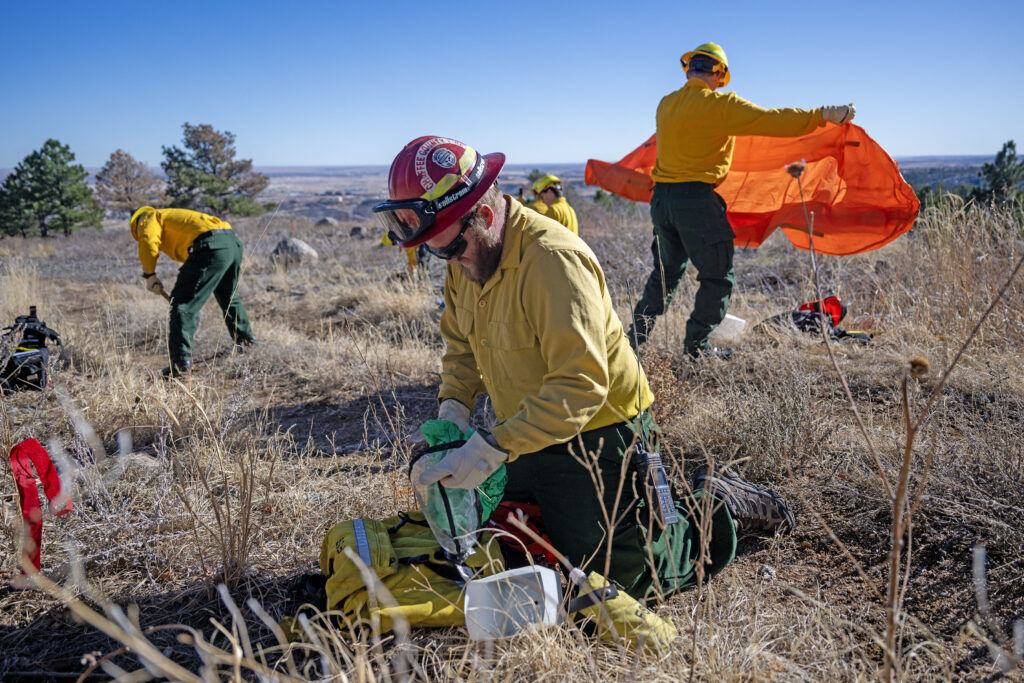
A fire shelter is essentially a tent made of fiberglass and aluminum foil, designed to reflect heat and provide a certain amount of breathable air. It’s the firefighter’s last-ditch survival mechanism, deployed when a fire is advancing too quickly and there’s nowhere to run.
Most shelters were found unopened near the victims, officials said. Other firefighters managed to get their shelters out but were knocked to the ground by a rush of superheated air before they could fully deploy.
Investigators determined that since most of the firefighters never got their shelters out of their packs, the South Canyon blaze “came on extremely fast and with little warning.”
In another deadly wildland fire, 19 members of an elite Arizona firefighting crew died in 2013 after flames trapped them in a brush-choked canyon.
When the Yarnell Hill Fire fire started, dry lightning had struck a patch of vegetation in steep, mountainous terrain and ignited the fire high on a ridge west of Yarnell, which hadn’t experienced a wildfire in more than 45 years. Two days later, the Hotshots were battling the wildfire in a box canyon when the winds suddenly shifted and the flames rapidly raced toward them. The 19 men tried to deploy emergency shelters: tentlike structures meant to shield firefighters from the flames and heat.
The gusty, hot winds caused the fire to intensify to more than 2,000 degrees Fahrenheit and cut off the firefighters’ escape route, killing the men, authorities said.
According to the Lessons Learned Center, a common thread connects many wildland fatalities: Firefighters trying to escape uphill while weighed down with their tools.
“Most of these firefighters would have lived had they run with only their shelters,” the after-action report stated. “You are 15%-20% faster without tools and packs.”
It is not yet known if the three firefighters killed on Saturday were able to open their shelters.
The Colorado Wildland Fire and Incident Management Academy, which held classroom and field courses at the University of Colorado Colorado Springs in January, placed special emphasis on rapidly deploying fire shelters, drilling prospective firefighters in the efficient use of a piece of equipment they hope they never have to use.
“You don’t ever want to need (a fire shelter),” instructor Tanner Webb told The Gazette. “But if you do, you have to know how to deploy it quickly and proficiently.”
The Associated Press contributed to this article.