







Aspen Acres fire crews make headway; blaze is 13% contained
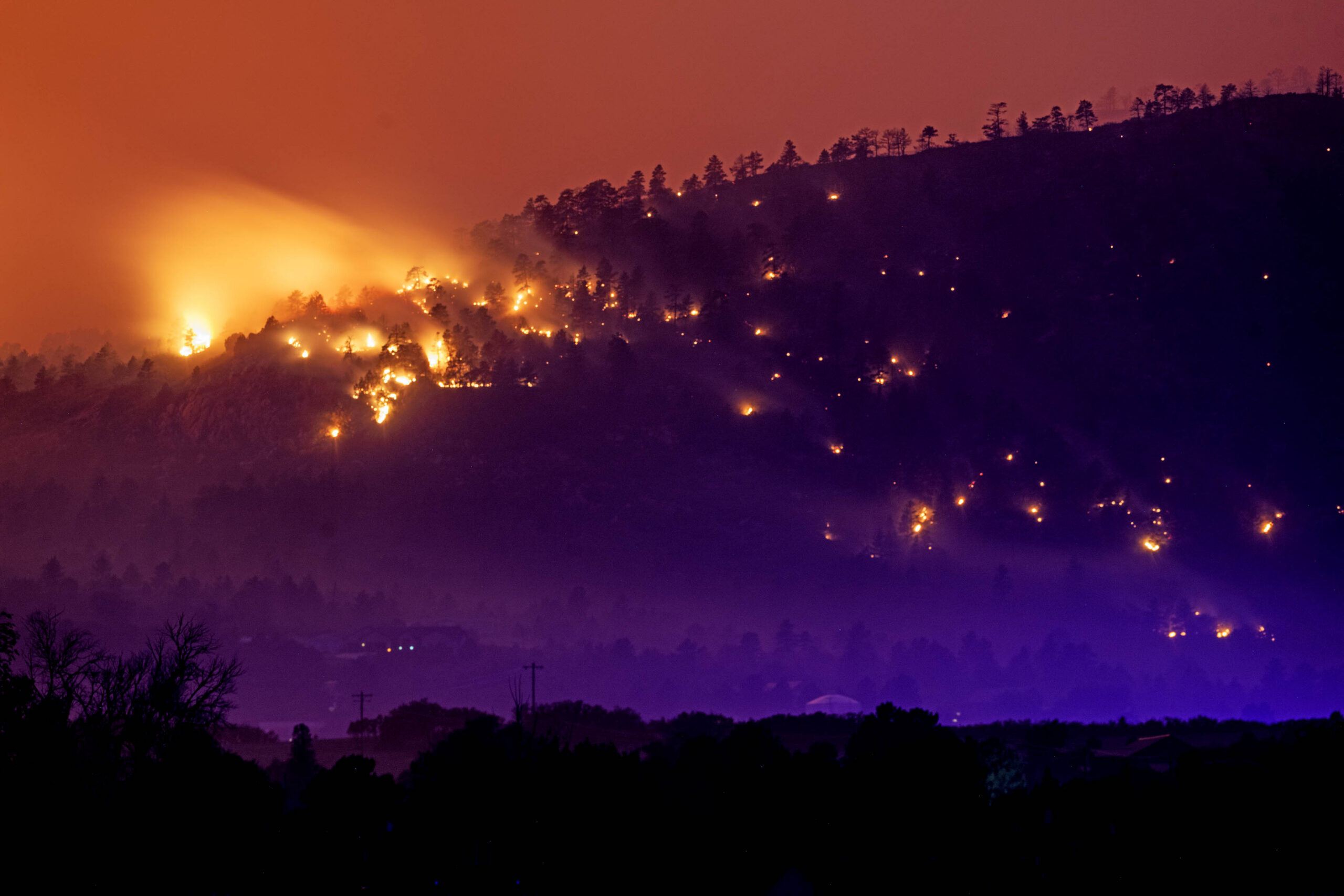
Crews have made additional headway in containing the Aspen Acres fire in Custer and Pueblo counties, according to incident officials.
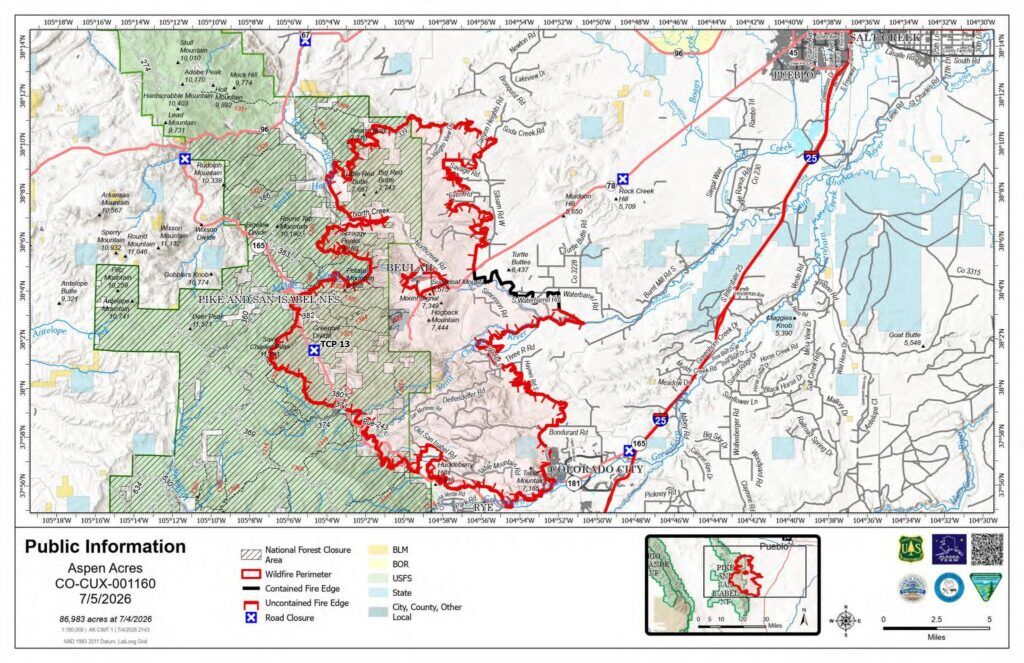
The widland blaze, first reported on June 29, has grown into one of the largest and most destructive fires in Colorado history, with at least 86,893 acres burned and roughly 200 structures destroyed. But officials announced on Sunday that containment has increased to 13%.
Incident spokesman Al Nash said pilots were unable to conduct a mapping flight on Saturday evening.
“However, we know the fire was nowhere near as active as it had been in recent evenings,” Nash said.
Saturday’s mild weather curbed fire behavior somewhat, allowing crews to perform more direct work on the fire’s perimeter, according to an update from Alaska Complex Incident Management Team 1, which has taken the lead in fighting the blaze. Firefighters were able to mop up around structures in areas where the fire had already passed through, and knocked down a flareup on Siloam Road.
The 13% containment is south of Turtle Buttes, on the north and south sides of the St. Charles River, officials said.
“Yesterday and last night, the weather was certainly better for us,” Nash said. “We got a small reprieve of slightly cooler temperature, slightly higher relative humidity and slightly lower winds. All these things gave firefighters a chance to make some noticeable progress.”
Gov. Jared Polis, who visited the incident site on Friday, declared a state of emergency and authorized the Colorado National Guard to mobilize more than 80 personnel to support the firefighting effort.
“Our dedicated Soldiers and Airman are prepared to support our state and our neighbors to help save lives, reduce suffering, and mitigate property damage whenever and wherever,” stated Army Maj. Gen. Bob Davis, adjutant general for Colorado.
All told, about 800 personnel from multiple agencies are battling the blaze, providing enough crew members to allow the firefighters to work in shifts.
“Some of the firefighting efforts in the western part of the state have had a measure of success and have been able to release some firefighters and equipment to assist us,” Nash said.
Still, crews on the ground are working long, difficult shifts, doing hot, physical work for as many as 16 hours at a time, Nash said.
“They’re still long, hard days,” he said. “But we’re in a position where firefighters are able to break off the fire line, get a hot meal and have a little chance to sleep.”
Sunday’s weather is expected to be similarly mild, but there’s a possibility of increased thunderstorms, which bring their own set of potential problems, according to Nash.
“Our incident meteorologist is not expecting significant rainfall, but we could see some dry lightning, which could start some new fires,” he said. “The other challenge is outflow winds. A thunderstorm can cause strong, erratic winds well away from the storm itself, and that could affect our efforts.”
The incident management team has set up the equivalent of a small support city at the Colorado State University-Pueblo campus, including caterers to provide hot meals and sack lunches, on-site fueling stations for fire engines, and a shower trailers for crew members who want to wash off after a long shift.
“One of the reasons a team like ours gets brought in is to be able to support an increasing number of firefighters and equipment,” Nash said. “It’s quite an endeavor to support an effort of this size.”
Among other area support efforts, the Pueblo-based laundromat Lady Fair Laundry is offering free use of their machines at its 515 N. Erie Ave. location. The free laundry day is from 7 a.m.-7 p.m. Monday and is strictly for evacuees, not Pueblo residents, according to the United Way of Southern Colorado. Evacuees must show proof of evacuation status to use the laundry.
As of Sunday, the eighth-largest blaze in Colorado history was less than 400 acres from becoming the seventh largest. (The 2012 High Park fire burned 87,284 acres, according to the Colorado Department of Fire Prevention and Control.) While 13% containment is cause for optimism, Nash cautions that it could be weeks before crews get the blaze fully under control.
“It’s heartening for us to be able to report some containment and we would expect that number to increase, if not daily, over the course of the next few days,” he said. “But we still have a lot of work ahead. There is going to have to be a significant fire presence in this area for quite some time.”