







Designs for Front Range Passenger Rail trains released
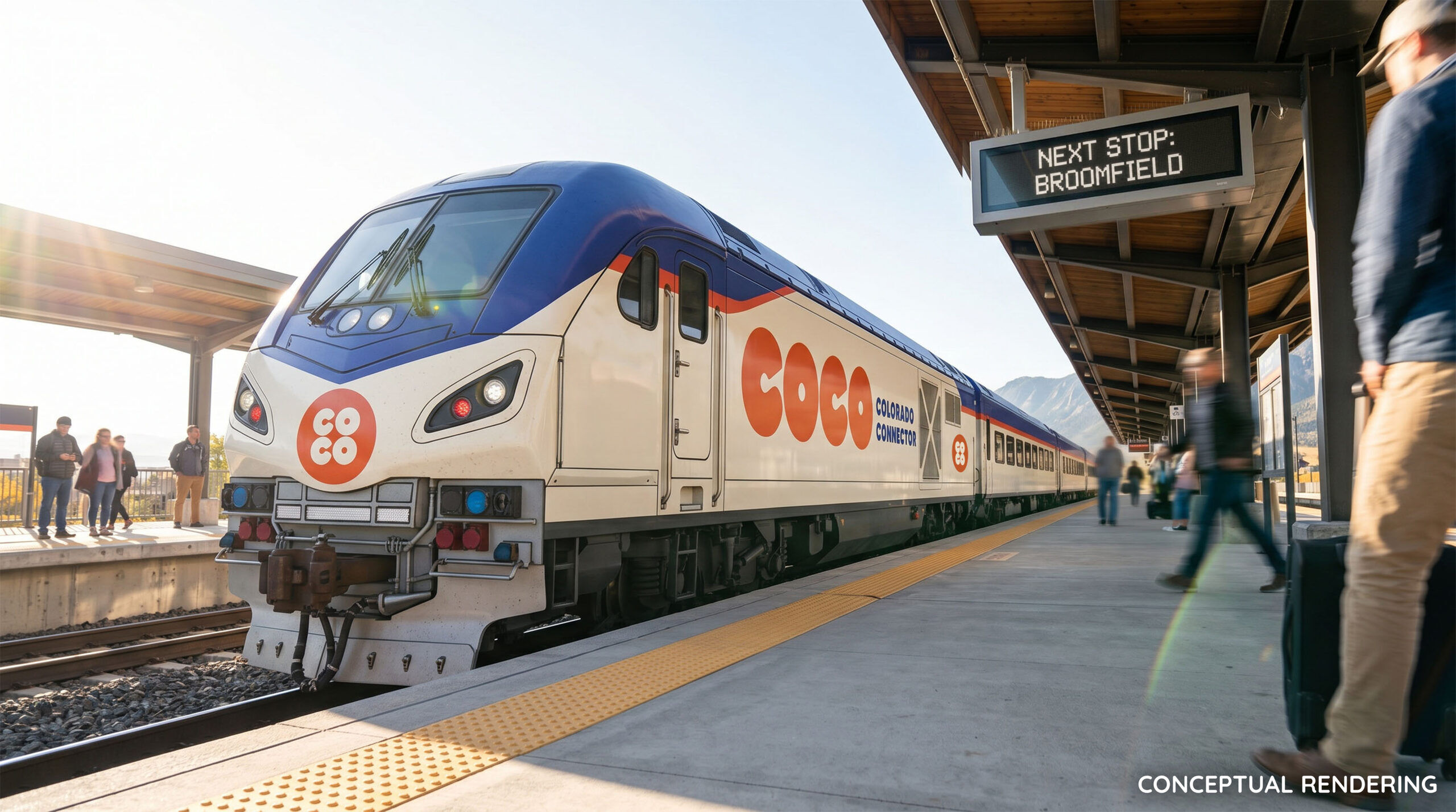
The Front Range Passenger Rail District on Sunday unveiled the new brand identity and personality for its planned Colorado Connector intercity train service, known as CoCo.
The district said the branding is intended to be welcoming, optimistic and distinctly Colorado while presenting a trustworthy and approachable identity for the service, according to a news release. The new brand includes a red fox mascot wearing a Colorado-flag bandanna.
According to district officials, the fox was chosen because it is native to Colorado and is known for agility, intelligence and the ability to navigate diverse landscapes.
Gov. Jared Polis said in an earlier announcement tied to the naming, “The Colorado Connector reflects exactly what this train is about: bringing communities together and creating a faster, cleaner and more convenient way to travel across our state.”
Nearly 26,000 Coloradans participated in selecting the Colorado Connector name earlier this year.
CoCo is designed as an express passenger train linking communities along the I-25 corridor from Fort Collins to Pueblo, using mostly existing freight rail lines. Burlington Northern Santa Fe Railway owns the lines for the initial north segment and will be paid for use under a term sheet agreement.
Initial starter service between Denver Union Station and Fort Collins is targeted for 2029 with three daily round trips. No new tax is planned for the initial Denver-to-Fort Collins starter service.
The first phase would serve eight stations and cost an estimated $333 million in capital expenses. Funding includes Regional Transportation District resources, including money made available through voter approval allowing RTD to retain revenue that otherwise would have been refunded under TABOR.
Recent legislation revised the district’s boundaries, removing some previously included communities and unincorporated areas while allowing additional municipalities and metropolitan districts to opt into the district.
Officials project $25 million to $35 million in annual operating costs once running. The lower price tag compared with earlier estimates reflects adjusted initial costs and upgrades. The limited frequency also stems from freight scheduling constraints on the shared lines.
Full build-out to Pueblo with higher frequencies would require additional funding, potentially through a sales tax measure on the November 2026 ballot in the rail district.
District officials estimate full build-out could cost between $3 billion and $3.5 billion. Proponents highlight relief for congested I-25 traffic, economic connectivity and environmental gains.
In a later statement on the Burlington Northern Santa Fe agreement, Polis said the deal represents “a big step toward delivering three daily round trips between Denver and Fort Collins, giving Coloradans transportation options to save us time and money, while reducing traffic and pollution.”
Some skeptics of the program have said it costs too much and doubt it will be embraced by a large number of users, evidenced by relatively low RTD ridership levels.
Some concerned residents at town halls have raised last-mile concerns. Jill Locantore, executive director of the Denver Streets Partnership, said it “would be a failure if people got off the Front Range Passenger Rail and had to take an Uber to get to their final destination, because we don’t have good local transit.”
The district has partnerships with Amtrak as the planned operator, the Colorado Department of Transportation and RTD.