







Wolf killed would have kept preying on livestock, Colorado agency says
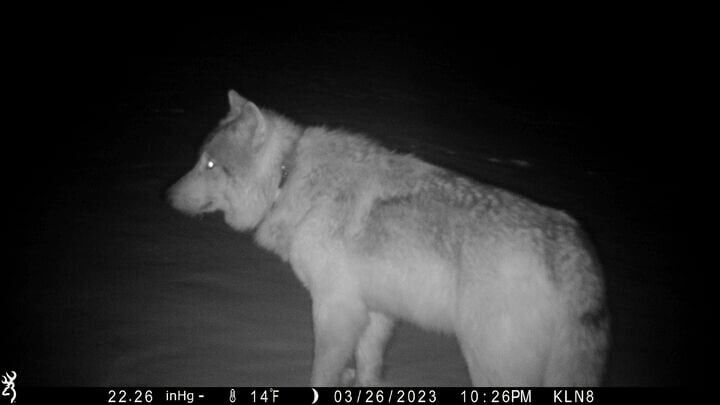
A gray wolf killed on June 12 in Routt County would have “likely continued” its pattern of chronic depredation had it not been removed, according to a report issued by Colorado’s wildlife agency.
The uncollared wolf was responsible for killing at least 22 sheep over the past year, including two depredations in the days before it was killed, according to Colorado Parks and Wildlife.
Agency staff had been hunting for the wolf since last year, and, at one point, believed they had shot it, but the animal survived and disappeared.
The animal was one of more than a dozen gray wolves to die in Colorado over the past two years.
“The decision to pursue lethal actions is never an easy one, but the circumstances around this wolf’s repeated depredation history made this a difficult but necessary decision,” said Colorado Parks and Wildlife Director Laura Clellan. “The producers impacted by these depredations have worked diligently with CPW to identify and deploy all viable and reasonable nonlethal tools and techniques identified through their site assessment and consultation with our field staff.”
No known attractants would have lured the wolf to the area of its most recent depredation, and the owner of the livestock had previously pursued nonlethal conflict minimization efforts, according to the report from CPW.
After consulting with the U.S. Fish and Wildlife Service, CPW determined that lethal removal was “appropriate and legal” under the circumstances.
Wildlife staff shot and killed the wolf on June 12 at the location of its most recent depredation. They had tried the night before but couldn’t get a clear shot.
Gov. Jared Polis said the decision became necessary.
“This elusive wolf had a number of chances but sadly chose to continue to depredate, which necessitated this challenging management decision,” he said. “Colorado remains committed to recovering and maintaining a viable, self-sustaining wolf population in Colorado, while concurrently working to minimize wolf-related conflicts with domestic animals, with nonlethal means as our priority.”
The wolf program is costing Colorado significantly more than the estimates.
Beyond wolf depredation payouts that are now nearly five times the state-budgeted amount, the program’s total cost is projected to exceed $10 million in its first six years.
Originally, Proposition 114 estimated the program would cost $800,000 per year.
Last July, a Colorado Parks and Wildlife official told the CPW Commission that the Blue Book — the voter guide explaining ballot measures — noted that “actual state spending will depend on the details of the plan” the commission developed and on the cost of compensating ranchers for wolf‑related livestock losses.
Since voters approved the measure in 2020, those additional costs have included funding to establish the range‑rider program, hiring staff for conflict‑minimization work and conducting “extensive public outreach.”
The 2026–27 budget allocates $2.1 million for the wolf‑restoration program, but a footnote prohibits the wildlife agency from using taxpayer dollars to acquire additional wolves.
The federal government has told Colorado it can no longer bring in any more wolves from British Columbia or elsewhere outside a six-state Western region: Wyoming, Montana, Idaho, eastern Washington, eastern Oregon and eastern Utah.
Five of the six states have refused to allow Colorado any wolves. Oregon allowed Colorado to take 10 wolves in 2023, including several that came from packs with a history of killing livestock. That’s despite the state wolf plan recommending against taking wolves with such a history.
Marianne Goodland contributed to this story.