







Colorado GDP trails direct competitor states, though slightly ahead of U.S. average

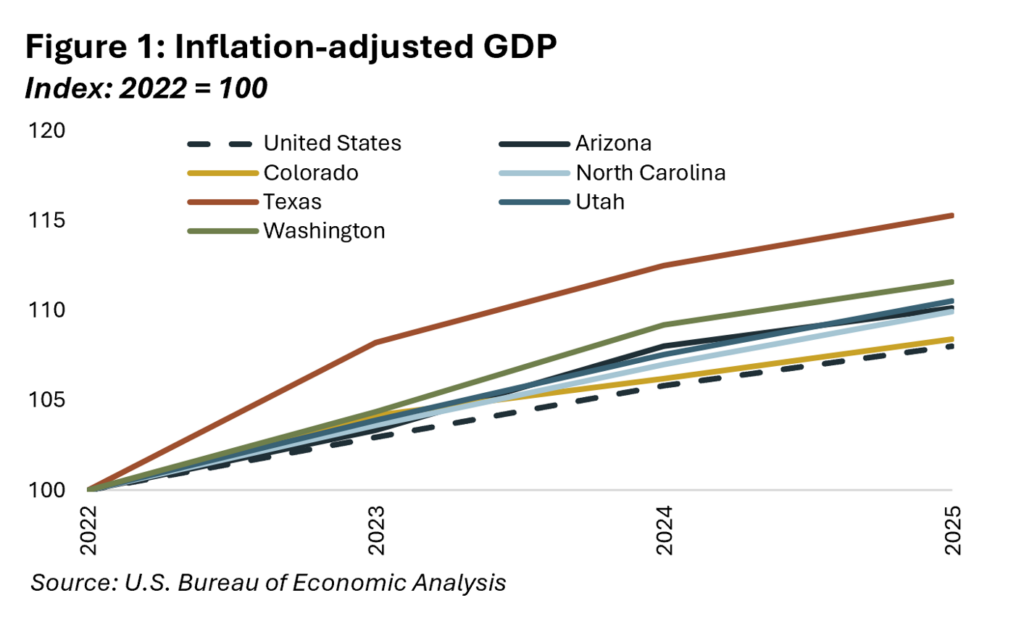
Colorado’s economy is marginally outperforming the national average but lags behind those of direct competitor states, such as Arizona, Texas and Utah, according to a report by a nonpartisan policy group.
And while some indicators for the Centennial State appear positive, costs of living and housing here are proving to be obstructions that are driving away the talent pool needed for stronger growth.
That fair-to-middling assessment appears to jibe with an “America’s Top States for Business” rating released last week by CNBC. Colorado has the nation’s 25th-ranked economy, falling 14 rankings from where it stood last year in the annual report.
That, according to the network, is owed in part to notable drop-offs in key indicators, such as infrastructure and “business friendliness.”
Report confirms out-migration
The study issued Tuesday by the Cherry Creek-based Romer Institute of Evidence-based Policy shows gross domestic product in Colorado trailing those of five benchmark peer states: Arizona, North Carolina, Texas, Washington and Utah.
The study noted that the labor market in Colorado, as well as payroll employment, are showing a softening. Meanwhile, the study confirmed that the state is experiencing an ongoing out-migration that began last year.
The Romer study consolidated reporting from the Leeds Business Confidence Index, the Federal Reserve Bank’s Beige Book, Rocky Mountain Economist, CNBC, Chief Executive and some local surveys.
CNBC, in its own ranking, gave the state an A-minus score in technology and innovation and B-minuses for its workforce, quality of life and access to capital. However, Colorado was issued D-plus grades for its cost of living and its cost of doing business.
The top-ranked state in the CNBC report is Ohio, driven by its infrastructure and by low business costs, the network said. North Carolina and Texas ranked second and third best, followed by California. Arkansas ranked as the most improved state for business.
The Romer study reported that the economic basics remain strong in Colorado — led by a high-quality, well-educated workforce.
Yet business confidence in the state has tumbled beyond what the study’s basics would suggest is reasonable, authors said.
Outperformed by Texas, Utah
While the study’s broad sources are almost unanimous in agreement on the basics behind the lagging performance, there is less agreement on several perceived causes, including the costs of doing business, the role of out-migration and the impact of government regulations.
Giving weight to the impact of regulatory factors is the relative positioning of GDP performance by Colorado with respect to the peer states.
Colorado is barely exceeding the national GDP average, while being outperformed by all five peer states, particularly by Texas and Utah, which the study noted are often cited for their friendly policy environments.
The study also noted that the turnaround in the state’s migration from positive to negative marked a notable shift from previous years.
Meanwhile, the ongoing growth of an educated workforce has been an asset to the state during much of its recent history.
Further affecting growth here and elsewhere is inflation. That has run below the peak experienced during the COVID pandemic but stands 30% above pre-pandemic levels, the study said.
That has driven up the costs for labor and materials and affected investment. Moreover, inflationary effects are continuing now as energy costs spike, related to the ongoing war in the Persian Gulf.
But even two years ago, the state had seen the birth of new businesses fall some 20%, the study said. The study ranked Colorado’s drop-off in new business generation as one of the most notable in the U.S. — among only 10 states that showed a decline.
New business growth
Recent data, the study said, show a rebound in business creation. Last year, Colorado showed a better birth rate than the five states in the peer group.
What are the assets that could create better performance in the years ahead?
All of the study’s sources identify the workforce as a Colorado plus, advantaged by a concentration of tech and other professional skills. However, employers are having issues in attracting and retaining workers in specialized occupations.
Wages run well ahead of peer states. However, Colorado’s higher living costs reduce the benefits to workers and represent added costs for employers.
The larger offset to the workforce advantage that Colorado maintains is the outsized costs of housing.
Those costs, the study noted, run not only 27% above the national median but above four of five peer states, with only Washington posting higher housing costs.
Keeping pace with costs of housing are higher property insurance costs, with premiums up substantially since the pandemic for both households and businesses.
Rising health costs are another factor offsetting better wages for employees and adding to business costs.
What are the policy options?
The Romer study includes a detailed analysis of policy options and of whether those can play a role in creating better performance. The question is underscored this election year, as candidates and voters weigh the performance of Colorado’s Democratic-led government over the recent term.

The regulatory burden on business includes the weight of Colorado’s current consumer protection laws. The state’s first-in-the-nation artificial intelligence regulations that passed in 2024, which had been cited as possibly having influenced the departure of Palantir’s headquarters to Florida, were mentioned as an example of how compliance costs and litigation exposure might affect the business outlook.
The report also pointed to labor and environmental regulatory costs as potential inhibitors to growth. Emissions statutes passed in 2019, it noted, are among the nation’s strictest in the country, with some added costs arriving in 2026.
Earlier this year, lawmakers passed requirements for state agencies to undergo regulatory review for cases of redundant and obsolete rules.
Last month, Gov. Jared Polis and the Colorado Chamber of Commerce Foundation announced a cooperative group to explore ways to hasten the pace of project permitting and “provide greater regulatory certainty” for investors.
The Romer Institute describes its mission as providing public and private decision makers with evidence-based research.