







Divided opinions tick upward, member goes missing | Colorado Supreme Court term in review

The Colorado Supreme Court released the last decisions of its 2025-2026 term at the end of June, with the final numbers showing a significant uptick in non-unanimous opinions over the prior two terms.
Further, the composition of the court had an unexpected change, with the appointment of Justice Susan Blanco in February to succeed Justice Melissa Hart, who announced her sudden retirement in December 2025.
The unusual midterm departure followed an equally unusual “leave of absence” that Hart took in late October. The Judicial Department never publicly explained the circumstances of Hart’s absence, and it again refused to provide any details nearly nine months later.
“The department has nothing to add to our prior comments on this matter,” said Chief Communications Officer Suzanne Karrer in a July 13 email.
Among the court’s major decisions, it upheld the disbarment of former elected District Attorney Linda Stanley for misconduct across multiple cases. It invalidated a Lakewood tax on cell phone providers and confirmed that a person must abide by the strict deadline to initiate a claim against a government entity for their injuries, even if another government entity conceals who is responsible. The court then delivered two decisions that generally favored those seeking to hold government bodies liable for open meetings violations.
The justices also walked back multiple Court of Appeals decisions. For example, they backed away from the appellate court’s view that local governments can authorize excess noise levels on privately owned property and that voters can rezone planned-unit developments via the ballot box. Then, after the Court of Appeals agreed that Arapahoe County jurors disobeyed their instructions to convict a defendant of murder, the Supreme Court upheld the conviction without commenting on the problem.
Finally, on its last decision day, the Supreme Court blocked ballot initiatives in Colorado responding to the unprecedented national effort to redraw congressional district boundaries between census counts.
In all, the Supreme Court issued 76 opinions during its 2025-2026 term. Just under two-thirds were unanimous, which was far lower than the 80% unanimity rate in the prior two terms.
Single-justice dissents increased significantly, with a total of 11 decisions being 6-1 or 5-1, compared to only three in the previous term.
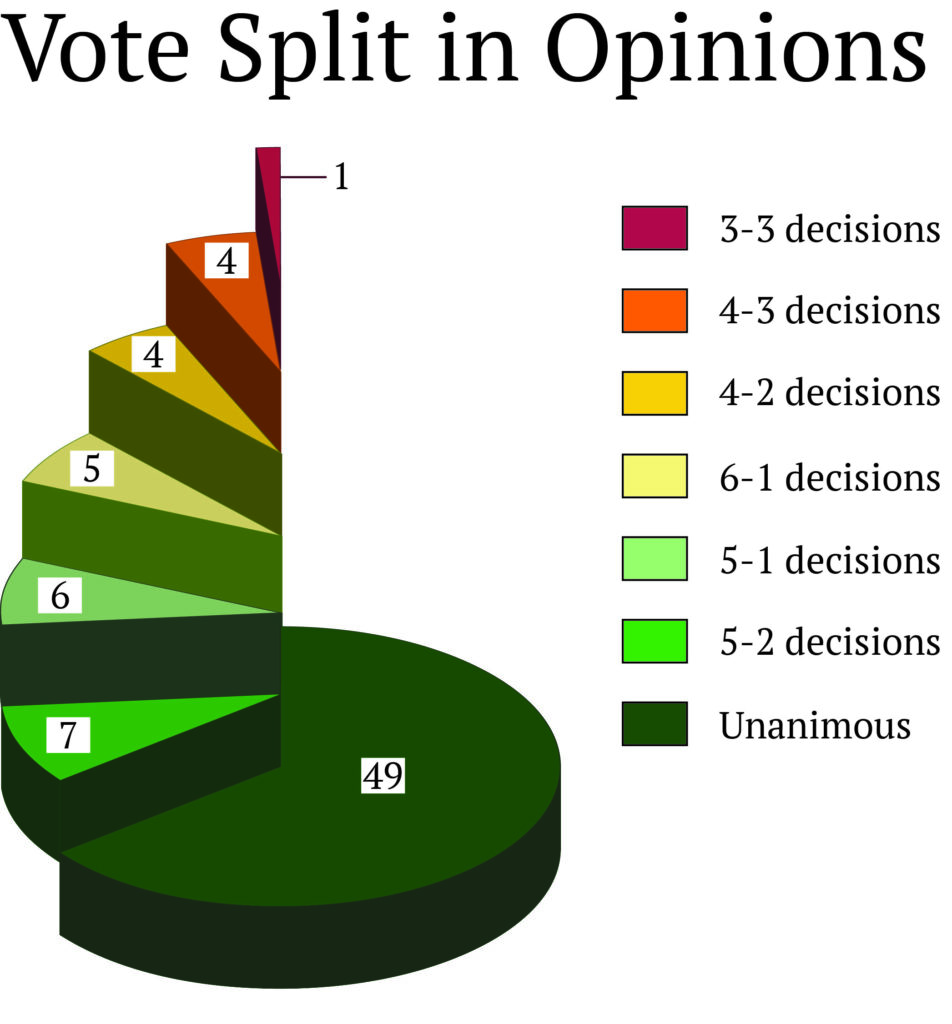
Hart’s vacancy also created the only 3-3 split, as the court was unable to issue an opinion in a child welfare appeal out of Morgan County. The chief justice later said at the press conference for Blanco’s appointment that the court has “been able to keep things rolling along,” without addressing the justices’ first evenly divided decision in seven years.
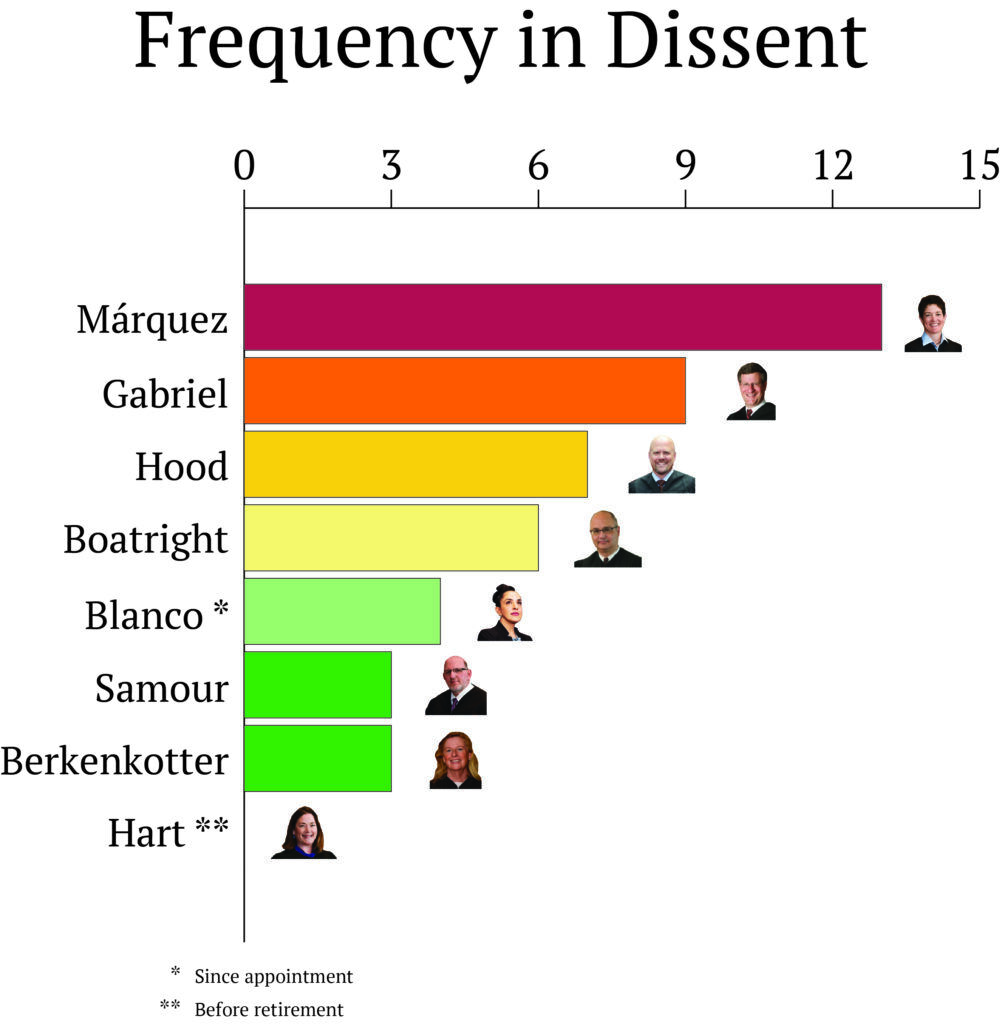
The term featured 26 opinions that contained dissents. Chief Justice Monica M. Márquez dissented most frequently. In contrast to the previous term, where she authored one dissent and joined two others, Márquez wrote dissenting opinions in 10 cases this term. Counting the other dissents she joined, Márquez was in dissent 13 times total.
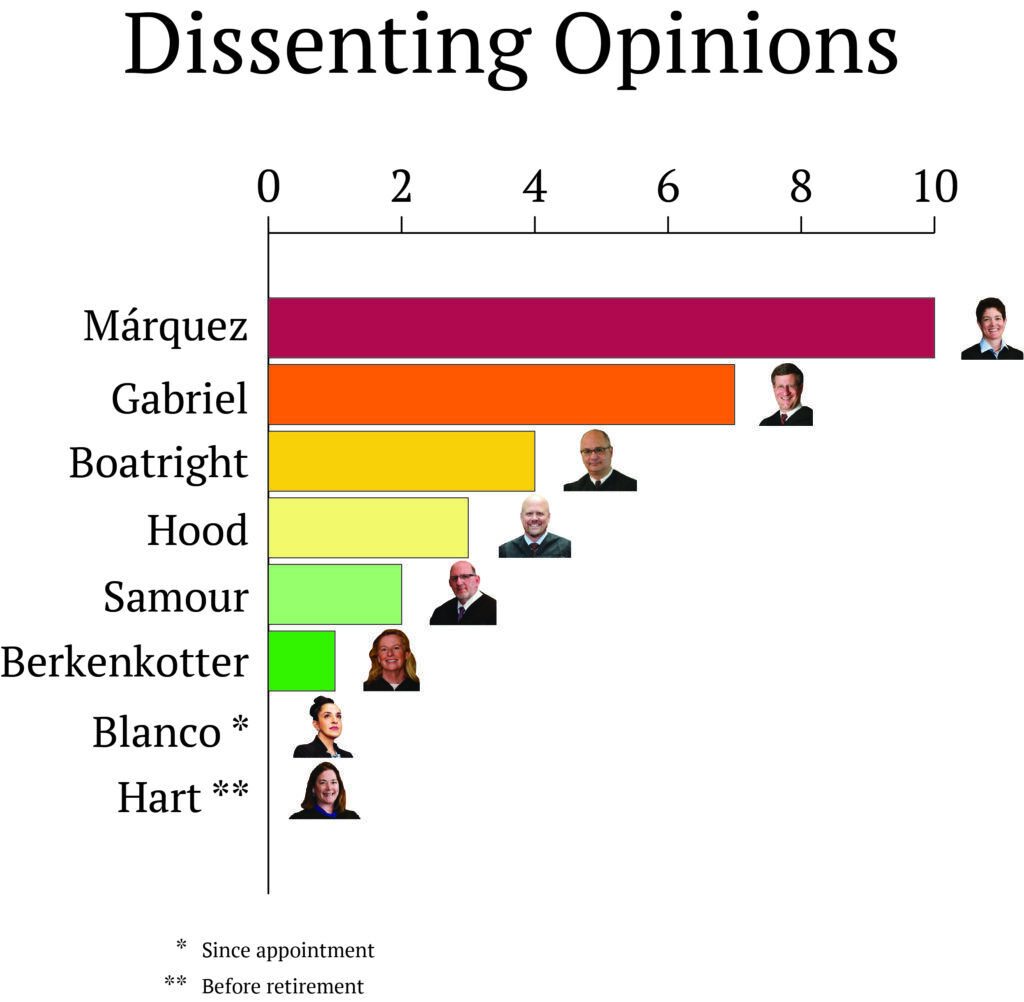
Not counting Hart, Justices Carlos A. Samour Jr. and Maria E. Berkenkotter were the least likely to be in dissent. But the dissent numbers do not include the few occasions on which members of the court authored concurring opinions that agreed with the ultimate outcome, even as they disagreed with the majority’s legal holding or raised other points.
For example, Samour wrote a concurrence that was twice the length of the majority opinion, criticizing the way the court treated leaving-the-scene criminal prosecutions. Berkenkotter also found the majority’s legal test “absurd” in a case revolving around judges’ reductions to parenting time, but she reached the same result under her preferred test.
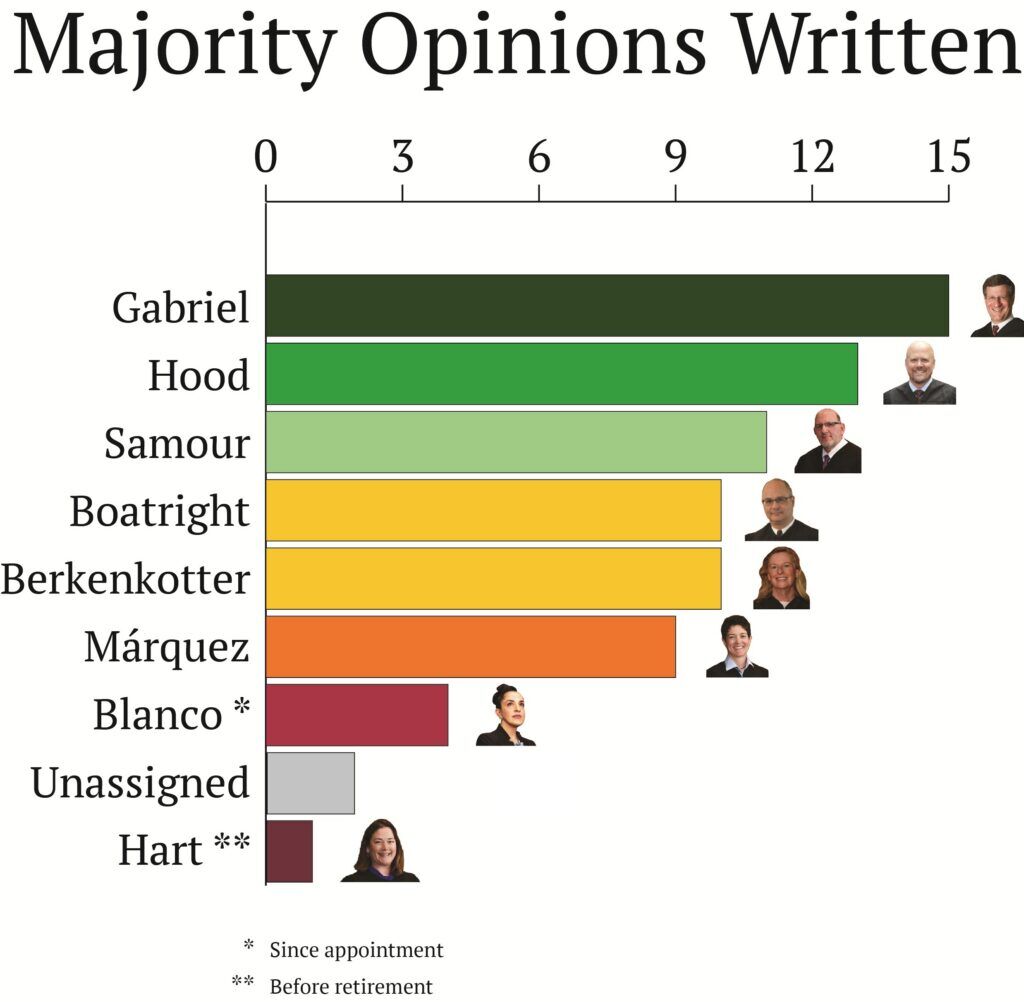
As in prior years, Justice Richard L. Gabriel authored the largest number of majority opinions, at 15. Blanco and Hart, who only served during portions of the term, wrote the fewest.
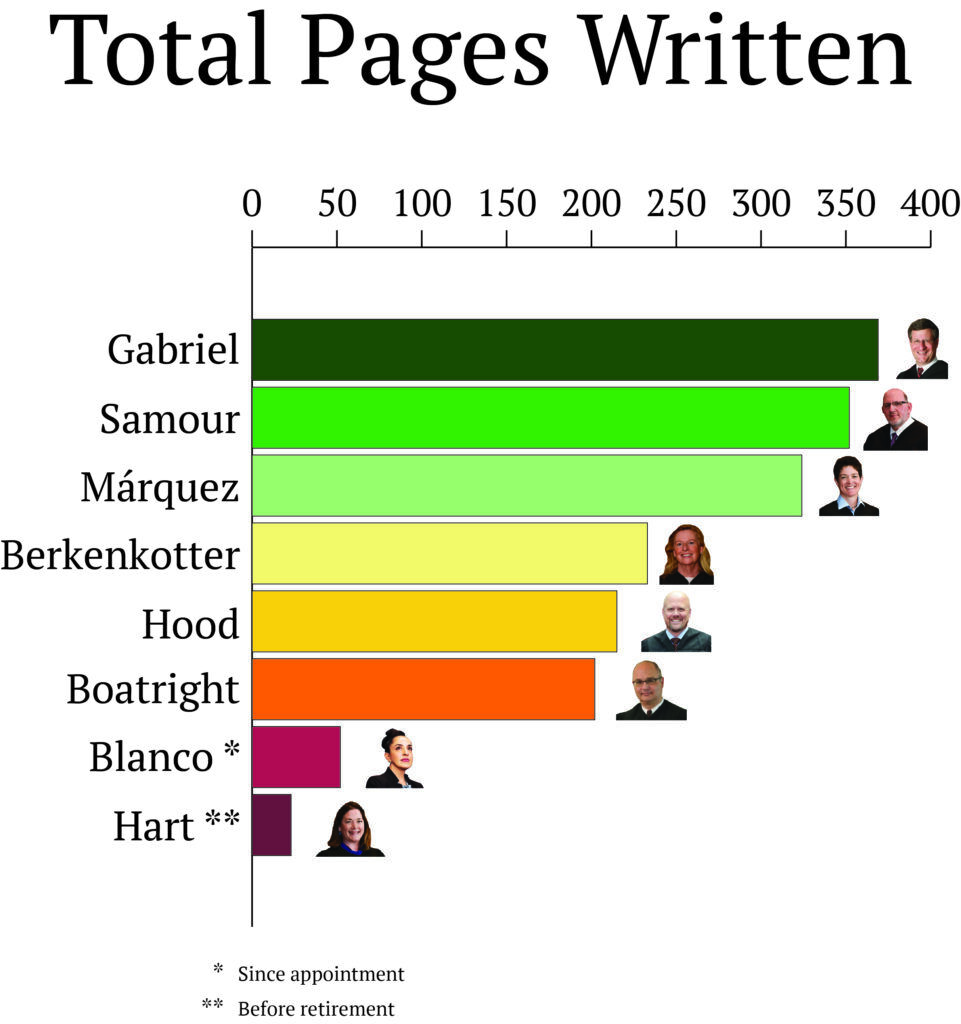
Gabriel’s opinions also occupied the most space, as he wrote 369 pages in total. Samour followed close behind with 352. Excluding Blanco and Hart, Justice Brian D. Boatright wrote the least, at 202 pages.
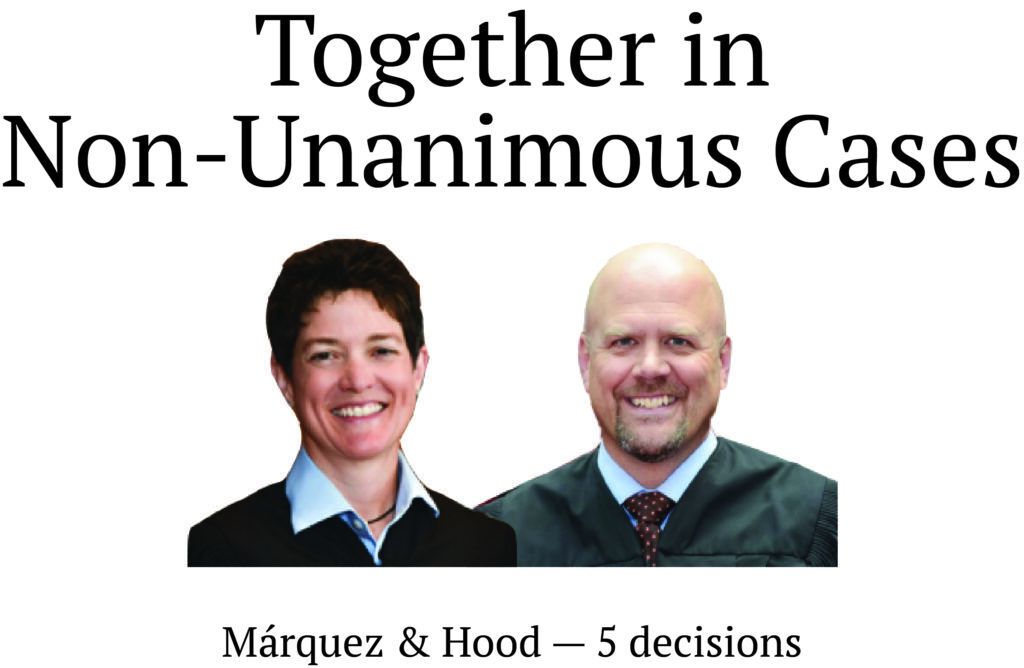
In non-unanimous cases, including those with concurrences, Márquez and Justice William W. Hood III were most likely to wind up together outside of the majority.
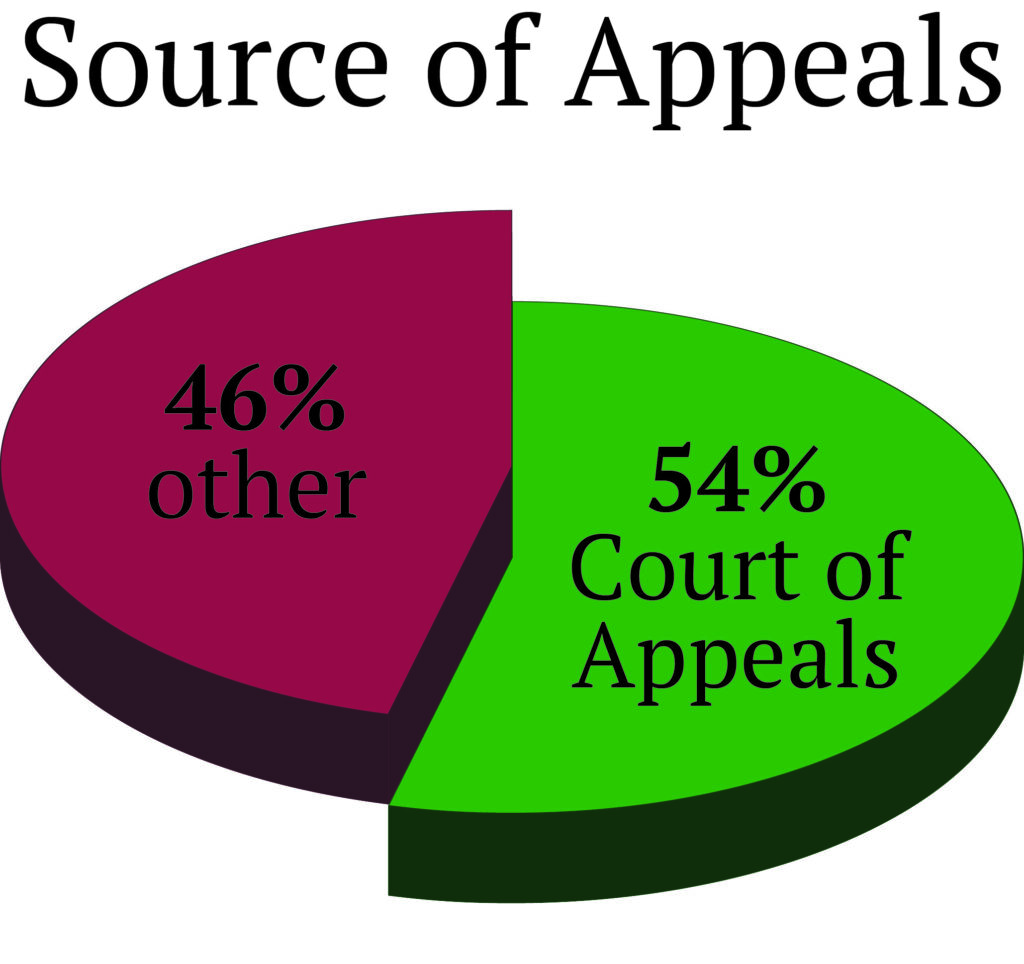
Similar to last term, the Supreme Court’s opinions reviewed decisions by the Court of Appeals in close to 54% of cases, while the remaining matters arrived at the Supreme Court outside of the normal appellate process. The justices were more likely than not to reverse the underlying decision on at least one key aspect being appealed.
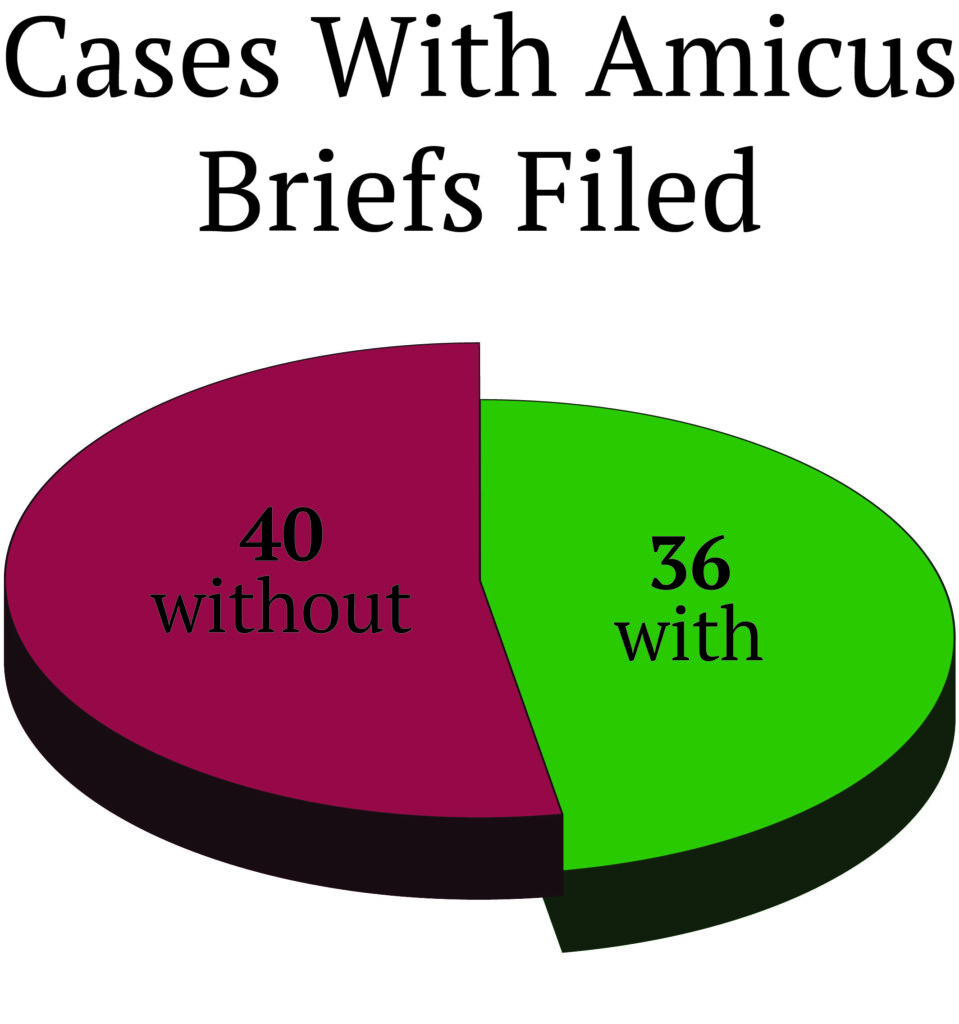
Supportive briefs from outside, “amicus” entities arose in 47% of cases, which is a slightly higher percentage than in prior years.
As of mid-July, the Supreme Court has not announced who its next chief justice will be starting next summer. The court adopted a rotational system in 2020 in which each incoming chief justice will serve for around three years. Márquez, who is finishing her second year in the role, told Colorado Politics in 2024 that there is a yearlong onboarding process for the incoming chief that starts close to Aug. 1.
Tom Hellauer provided the graphics for this article.