







Federal judges’ backlogs increase in Colorado
Colorado’s federal trial judges collectively had 73 motions in civil cases that had been sitting on their dockets for at least six months without a ruling as of March 31, a backlog that nearly doubled from the previous reporting period.
Further, discrepancies in the judiciary’s data showed one judge claiming that he belatedly decided motions that he never did and another judge’s data omitted three motions that have been awaiting a decision for nearly three years.
The Civil Justice Reform Act of 1990 requires public reporting of motions awaiting action in civil matters assigned to each federal district and magistrate judge. The goal was to enhance accountability and move backlogged cases forward, as lawsuits — unlike criminal cases — are not subject to the constitutional guarantee of a speedy trial.
Twice a year, on March 31 and Sept. 30, a report is generated of all motions pending for six months or longer. Under the reporting protocols, a motion becomes “pending” 30 days after its filing. Judges also have the opportunity to give a reason for the delay, such as “complexity of case,” “extensive discovery involved or “voluminous” materials.
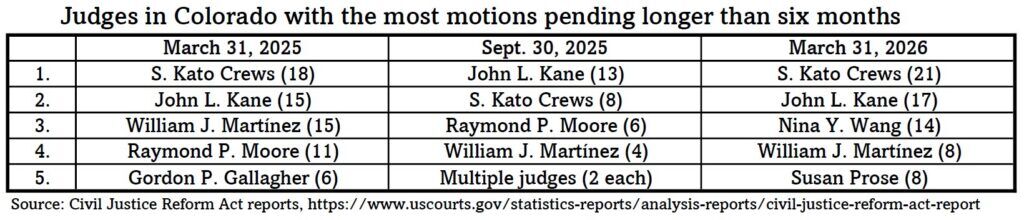
Compared with the 37 motions that had been pending for six months or longer at the end of September 2025, a handful of the U.S. District Court’s members experienced worsening backlogs.
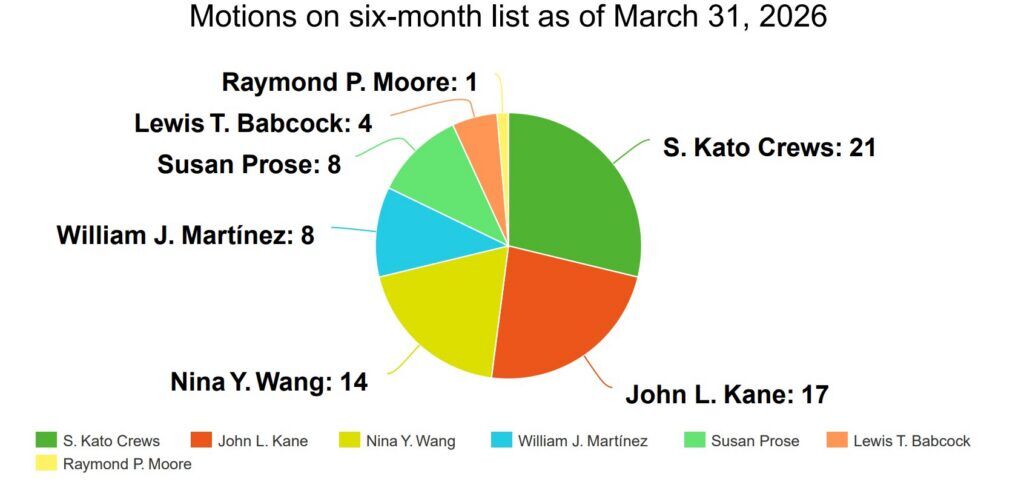
Judge S. Kato Crews’ motions list nearly tripled to 21 motions as of March 31. He attributed all of his delays to a heavy caseload, plus the complexity of some cases.
Senior Judge John L. Kane had 17 motions on his list and also experienced the most significant delays. Five motions in a single case had been pending for more than two years as of the reporting deadline, and two other motions were pending for one to two years.
Judge Nina Y. Wang’s backlog entered double digits for the first time since at least 2022. Senior Judge William J. Martínez and Magistrate Judge Susan Prose each reported eight motions.
The reporting period coincided with the court’s civil caseload ballooning to over 4,000 filings in 2025, with a significant increase in challenges to immigration detention. Judges had been rapidly evaluating requests for release before the Denver-based federal appeals court recently determined that the government’s main legal argument for detention was unlawful.
The motions on the six-month list range from dismissal and summary judgment requests, which can potentially end a case without a trial, to evidentiary and procedural matters. However, Colorado Politics identified some discrepancies in reporting.
Senior Judge Lewis T. Babcock’s list included three motions that were pending as of March 31 and that were originally filed in late 2024 or early 2025. He noted that he had decided them after the reporting period. However, all three cases had been closed for months and two of them were transferred to courts elsewhere.
Further, one of the motions also appeared on Babcock’s list from September 2025 — with the identical note that he had issued a decision after that reporting period had ended.
Jeffrey P. Colwell, the court’s clerk, said that while judges are ultimately responsible for the data on their lists, he took accountability for the erroneous entries on Babcock’s list.
“Judges receive hundreds, even thousands, of motions each year and rely on our internal systems and processes to keep on top of them,” Colwell said. “Missing the motions and the reporting code used on the report was an administrative oversight at our end. It is being rectified.”
In a constitutional rights case brought by a plaintiff who Denver detectives allegedly coerced into confessing to a high-profile murder when he was a teenager, there are five undecided motions for summary judgment pending before Kane. Yet, Kane’s public six-month list only has two of those motions listed, which has remained unchanged since Colorado Politics inquired with Kane about his data in March 2025.
In response to the latest data, Kane provided a detailed explanation for his overdue motions. In one instance, he decided the motion in person after the reporting period. Some had been resolved in written orders, been transferred to other judges or become moot after settlement talks, while others remain in process. For the police coercion case whose motions have been on the docket since July 2023 — and which generated an additional motion in February — Kane said the decision is awaiting “a final cite check by a law clerk.”
“The reporting requirements and motions/case lists are helpful in stimulating diligence and speedy decisions, but, in my view, a strict goal of emptying the lists ignores case realities and risks incentivizing arbitrary and vacuous rulings,” Kane wrote in an email. “As my mentor, Judge (Alfred) Arraj, once told me shortly after I was appointed, ‘A judge has only one obligation at a time and that is to strive for justice in the one case before him.’”
Prose, the only magistrate judge with overdue motions, indicated that all of her motions had a “decision in draft.” While Prose decided some of the motions after March 31, it is unclear how far along the other draft decisions are.
In an employment discrimination case, Prose heard arguments on May 22 on the defendant’s motion to end the case in its favor, which it filed almost exactly one year earlier. Days after the hearing, she wrote that “consideration of the motion will require additional time.” Consequently, she vacated the jury trial that was scheduled to take place in August.
In another case, involving a corporate contract dispute, the defendants submitted a motion to dismiss in April 2025. The parties fully briefed the motion by the end of May. In the 14 months since, Prose has not ruled on the motion, even as her six-month list notes that the decision is “in draft.”