







Is it time to up and out military’s ‘up-and-out’ system?

There’s nothing more bracingly refreshing than a highly decorated retired admiral who isn’t afraid to speak his mind. That’s what Retired U.S. Navy Vice Admiral Bob Harward, former Navy SEAL and deputy commander of U.S. Central Command, did at a breakfast meeting during the Aspen Security Forum last week.
Harward had this to say: “In 2012, we knew the Iranians had about 1,200 ballistic missiles, and we knew where the missiles were, but we didn’t know where the launchers were.” So the No. 1 intel priority became locating all the launchers and missiles, Harward said.
“And now it’s 14 years later and we don’t know where the launchers are.”
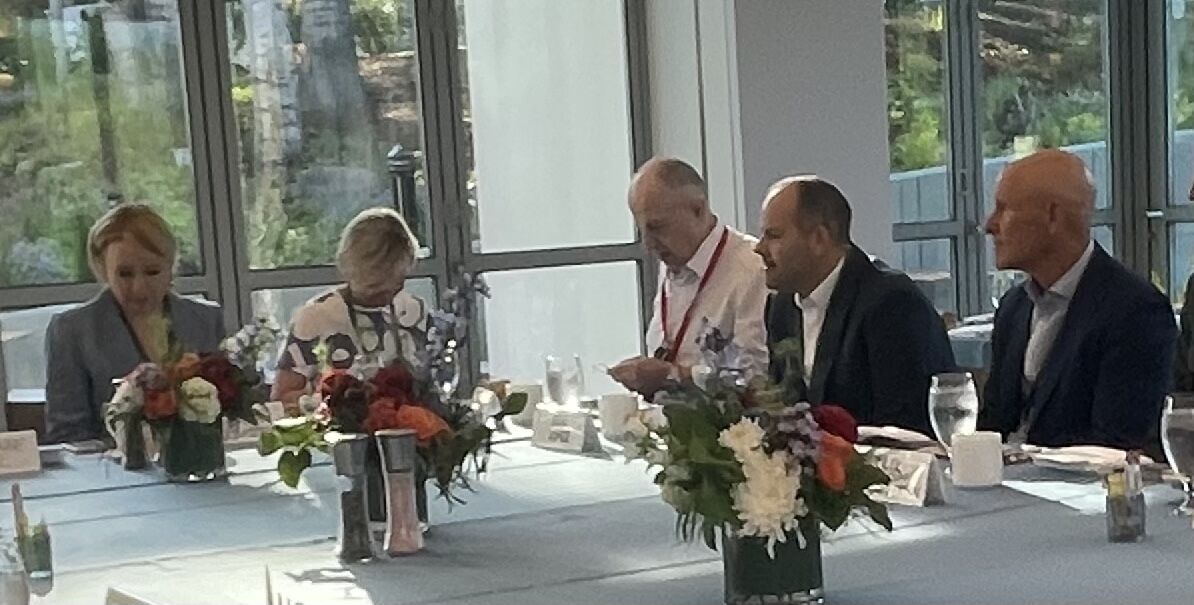
The 3-star admiral who grew up in Iran didn’t mince his words:
“I’m just appalled by the amount of resources into the intel and yet we have these strategic failures. The fact that we haven’t been able to solve this missile and drone debate is an epic failure.”
And he blames that epic fail on lack of continuity in the armed forces.
“Continuity of effort is one of the flaws of our system,” stated Harward, now serving as the Executive Vice President for International Business at Shield AI.
Harward believes the military is running through commanders too quickly. With captains and colonels, the military’s culture of two- to three-year rotations makes more sense to broaden officers’ experience, prevent fiefdoms or cults of personality from being built, and inject fresh thinking and youthful vigor into military missions. But changing two-star, three-star and four-star generals and admirals every couple years doesn’t allow enough time for leaders to recruit and operationalize the necessary expertise for the high tech military we have now.
We change out combatant command commanders every two years, Harward points out. He himself had 23 jobs in 46 years in the military.
We also change out Congressional representatives every two years, so policies guiding the military change often, too, meaning many ambitious missions don’t get seen through properly.
Continuity is especially a problem in our intelligence community, Harward believes.
The military’s “up-and-out” model promotes and retires officers by year-group cohort rather than by the military’s actual need for specific expertise. Military personnel are involuntarily separated based on grade-table limits, regardless of performance or the retention of specific skills.
The up-or-out system dictates that if a leader is determined not ready for promotion, and does not achieve a certain rank within a certain period, they are removed.
Harward and other officers argue that reforms are urgently needed to meet the expertise demands of modern warfare. The promotion system should be based on education, experience and performance, rather than time in grade and peer groups, they believe.

The sharpest example of the continuity problem right now is Space Force’s Golden Dome project.
Harward made the point that Golden Dome is so tied to the Trump administration it may not survive a change in president, though the underlying idea of a missile shield like Israel’s successful Iron Dome air defense system has strong bipartisan support.
A recent contractor’s guide noted that Golden Dome’s acquisition program is driven by this hard political deadline rather than engineering reality, compressing a process that usually takes a decade into three years.
Lack of continuity puts Space Force, which is in charge of developing Golden Dome, at a particular disadvantage.
Todd Harrison, senior fellow at the American Enterprise Institute, has argued that Space Force’s rank structure doesn’t work for a force that is the most high-tech and specialized military service in the country. Some 48 percent of Colorado Springs-based Space Force personnel, for example, are officers (vs. 17 percent servicewide) and 57 percent of those officers hold specialized, advance degrees.
“Officers are effectively locked into a one-size-fits-all career model that rotates them among jobs so frequently they have little time to develop deep domain expertise,” Harrison wrote in Space News. “This disjointed and discontinuous talent pipeline does not provide the right tools to develop the skills and expertise the Space Force requires.”
Think of how much easier it would be for our local Space Force officers to raise a family if we let them keep their assignments and homes in Colorado Springs but rotate among bases here in town such as Peterson, NORAD and Schriever rather than moving them all over tarnation and back.
At his confirmation hearing, incoming Secretary of the Air Force Troy Meink amplified the point about expertise emphatically, saying “These (space systems) are some of the most complicated systems, and if the U.S. is going to maintain our advantage, which we need to do in space, we need to make sure we have the right workforce.”
Meanwhile, in China, People’s Liberation Army officers and the Communist Party’s political and military leaders tend to stay in specific assignments like space, cyber and specific weapons programs much longer. China’s political leadership spans decades, featuring five-year plans and long-term military modernization goals like the 2027/2035/2049 benchmarks it has now. U.S. strategy shifts significantly with each new Congress and administration.
Critics argue this lets China execute patient, incremental strategies while the U.S. military policy has the attention span of a newt. We completely reinvent strategy every few years and lose all institutional memory when senior officers or diplomats rotate out.
Our culture is certainly more adaptable on the fly and builds great resilience in our corps. But does it get done what it needs to get done? We’ve been trying to build a missile shield since Ronald Reagan was president 45 years ago.
The trope of the military brat who moves every few years is well ingrained in our culture. Maybe it’s time we let our brats grow up.