







Marx’s narrow victory over two state legislators is an interesting case study | Cronin and Loevy
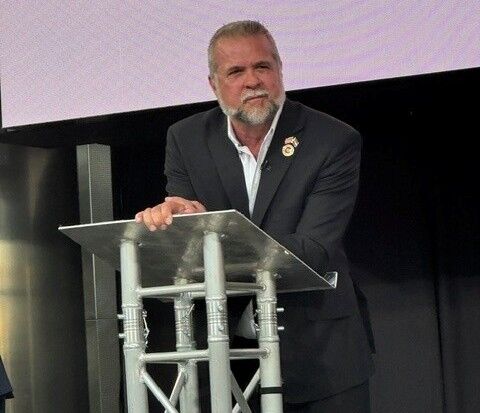
Running for governor of Colorado, controversial outsider Victor Marx, 61, a self-proclaimed exorcist and a friendly ally of the late Charlie Kirk, pulled out a 39.9% Republican primary victory.
State senator and Republican establishment candidate Barbara Kirkmeyer came in a close second with around 39.4% of the vote. Meanwhile, Scott Bottoms, a state legislator and an Assemblies of God pastor from Colorado Springs, placed third with about 21% of the vote.
Voter turnout in this race was the highest for a Republican primary election in Colorado in years, but turnout in the simultaneous Democratic governor primary was decidedly even higher. And unaffiliated voters turned out more than expected.
Colorado election procedures allow unaffiliated voters, also known as independent voters, to get both a Democratic and a Republican primary ballot. The voters then choose which political party’s ballot they want to mark up and mail in.
We had predicted that more unaffiliated voters would choose the Democratic ballot this year, and that was the case. But no one expected that a whopping 72% of the unaffiliated voters would decide to vote the Democratic ballot and only 28% would choose the Republican ballot.
What explains this? We think most people assumed their vote in the Democratic Party balloting for Colorado governor would be more important because chances are greater that Colorado will elect a Democrat as governor on Nov. 3 rather than a Republican.
The unexpectedly high tilt of unaffiliated voters to vote the Democratic ballot was probably also a reflection of the anti-President Donald Trump sentiment in much of Colorado.
Marx’s defeat of the two state legislators may also be part of this year’s anti-incumbent trend.
Marx was outspent by Kirkmeyer, but it appears that he had a greater presence on social media. He claims to have three million or more followers on Facebook, Instagram, etc.
And, in retrospect, it seems that Marx’s friendship with the late MAGA (Make America Great Again) organizer and Trump favorite Kirk generated interest and social media support for Marx.
Marx had appeared and spoken at Kirk-inspired Turning Point organization rallies.
And the now lionized conservative activist Kirk wrote a promotional preface to a book by his “friend” Marx.
Trump did not endorse any of these candidates, but it is likely that the 61% of Republican ballots cast for the outsider Marx and the fellow evangelical minister Bottoms came from Trump supporters.
Now let’s look at the Colorado political geography of this controversial and consequential Republican primary for the Colorado governorship.
In terms of regions of the state, Kirkmeyer, from Weld County, received her highest percentage of the vote in the Denver metropolitan area.
Metro Denver voted 44.4% for Kirkmeyer, 36.4% for Marx and 19.2% for Scott Bottoms.
Kirkmeyer carried Denver with 50.8% of the vote and Broomfield with 50.1%.
In the populous Denver suburb of Adams County, however, Marx scored a close upset victory over Kirkmeyer. Marx received 41.1% of the vote compared to 39.7% for Kirkmeyer and 19.2% for Bottoms.
The Front Range consists of the Denver Metropolitan Area plus the additional counties of El Paso, Larimer, Pueblo, Teller and Weld.
Similar to the Denver metropolitan area, the Front Range voted for Kirkmeyer over Marx and Bottoms. The Front Range results were Kirkmeyer 39.4%, Marx 36.2% and Bottoms 24.4%.
Larimer County (Fort Collins) and Weld County (Greeley) both went strongly for Kirkmeyer. Helping with that is Weld County is Kirkmeyer’s home county. The tally came to: Larimer County 45% for Kirkmeyer, Marx 35.2%, Bottoms 19.8%, and Weld County 48.9% for Kirkmeyer, Marx 36.3%, Bottoms 14.8%.
An interesting case was Pueblo County (Pueblo), which has a large steel mill and many union members. It turned out to be one of Victor Marx’s strongest areas. The count in Pueblo was Marx at a very high 53.9%, Kirkmeyer at 25.1%, and Bottoms at 21.0%.
El Paso County (Colorado Springs) is the home county for Marx and Bottoms. The results reflected the usual effects of having two candidates residing in the same county.
Kirkmeyer received only 33.7% in El Paso County while Marx got a hometown boost to 42.3% and Bottoms scored 24.0%.
Teller County (Cripple Creek) is located just west of Colorado Springs and El Paso County. It also supported Marx’s candidacy: Marx 46.0%, Kirkmeyer 29.7%, Bottoms 24.3%.
The Eastern Plains of Colorado contain the many counties east of the mountains and the Front Range. This large area is mainly rural and agricultural. It has historically voted strongly Republican.
In this Republican primary election, the Eastern Plains region voted strongly for Marx at 44.7%, Kirkmeyer 35.6%, Bottoms 19.7%.
Another important region of Colorado is the Eastern Mountains. These counties are east of the Continental Divide. They include places like Lake County (Leadville) and Chaffee County (Salida).
Similar to the Eastern Plains, the Eastern Mountains voted strongly for Marx at 49.5%, Kirkmeyer 26.5%, Bottoms 24.0%.
That 49.5% for Marx was his highest score in any of the regions of Colorado.
Southern Colorado consists of counties with a Hispanic flavor that are grouped around the Rio Grande. An example is Alamosa County (Alamosa).
Southern Colorado voted for Kirkmeyer, but only by a very narrow margin. Kirkmeyer came in at 37.8%, only about two points ahead of Marx at 35.3%. Bottoms received 26.9%.
Western Colorado has two distinct sets of counties. Most notable are the ski resort counties, which have skiing in the winter and a resort atmosphere all year long. Examples are Eagle County (Vail) and Pitkin County (Aspen).
And then there are the no ski counties, which have no ski resorts and are mainly agricultural in character and often are quite remote. Examples are Mesa County (Grand Junction) and Moffat County (Craig) in northwestern Colorado.
The ski resort counties were a close contest between Kirkmeyer and Marx, with Marx getting the edge at 38.9%, Kirkmeyer 37.7%, and Bottoms 23.4%.
The no ski counties, however, were a runaway victory for Marx at 46.5%, Kirkmeyer 29.4%, and Bottoms 24.1%. Here are our conclusions from this regional analysis:
— The more populated and economically successful an area, the more likely it was to vote for the experienced candidacy of Kirkmeyer.
— The less populated an area, the more likely it was to vote for the inexperienced candidacies of Marx and Bottoms.
Kirkmeyer only ran strongly in the Denver metropolitan area region. In most other parts of the state, she was in a competitive struggle with Marx for every vote.
Marx’s strong showings in the Eastern plains, the Eastern mountains and the no ski counties on the Western Slope enabled him to barely overcome Kirkmeyer’s strong vote-getting in Denver metro.
Marx proudly casts himself as a nonpolitician outsider. His biography does not include a college or divinity school but emphasizes his Marine service, a few years as an assistant with the Focus on the Family program in Colorado Springs, his martial arts and karate expertise and his founding in 2003 of the All-Things Possible Ministry which specializes in humanitarian missions.
He is the father of five children and grandfather of five. He shares mainstream Republican views on gun rights, TABOR refunds and school choice — yet calls for greater emphasis on parental rights “moral renewal” and much deeper reductions in state spending.
Marx seems to have divided state Republicans and is striving to forge unification efforts with other statewide and state legislative candidates. He will need help — yet his Marine ties, long-term ministry work, martial arts and maverick persona and ties to the Kirk following make him an unusual underdog.
Tom Cronin and Bob Loevy are news columnists who write about Colorado and national politics.