







RTD considers adding debt instead of making cuts, setting stage for 2028 measure
The Regional Transportation District may be trying to thread the needle between dramatic service cuts and financial ruin.
After agency documents unveiled scenarios of reducing service by up to 20% beginning in 2027 — with one notable proposed discontinued route being the 16th Street FreeRide — two RTD committees met last week to determine how to proceed with financial decision-making under increased public scrutiny.
With the agency on track for a structural deficit of $215 million next year, and only compounding in 2028, board members emphasized the urgency of deciding how to generate revenue while best maintaining RTD’s current operations.
Some showed interest in moving forward with service cuts of up to 20%, a difficult but necessary sacrifice to rein in RTD’s operational expenses and eat into the structural deficit.
Others supported refinancing the agency’s current debt to continue funding RTD operations, incurring long-term financial risk to generate short-term cash in violation of the board-adopted fiscal policy.
But what came out of each was a solemn understanding that, regardless of the path the agency chooses in the coming months, it will be betting that Denverites understand its value and will vote for a revenue-generating ballot measure come 2028.
RTD directors look to financing, debt as ways to generate cash
Two RTD committees met July 14 and 15. Going in, each was tasked with providing a recommendation for cutting service by a certain percentage, as well as an annual savings target dollar amount.
After much deliberation, mostly around exactly what members were voting on, Tuesday’s Finance and Planning Committee meeting ended with members voting to recommend reducing service by none.
Despite the RTD’s finance staff recommending a 17.5% reduction — equating to just over $54 million — earlier in the year, the committee chair, District I director Karen Benker, pushed hard for no service cuts.
“Cuts of that size are enormous and will do damage, in my opinion, to our customers, to our staff,” Benker said. “There will be layoffs. We will lose many, many, many customers. Fare revenue will go down.”
Agency directors JoyAnn Ruscha, District B and Michael Guzman, District C, objected to Benker’s assessment, each citing the need to address the systemic deficit — brought on by low post-pandemic ridership and rising operational costs — or find other solutions to generate cash.
Alternative proposals included financing legally mandated bus purchases in 2027 and 2028, which would free up an amount of about $500 million over the next few years, said RTD CFO Kelly Mackey. She added that financing bus procurements violated the board-adopted fiscal policy, as ongoing operations cannot be funded with debt.
But committee members, eager to postpone reckoning with RTD’s present financial situation, voted 4-2 against recommending any service cuts.
The agency’s Operations, Safety and Security Committee took a different approach the following night, with directors starting the meeting seemingly intent on recommending a significant amount of service cuts.
“I’m not willing to play Russian roulette with the agency’s finances under the assumption that we pass a ballot measure in 2028, as much as I think we probably will,” said Chris Nicholson, District A director, early in the discussion.
Later in the meeting, the discussion again prompted Mackey to note the possibility of the RTD leveraging both existing and future debt to fund operations, though she also added that the decision would put the agency in a fiscally irresponsible “black hole.”
“We can choose to be a little bit less responsible,” said District E Director Matt Larsen in response.
The committee concluded the agenda item by recommending service cuts of 10%, not to exceed $31 million, with a directive to further research the effects of refinancing the agency’s existing debt to give RTD more financial flexibility.
RTD CEO says route reduction scenarios were ‘illustrative’
While the meetings had been on the board’s schedule for some time, they received additional public attention and scrutiny after Tuesday’s public agenda packet showed possible route reductions for service cut scenarios of zero, 5%, 10%, 17.5%, and 20%.
One such discontinued route in all scenarios above 5% was the 16th Street FreeRide service, one of the RTD’s most popular and heavily boarded bus routes.
At both meetings, agency CEO Debra Johnson stressed that the scenarios were purely “illustrative” and that the potential route discontinuations were purely “examples” of what could occur in each scenario.
But that didn’t stop those participating in public comment from voicing staunch opposition to some of the routes listed for the cutting-room floor.
“We are definitely concerned about the proposal to reduce downtown transit service, particularly the inclusion of the elimination of the FreeRide and cuts to other key routes that serve the urban core,” said Andrew Iltis, senior vice president at the Downtown Denver Partnership, before Tuesday’s meeting. “These changes don’t simply reduce transit service; they reduce access.”
Even former RTD board members expressed their disappointment that such a popular bus service could be in consideration of being completely eliminated.
“I understand looking for cost-cutting measures is a necessary exercise … it’s in that spirit that I view this staff proposal: it’s an exercise in magical thinking to suggest that this board would ever cancel the FreeRide,” said Doug Tisdale, former RTD District H director and current chair of the Denver Downtown Development Authority.
“Outside of the A Line, no other RTD service matches the success, high ridership and enthusiastic public support of the FreeRide,” Tisdale added. “For decades, it’s been the economic and logistical lifeline of downtown Denver.”
The agency’s current board members, too, openly stressed the need for the board to operate with caution, given the increased public focus.
“The list that we have, that we were given in our packet, has already caused a lot of controversy, a lot of conversations, newspaper articles, media, discontent among a number of our cities,” Benker said.
Front Range rail funding not off the table — yet
One idea multiple board members raised to cut some of the agency’s expenses was to back out of its Joint Service Agreement with the Front Range Passenger Rail District.
The agreement, the development of which was signed into law in 2024, has not yet been formally finalized, as a full financial plan won’t be presented to RTD’s board until 2027, according to the agency.
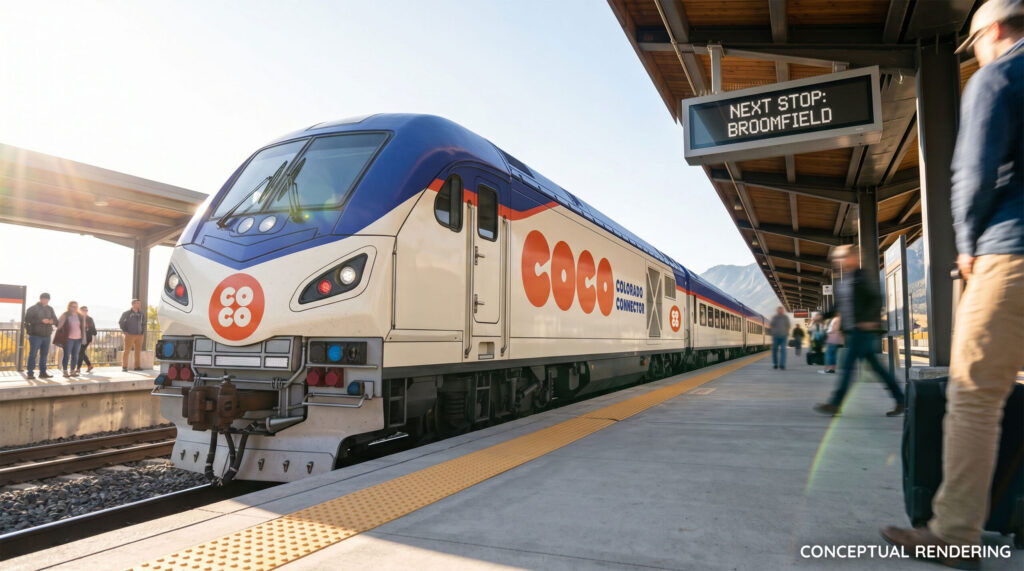
But the rail project — which aims to begin its three-train-per-day “Starter Service” by 2029 — is relying on the agency to provide $156 million, or nearly 47%, of the capital construction costs required to begin the service, as well as an additional $10-12 million in annual operating costs, according to its delivery plan.
Because it hasn’t yet been agreed to, that expense was not included on the RTD’s financial projections, Mackey said.
Sal Pace, general manager of the Front Range Passenger Rail District, declined to speculate on what could happen if the agency were to pull out of funding the project, citing the signed term sheet passed by the RTD board.
“Unless I’m told otherwise, I’m assuming RTD will continue with its participation in the project,” Pace said.
While some directors certainly have expressed opposition to funding joint service, Nicholson still believes the agreement has enough board support to “pass easily,” he said.
The director added that, while not part of the presented five-year financial forecast, the board has seen financial projections including joint service and could have to make additional service cuts to help stomach that cost.
RTD’s sights set on 2028
Despite differences over how much service to cut initially, RTD directors largely agreed that the agency will need to pass a revenue-generating ballot measure in 2028 to sustain its current operational network.
While the specifics of that measure — whether it will be a sales tax or some other stimulus — were not discussed, directors agreed that the agency would need an influx of money if difficult conversations about cutting routes were to be pushed off.
Additionally, passing the measure would help stave off concerns about the agency putting itself in a precarious financial situation, as Mackey warned in both meetings.
“While RTD continues to maintain substantial assets and liquidity, the organization is experiencing some erosion in financial position over time, which is why staff remains focused on balancing near-term operational needs with long-term operational sustainability,” Mackey told both committees before each voted for fewer cuts than what staff financiers recommended.
The agency’s next board meeting will take place on July 28, during which there will be a larger conversation about how to proceed with RTD’s present financial situation.