







Capitol Hill could lose some neighborhood parking when bike lanes are improved
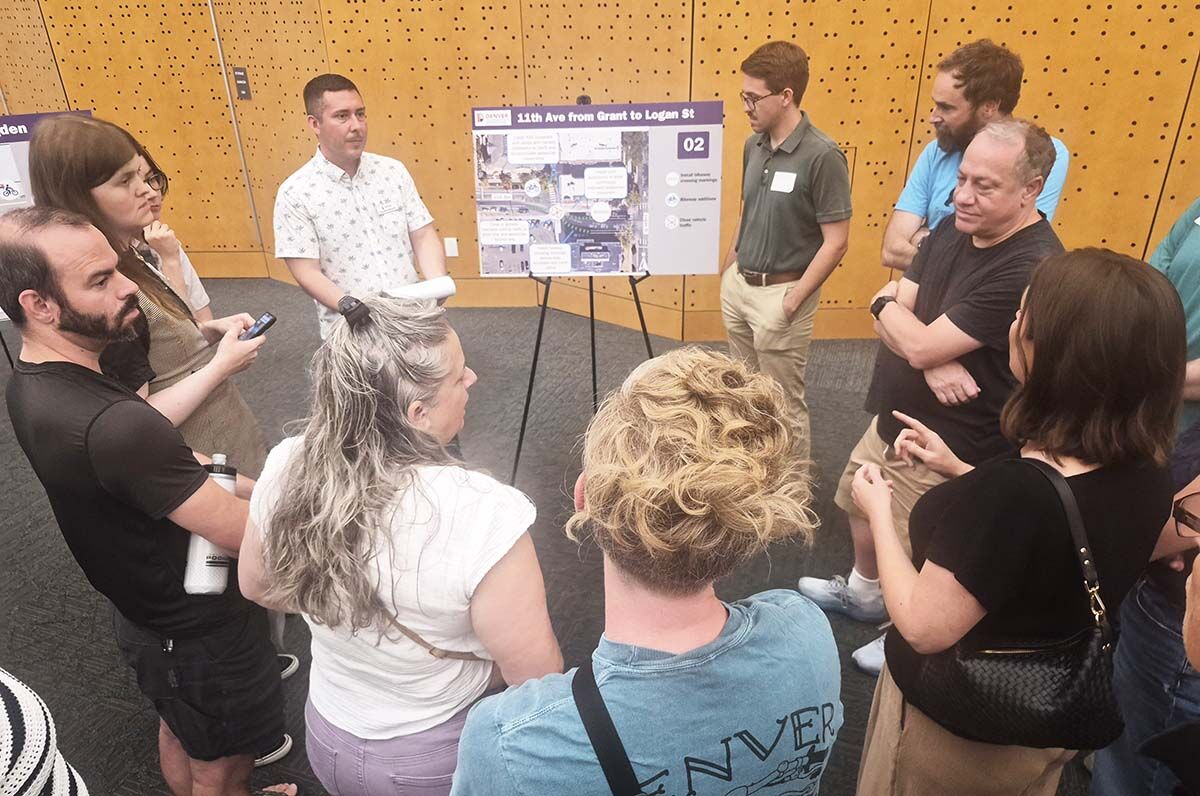
Residents of Capitol Hill and the Golden Triangle have begun weighing the traffic impacts of a series of bike and pedestrian enhancements proposed by Denver’s Department of Transportation and Infrastructure following an open house the agency held for residents on Wednesday night.
DOTI representatives noted that plans were part of its Neighborhood Transportation Management Program for the area issued in 2018, and that numbers of reviews, prioritizations and a draft action plan for the projects had all been released more than two years ago.
But several residents among the 25 who turned out on two days’ notice for the meeting said they had no knowledge of the plans and were concerned that they wouldn’t be able to provide timely input.
Chief among the concerns were parts of the plan affecting 11th Avenue between Speer Boulevard, east past Broadway to Ogden Street.
Concerned about traffic flow
The city hopes to upgrade bike lanes along the mile-long stretch of road — including closing off car traffic at East 11th for a one-block stretch between Grant and Logan streets, where its two lanes of traffic are narrowed by an S-curve. That would leave the narrowed corridor limited to bikes and pedestrians only.
“I just think it’s important that we keep the convenience of the traffic going both directions over 11th,” Terry Mischel, who lives on Humboldt Street near Cheesman Park, told The Denver Gazette.
He was handing out flyers on behalf of the Neighbors for a Greater Capitol Hill, advocating for an alternative solution that would purchase some parking lot space at 11th and Grant, to allow both car traffic and bike lanes to remain.
It’s an alternative that I think is more viable than doing what DOTI is wanting to do,” he added.
One-block stretch
Rolando Melgoza, a project manager for DOTI, said that the department would be weighing that possibility.
“We went ahead and sketched that out a little bit to see what that would look like, to acquire that additional right of way,” he told residents.
Melgoza added that a third possibility would be to shut off just one lane of traffic, while still allowing for a better-defined bike lane and sidewalk. In either case, he added, additional costs would be involved.
According to Melgoza, some 4,300 vehicles pass the stretch daily, reflecting additional loading that 11th Avenue carries from its connection to Speer Boulevard, where it is one of only a few streets with a bridge to cross Speer and to cross over to Cherry Creek.
Melgoza told The Denver Gazette that most of the traffic load, some 3,000 cars, head eastbound on 11th and only 1,300 are westbound. That, he suggested, would weigh in favor of closing the westbound lane as a possibility.
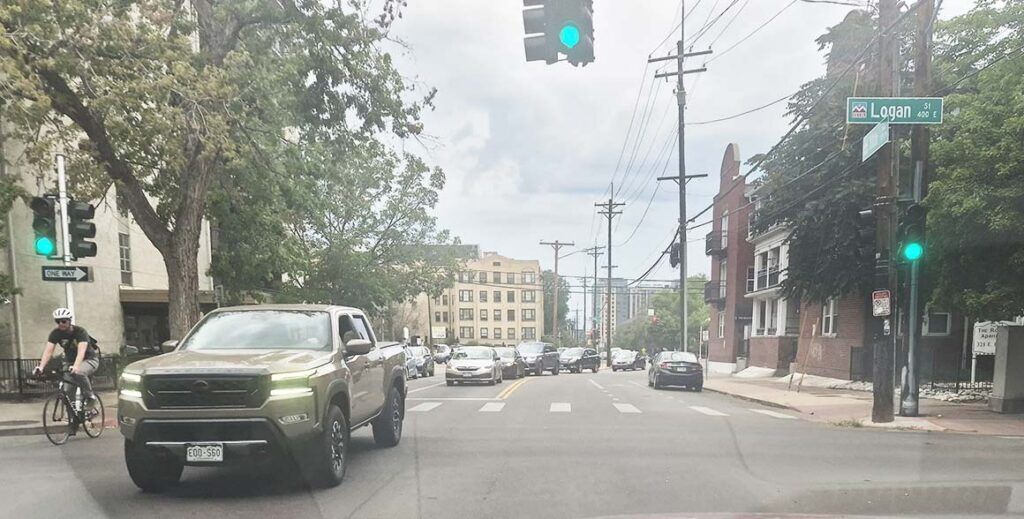
Melgoza and other DOTI representatives at the meeting were quick to note that the “traffic diverter” option at East 11th and Grant was among a number of other projects to be undertaken as part of the plan.
Other parts envision bike and pedestrian improvements along additional intersections of 11th Avenue, as well as on Bannock Street from West 9th Avenue north to West 14th Avenue and at East 9th and Washington Street. At the latter intersection, DOTI proposes adding curb extensions to “improve sight distance and decrease pedestrian crossing distance.”
Several DOTI representatives confirmed that all of the modifications would result in losing parking spaces. Those improvements require installing bollards and other devices to better define the exclusive bike lanes in stretches where those were never marked on the original path.
Brad Cameron, president of Neighbors for a Greater Capitol Hill, told The Denver Gazette before the meeting that he found the proposals to be confusing and lacking in candor.
‘Lack of common sense‘
“I’m an avid bicyclist,” Cameron said. “The problem I have with them is a lack of common sense in what they end up doing.”
Cameron added that he keeps track of how bike projects were affecting other Denver neighborhoods, mentioning East 7th Avenue at Williams Street.
“There was never much traffic to begin with,” Cameron said. “It hasn’t worked; people just disobey the traffic signs.”
DOTI’s Melgoza said that crash analysis for the intersection on 11th getting the most attention showed a typical number of wrecks for that area and that the numbers themselves showed no outsized risk to cyclists.
However, Melgoza noted that the department had conducted one user analysis in which subjects place a dot on a map to indicate areas where they feel less secure.
“What’s the intersection that you don’t feel safe walking through, driving through, biking through, rolling through, whatever,” Melgoza said. “One of those intersections that received a number of those dots was at this pinch point here.”
‘A little sketchy‘
A regular cyclist in the neighborhood, who said he lives on Bannock Street, told The Denver Gazette that the pinched block made him more cautious on his sojourns — one of a number of sites along 11th where the bike lane is marked in the middle of the block, then quits at an intersection.
“I go (through) there to go to Whole Foods,” the cyclist noted, who said his name is Harrison. “It’s a little sketchy. You’ll be in a bike lane, you kind of have your own bike space, but then you’re kind of put into the road and the road is narrow at that curve. As a cyclist, there’s not even a shoulder for me to kind of pull off. So, I just have to hope that a car doesn’t hit me.”
Residents also showed concern for the possibilities of lost parking that would accompany the upgrades, in an area where parking is extremely tight.
“It’s always too easy to take them away,” Capitol Hill resident Mischel said about parking spaces in the neighborhood. “It’s never easy to find more. And I don’t think anybody in DOTI is actually working on finding more parking places, which is what they really should be doing for the livelihood of downtown and the neighborhood.”
In its presentations, DOTI makes frequent mention of Vision Zero, the Swedish-designed program to eliminate traffic fatalities, which was widely adopted by U.S. cities, including by Denver in 2016.
A spokeswoman for District 10 Councilmember Chris Hinds, whose district includes much of the affected area, said that he understands that DOTI would be studying the situation further following the neighborhood briefing. She added that Hinds is examining the situation and would comment on it soon.
Several DOTI specialists at the event said that it is unlikely any construction on the projects would happen before 2028.