Arapahoe Basin seeks more snowmaking, parking and remote avalanche control
Arapahoe Basin Ski Area wants to significantly expand snowmaking, build two more parking lots and install towers for remote-controlled avalanche mitigation.
The U.S. Forest Service has detailed the proposals in a document recently posted for public review. The land-owning agency is taking comments until Aug. 24 as it begins an environmental review.
According to a news release, A-Basin’s proposals are intended “to improve operational efficiency, employee safety and visitor experience, as well as provide more reliable early-season terrain through snowmaking.”
Snowmaking would almost double under the drafted plan ー from about 75 acres to closer to 140 acres, as outlined in the Forest Service’s scoping document.
To make snow, A-Basin has diverted water from the North Fork of the Snake River to a 5 ½-acre storage reservoir. An environmental review in 1999 resulted in those diversions being limited to 25% of the stream flow. The ski area seeks to remove that limit to achieve another 65 acres of snowmaking coverage.
The Forest Service’s scoping document notes A-Basin has collected fish population data over the years that indicates “snowmaking diversions have not impacted the measured environmental characteristics.” The document also indicates A-Basin’s proposal is “within its state-law water rights.”
Under the proposal, 4.4 miles of new snowmaking lines would have to be installed among infrastructure that would be focused around the Montezuma Bowl, intermediate runs in the Beavers and by the front-side Lenawee Express and parts of the Shooting Gallery, Upper Wrangler and Sundance trails.
The expansion “would ensure a more consistent snow surface throughout the year, maintain critical connections during low snowfall and increase the amount of terrain open earlier in the season,” according to the scoping document.
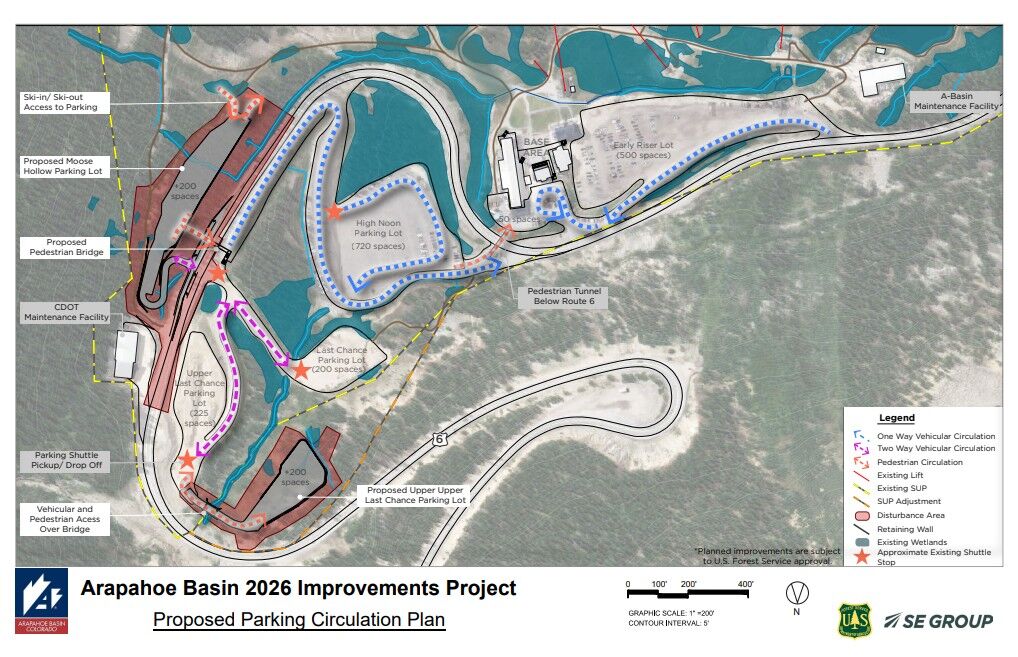
A-Basin also wants to increase parking that has long been a concern, leading to paid reservations in recent years.
The proposed Moose Hollow and Upper Upper Last Chance parking lots would be built with about 200 spots each, increasing the ski area’s total spaces from about 1,695 to 2,095.
The Forest Service document details complex engineering still needing development for the Upper Upper Last Chance lot, which would be situated along a U.S. 6 curve above the Upper Last Chance lot. The Moose Hollow lot would be built on the opposite, south side of the highway, providing ski-in/ski-out parking. From Moose Hollow, A-Basin envisions a pedestrian bridge crossing over the highway to the Last Chance lots.
And the ski area envisions emerging technology to assist with avalanche mitigation.
The scoping document refers to the proposed “Remote Avalanche Control Systems” as a “reliable and effective complement to existing methods for increased worker safety, public safety and operational efficiency.”
While the document says hand charges will still be used, risks would be “significantly reduced” by remote-controlled towers that drop charges and detonate ー “creating an ‘air-blast’ to trigger avalanches.” A-Basin has estimated 11 towers around the East Wall area and another six in Montezuma Bowl.
The Forest Service emphasizes those numbers and locations are still being analyzed, among other specifics to be determined through its environmental review.