







‘CoCo’ would take taxpayers for a ride | John Caldara
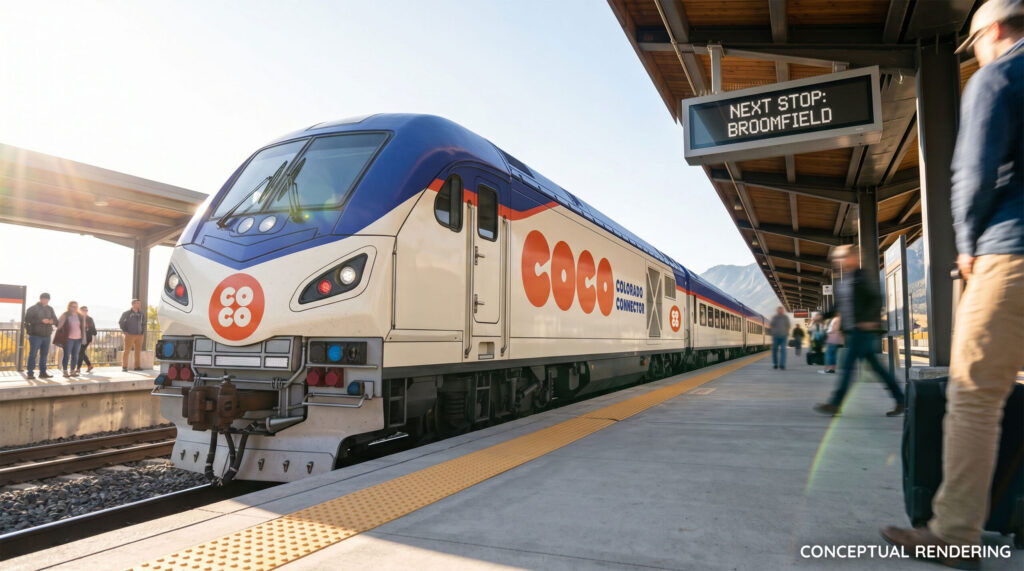
Colorado wants taxpayers to spend another $4.73 billion on passenger rail.
Don’t worry. They have a plan.
Which is a little like your brother-in-law announcing he’s launching another exciting restaurant venture after his last three restaurants ended in bankruptcy.
Please. Tell me where to send the check.
This week the Front Range Passenger Rail District released its “plan” for their choo-choo, laughingly branded “CoCo,” a desire named streetcar stretching from Fort Collins to Pueblo.
According to Independence Institute transportation analyst Randall O’Toole, the project will cost at least $4.73 billion. At least.
If that number sounds familiar, it should. It’s nearly a billion dollars more than Denver’s Regional Transportation District promised FasTracks would cost.
As the former chairman of RTD, I’ve seen firsthand how these numbers are invented for political marketing. Keep the estimate low enough to win the tax increase. Worry about reality later.
We were promised FasTracks would relieve congestion, transform transportation, and be completed by 2017 for $3.8 billion.
Instead, taxpayers have already spent about $5.5 billion. RTD says it still needs another $1.6 billion to finish what it promised. Congestion is worse. Ridership is down. And Longmont is still waiting for its train.
Passenger rail is Colorado’s abusive boyfriend. It lies. It takes your money. It promises it’ll change this time. And somehow, we keep taking it back.
So here we are again.
The choo-choo undead never stay dead. Like any good horror movie, they just keep coming back. Every failed rail proposal depends on one thing: taxpayer Alzheimer’s.
Forget the promises. Forget the cost overruns, the delays, the unfinished projects.
Then buy the next glossy brochure.
RTD’s original sales tax increase proposal in the 1970s promised 118 miles of rail by 1980, after which the tax would be reduced.
Voters approved the tax. Not one inch of rail was built. The tax was never lowered.
Then came FasTracks in 2004, complete with another sales tax increase and another set of promises. The ending wasn’t much different.
And now it’s time for a train named after a cross-dressing stripper. On stage number one: Give it up for CoCo!
O’Toole points out something that should embarrass every elected official promoting this proposal. The document isn’t really a plan at all, even though it proudly calls itself A Plan That Works.
A real plan asks uncomfortable questions. What if ridership falls short? What if construction costs explode, if changing technology makes the project obsolete, if another transportation investment produces greater benefits?
This document asks none of them. Instead, it simply says we’ll spend $332 million in Phase One. Then another $1.7 billion. Then another $2.7 billion.
Apparently, recessions never happen. Construction costs never rise. Ridership never disappoints. Politicians never overpromise. Reality simply isn’t modeled.
Private businesses don’t operate this way. You open a restaurant and nobody comes, your response isn’t, “Excellent. Let’s immediately open three more locations.”
Otherwise, you’d be RTD.
One of my favorite CoCo selling points is that people can ride the train to Broncos games. Adorable.
CoCo carries roughly 500 passengers. Empower Field holds around 76,000 fans. Congratulations. You’ve solved approximately one bathroom line.
Then there are the economic claims. The report insists every taxpayer dollar invested somehow creates five dollars in economic benefit.
Awesome! Government planners have discovered a machine that turns one taxpayer dollar into five dollars. They should stop building trains and take over Wall Street.
But here’s the question missing from every glossy brochure: What else could Colorado do with $4.7 billion? Economists call it opportunity cost.
According to CDOT’s own 10-year transportation plan, that same amount of money would fund the state’s 23 most expensive transportation projects: Floyd Hill. Vail Pass. Eisenhower Tunnel repairs. Major reconstruction on I-25 north of Denver. Bridge replacements. Colorado Springs improvements. Grand Junction improvements. Twenty-three major transportation projects.
Or — one train.
If the goal is reducing traffic congestion with nearly $5 billion, it’s difficult to imagine a less effective investment than passenger rail.
This isn’t rail versus nothing. It’s rail versus everything else.
Colorado isn’t suffering from a shortage of transportation needs. It’s suffering from a shortage of priorities.
FasTracks already taught us that rail mega-projects routinely cost more than promised, take longer than promised, and deliver less than promised.
Before Colorado asks taxpayers to finance another multibillion-dollar railroad, perhaps government should finish paying for the last one.
Jon Caldara is president of the Independence Institute in Denver and hosts “The Devil’s Advocate with Jon Caldara” on Colorado Public Television Channel 12. His column appears Sundays in Colorado Politics.