







Denver weighs permanent restriction on low-level traffic stops
A Denver City Council committee is considering permanently limiting certain types of low-level traffic stops used to investigate unrelated crimes and requiring better public reporting about why such stops happen.
Members of the Budget and Policy Committee on Monday were briefed on a proposal by District 6 Councilmember Paul Kashmann that would codify an existing Denver Police Department policy into a city ordinance.
The committee took no action on the proposal.
Low-level traffic stops, also referred to as pretextual stops, are minor traffic violations that do not pose a public safety threat, such as improperly displayed registration, heavily tinted windows or a cracked taillight.
Traffic violations such as speeding or reckless driving would continue to warrant a stop, according to Kashmann.
The current Denver Police Department operations manual discourages such stops unless officers can justify why the stop was necessary, such as connecting the driver to a serious crime or one that involves serious bodily injury.
Kashmann cites two big reasons to address low-level stops in Denver.
“First, historically, nationwide, lower-level infractions have been used to justify stopping people of color in excessive numbers for how they look rather than how they’re behaving,” Kashmann said. “The other extremely important reason to address low-level stops is that data has shown that low-level stops do not make the best use of our officers’ time.”
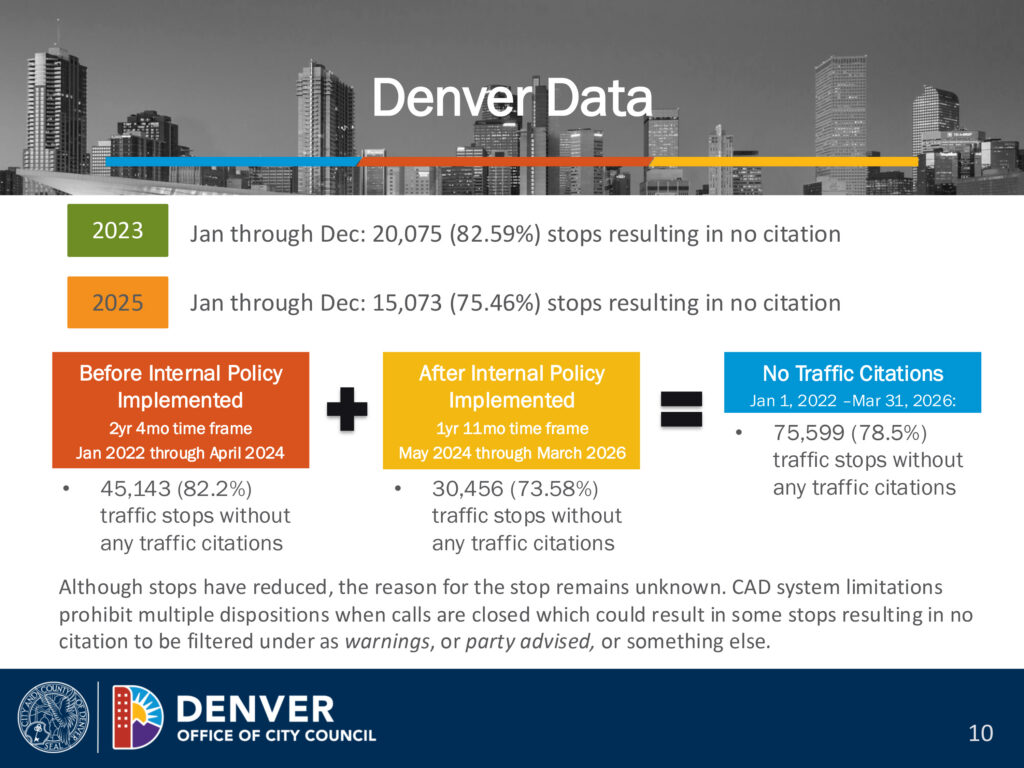
Supporters argue that the proposed change is not about ignoring traffic safety, but rather about a better use of city time and resources, concentrating more efforts on more serious crimes.
Along with the seizure of contraband in far lower numbers than more serious violations, low-level stops waste resources, Kashmann told the committee members.
“They can involve DPD time, city attorney, public defenders’ time and the courts all spend time prosecuting and defending these cases,” he said.
However, District 2 Councilmember Kevin Flynn doesn’t support the proposal nor would he vote in favor of it, adding that “I don’t think we should be micromanaging these operations in the code.”
Among the challenges with low-level stops, Kashmann said, is the lack of documentation from the participating officer for the reason for the stop.
Eelise Bupp, Kashmann’s chief of staff, said her office was told by DPD and the Department of Safety that “officers have fields available to document the reason for a stop. However, this information is difficult to extract and present in a data set because it may be recorded in a narrative notes section of an internal police form or in another open-text field that does not use standardized response options.”
If adopted, the measure would require quarterly reports detailing the type and reason for the stops to be presented to the Denver City Council.
Targeted periods of enforcement authorized by DPD, such as those for expired license plates, would be exempt.
The concept is not new.
Nine U.S. cities have enacted ordinances limiting low-level traffic stops: Ann Arbor, East Lansing and Ypsilanti, Michigan; Memphis, Tennessee; Philadelphia and Pittsburgh, Pennsylvania; Chapel Hill, North Carolina; Shaker Heights, Ohio and West Hollywood, California.
More discussion on the draft bill’s language will take place before it is expected to return to committee.