







Climate crisis looms large for weaver Tali Weinberg

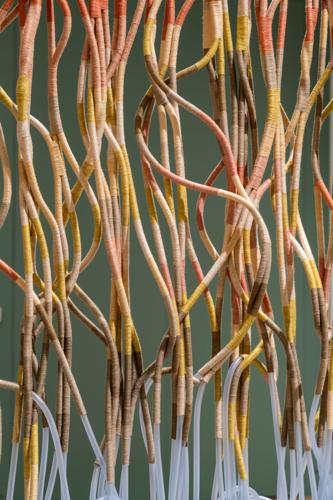
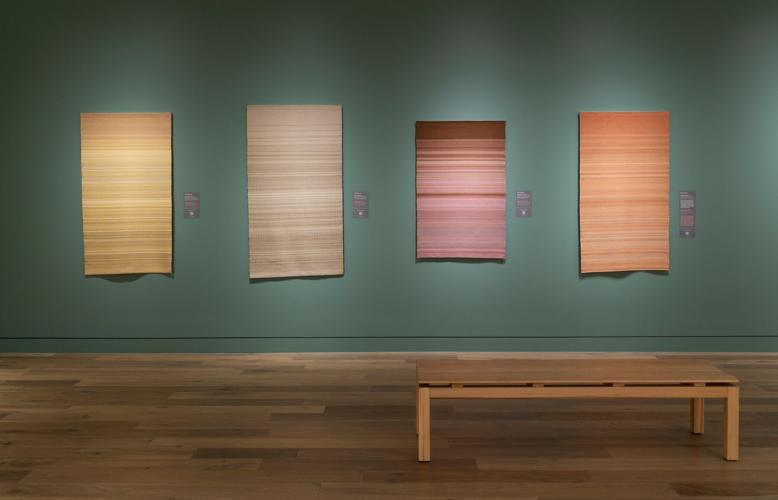
Tali Weinberg, detail of Heat Waves/Water Falls, watershed climate data, plant fibers, plant dyes and medical tubing, 2023. Tali Weinberg, detail of It’s Not Just About the Rain, 120 years of annual temperature data for California (top), 120 years of Palmer Hydrological Drought Index data for California (bottom), cotton, madder root, cochineal, weld, osage orange, indigo and iron, 2015. Installation view at Denver Botanic Gardens, 2024.
Courtesy photo, Scott Dressel-Martin
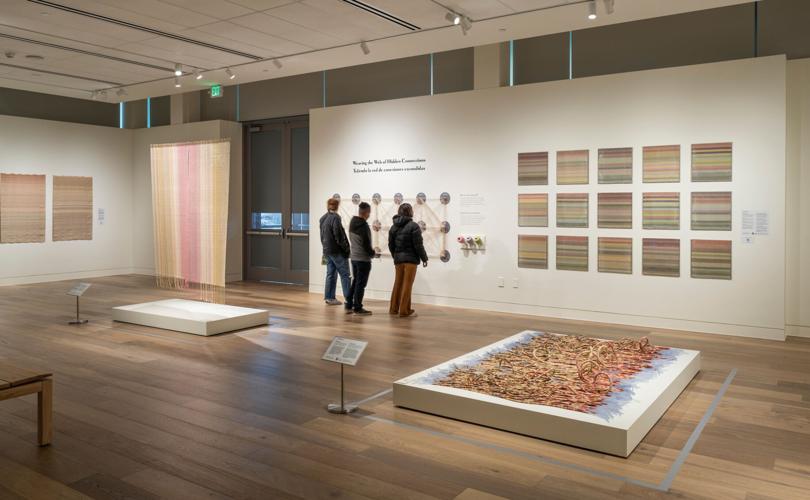
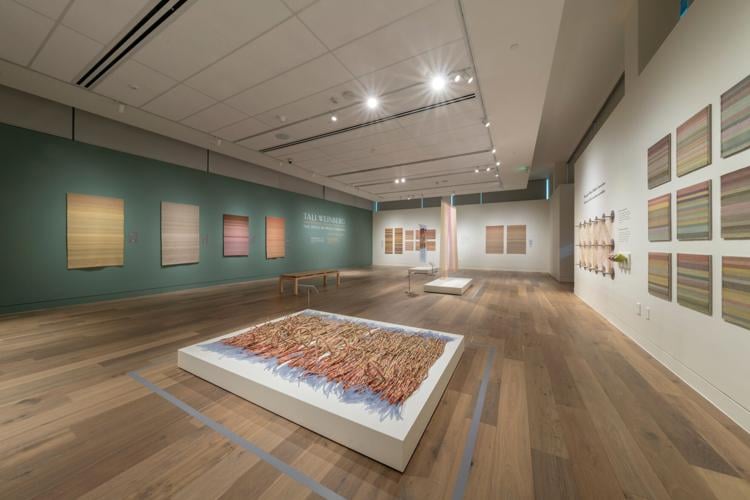
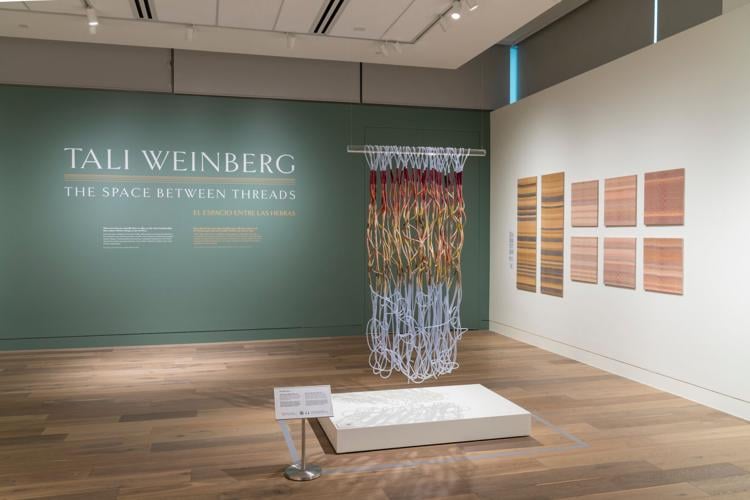
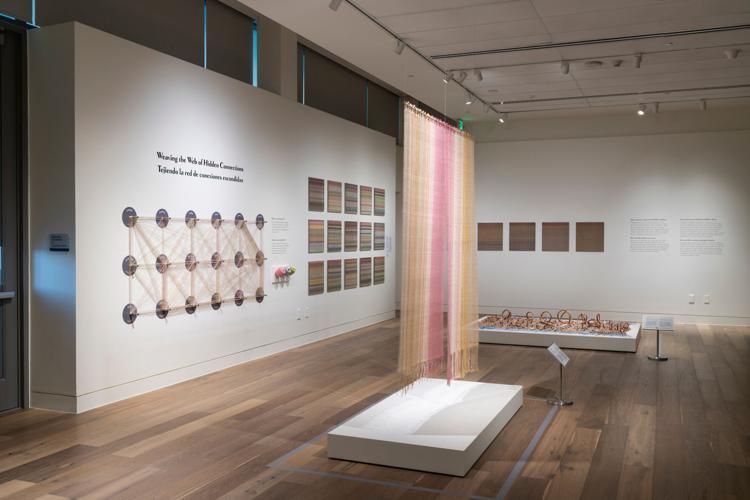
The word “weaving” is both a noun and a verb. As a weaver, Tali Weinberg deftly interworks warp and weft — two diametrically opposed fibers that under tension and her skilled hands form a third object: cloth.
Indoors through June 9, Denver Botanic Gardens (DBG) exhibits Weinberg’s compelling weavings and fiber sculptures that the artist considers abstract landscapes. Titled “The Space Between Threads,” the show appears at first glance feminine, pretty, somewhat domestic.
Yet, in a twist of beauty woven with ugly evidence, Weinberg’s art portrays the dreadful dangers of Earth’s worsening climate crisis. Lovely to behold, one piece suspended like a giant diaphanous scarf is delicate and iridescent as a dragonfly wing. Woven with dyed linen interspersed with monofilament fishing line, the luminous weaving — like other works in the show — artistically documents alarming climate data from the National Oceanic and Atmospheric Agency (NOAA), a branch of the U.S. Department of Commerce. Weinberg’s works intertwine NOAA’s numerical information with landscape and humanity.
“One of the things that drew me to weaving, and that I think is interesting in connection to NOAA climate crisis data, is all of the histories and mythologies of weaving as a subversive language for women and for marginalized people,” the artist said in an interview during a break while installing her show.
“Weaving is a way of speaking and a way communicating, a way of encoding knowledge. Weaving becomes this language that allows me to communicate in way I can’t communicate in words,” Weinberg said. “Everything gets to be a bit more complicated than is possible to put into words when I’m interacting with these materials.”
DBG associate director of exhibitions and art collections, Jen Tobias curated the exhibit.
“Climate data can be really hard to connect to on a personal level because it feels so abstract,” Tobias said in an email. “Tali uses the data as the foundation of her works, but frames it within the scale and terms of human experience in a way that makes it tangible.”
One common thread meshing DBG and Weinberg’s artworks is the organic plant fiber the artist colors with plant- and insect-based dyes. Weinberg’s historical natural palette ranges from a spectrum of rosy pinks and reds derived from madder or cochineal beetles to pastoral greens extracted from plant material to neutrals steeped in tannins.
“I don’t dye yarns for specific pieces,” Weinberg said. “I dye a ton of material all at once. Partly, it’s more efficient and especially more efficient water-wise.”
Water is one of Weinberg’s concerns, and the exhibit showcases her newest mixed-media sculpture which interprets temperature data for the major river basins of the continental U.S. The sculpture juxtaposes lengths of plastic medical tubing which she wraps — and wraps and wraps and wraps — with her yarns, color-coding climate data.
“Coiling is a practice that has roots in different textile processes like basketry,” Weinberg said. “For me, also, the physical entwining has an element of a care practice — like swaddling a baby or putting a blanket around someone.”
Weinberg’s laborious and dexterous touch, her fibrous stripes of muted colors, softens and makes beautiful the usually frightful and off-putting plastic tubing medical clinicians typically use for ventilators or chemotherapy.
“Medical tubing is a petrochemical-derived material, and this work is a way of connecting fossil fuel extraction harming the earth and our bodies in scarily parallel ways,” the artist said.
Titled “Heatwaves/Waterfalls,” Weinberg created the piece in the summer of 2023 — the hottest summer on record.
“I was listening to all of the horrible things the heat was doing to human bodies,” she said. “I was thinking about intimate connections and the way we are literally braided together.”
Weinberg began interlacing NOAA data in her artworks in 2015.
“Over the course of the years building this body of work, I’ve realized how much more entrenched the climate crisis is,” she said. “It’s a part of all of our lives.”
Another group of weavings in the show charts rising temperatures in four states where the artist has resided: her home state of Illinois, along with California, New York and Oklahoma. And while weaving and NOAA data might seem as opposite as warp and weft, Weinberg explained that they’re enmeshed.
“Weaving is a very mathematical thing. There’s a lot of mathematical patterning. There’s also a whole history of connections to computing, so in a way it’s very intuitive to interpret data through weaving. And at the same time, weaving does things the data can’t do,” she said.
“These works are tracing relationships between place, relationships between ecological and human health, between the deeply personal and the political, the body and the earth. A lot of the work in this show is exploring that things we think of as disparate are actually intimately interwoven and intertwined.”
The artist finds gratification in her fibrous crisscrosses where one bit of yarn plaits with another.
“For me, weaving is a million points of intersection. Every point of connection is what makes up the weaving,” Weinberg said. “There are thousands or millions of points of intersection.”
Weinberg’s works splicing science and art simultaneously sound an alarm and comfort visitors like a handmade blanket.
“There can be a tendency when talking about climate crisis to lean all the way to the side of ‘We are doomed and it’s the apocalypse.’ It’s so easy to talk about the end of the world. That is defeatist in a way that is not particularly helpful,” said Weinberg.
“We’re still surrounded by beauty. We’re still surrounded by places and people we can care for, and I think when you love something and acknowledge there is beauty, there’s a way in which it’s acknowledging what there is left to protect,” she said.
And while Weinberg applauds individual environmental efforts such as conserving water and recycling, she underscores the importance of policy change. And optimism.
“Even though this progression from cooler to warmer is very stark, we still have a choice every day in our policies about how much worse it’s going to get,” she said. “I think that it’s important to have the beauty and the hope, for lack of a better word.”
In May, Weinberg will return to Denver to teach two, one-day DBG classes.
“She will guide students through data, then teach them how to translate the information into small weavings,” said Melinda Laz, manager of DBG’s School of Botanical Art & Illustration. (Visit DBG’s website for registration.)
Weinberg also invites DBG visitors to avail themselves of benches in the galleries, to pause, to contemplate who they are and what they are responsible for, what they value and what they will or won’t do vis-a-vis the climate crisis.
“I would like people to see grief in the pieces, but I think that there’s something really powerful about that relationship between grief and possibility,” Weinberg said, adding: “There is always this ‘both’ ‘and.’ Weaving and art offers that ‘both’ ‘and.’ I would love for people to come and just sit and be with the colors and see what comes up for them, just to have a chance to sit with all we have left to save, all of that possibility that’s still there.”