







The call for a ceasefire, from a mother’s point of view | John Moore

Photos by John Moore, The Denver Gazette

There’s one basic human truth that bipartisan supporters of an immediate ceasefire in Gaza want befuddled politicians in Denver and across the United States to know:
“There are mothers on the other side of the fence as well.”
They want them to make the fighting and the suffering stop. Now.
Several U.S. cities have signed resolutions urging President Biden to call for an immediate ceasefire in Gaza as the war between Israel and Hamas enters its fifth month – San Francisco, Minneapolis and Detroit among them.
Not among them: Denver. On Monday, the city council voted against a similar proclamation by an 8-4 vote. Darrell Watson essentially called the idea pointless. Diana Romero-Campbell said a proclamation would be a disservice to Denver’s Jewish population, even though polls consistently show a majority of Jewish Americans support a permanent ceasefire. Kevin Flynn said a random proclamation out of Denver won’t affect what happens in Gaza one bit anyway – so what’s the point?
Last week, a group of theater artists tried to explain the point in a way that people can sometimes better understand than by way of political rhetoric: They made their case through art.
Longtime Boulder playwright and theatermaker Ami Dayan is presenting multiple readings of a brand-new, 20-minute play called “How to Be a Humanist After a Massacre in 17 Steps.” It was written by Israeli playwright Maya Arad Yasur in the raw days following the Oct. 7 attack on Israel and its ongoing bloody aftermath. Her play is best described as a short “how-to” course on maintaining one’s humanity in the aftermath of barbarism on both sides.
For example, No. 12: “Protect your children’s souls from being stained with the blood of too much information about evil.” Because too much information about what is really happening to affected families in the area “will rip to shreds the cloak of innocence you have wrapped their hearts in,” the playwright warns.
Of course, no 20-minute play is going to solve a conflict that has frustrated world leaders for more than 75 years. But it does help to bring things into a more understandable emotional focus:
“There are mothers on your side of the fence whose children are on the other side of the fence.”
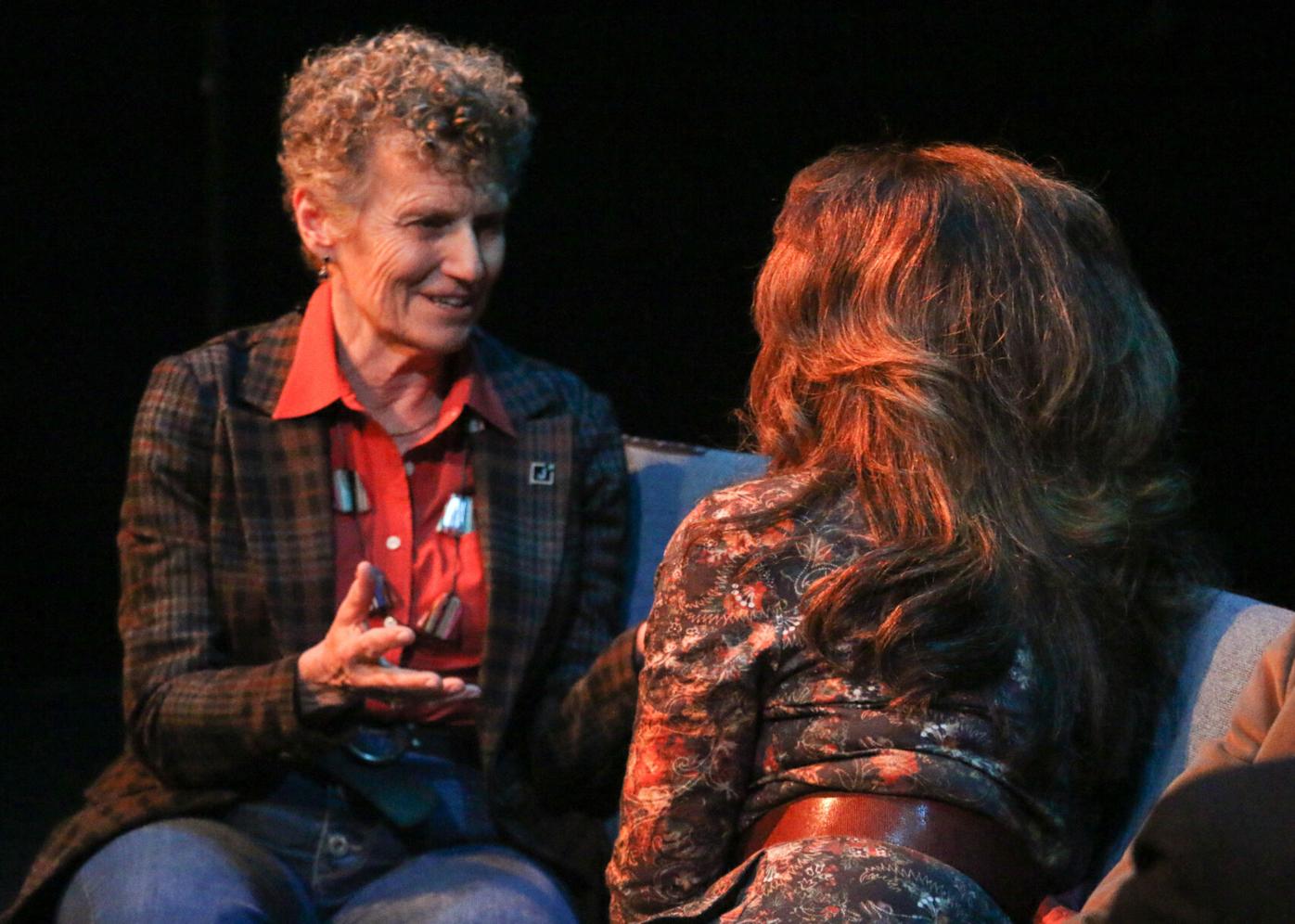
Nancy Reichman, vice-chair of J Street National Board, left; and Tirzah Firestone, Rabbi Emerita of Congregation Nevei Kodesh in Boulder, take part in a post-play panel conversation on the role of religion as a response to violence on Feb. 11 at Buntport Theater.
John Moore, The Denver Gazette


Nancy Reichman, vice-chair of J Street National Board, left; and Tirzah Firestone, Rabbi Emerita of Congregation Nevei Kodesh in Boulder, take part in a post-play panel conversation on the role of religion as a response to violence on Feb. 11 at Buntport Theater.
The first of four performances took place last Sunday and was followed by a compelling panel discussion that gathered several local religious and community leaders: Tirzah Firestone, Rabbi Emerita of Congregation Nevei Kodesh in Boulder; Carl Hofmann, Senior Associate Pastor at Grace Commons Church in Boulder; University of Denver Professor Nancy Reichman, vice-chair of J Street National Board; and Sergio Atalla, a Christian Palestinian from the Rocky Mountain Peace and Justice Center.
Two things they all have in common: Their singular faiths – and their unified call for a ceasefire. This despite their peoples having experienced very different kinds of losses on and after Oct. 7, when Hamas militants crossed Israel’s southern border, killed roughly 1,200 people, mostly civilians, and abducted about 250. The immediate and ongoing Israeli military response has taken more than 28,000 lives, according to the Hamas-run Health Ministry in Gaza.
If these faith leaders agree on one thing, it is this: The killing must stop. And until the politicians and military strategists who decide such things come to an unconscionably delayed cessation of hostilities, art will play its small but essential role 11,000 miles away at small venues like Denver’s Buntport Theater.
But of course, they agree on many things. They agree that this is all a minefield – a big, scrambled mess. One that, on Oct. 7, sent Jews, Muslims and humanists of every faith across the globe into what Firestone calls “trauma response in full blossom.” She was talking about our visceral, knee-jerk and often angry response to any monumental horror. “It’s coming from deep inside the body, she added, “and it’s like we can’t hold ourselves back.”
The play, she said, successfully conveys the complexity of that moment. “That playwright actually took a moment to feel and took a moment to think and to cognate and to unpack that complexity,” she said.
“But that did not happen en masse. It didn’t happen governmentally. There wasn’t one moment to sit back and say, ‘Wow, let’s look at the bigger context of this.’ There wasn’t one moment to stop and grieve, to rip our clothes, to hang our flag at half-mast or to do any of the ritual gestures that were necessary in that moment. Instead, we immediately went to war. And that tells us that our immediate response is not coming from our rational side or our spiritual side or our human side. It’s coming as an animal response to our own pain and trauma.”
The conversation touched on the political complexities of the conflict, the impact of antisemitism, the role of humanism and humanitarianism in navigating the conflict and, perhaps most compellingly, the false role of religion as a means for justifying violence.
Hoffman, the pastor from Boulder, admits to a frustration he often feels whenever his fellow Christians use scripture as a way of recruiting religion as a weapon. He sees it happening right now in this country with Christian nationalism, which he calls “a superficial and absolutely illegitimate misuse and seizing of our sacred scripture.
“Our deepest understanding of the text is humanism,” he said. “I feel like our strictures do that, and I think the Torah does that, too.”
To Firestone, so much about this conflict has nothing to do with Judaism – although it is very much identified that way by certain people.
“What’s happening right now is absolutely antithetical to any of the Jewish principles or core values,” she said. “I would say that anyone who is a spiritual Jew – or any spiritual person, really – understands that this is such an absolute aberration to religion.”
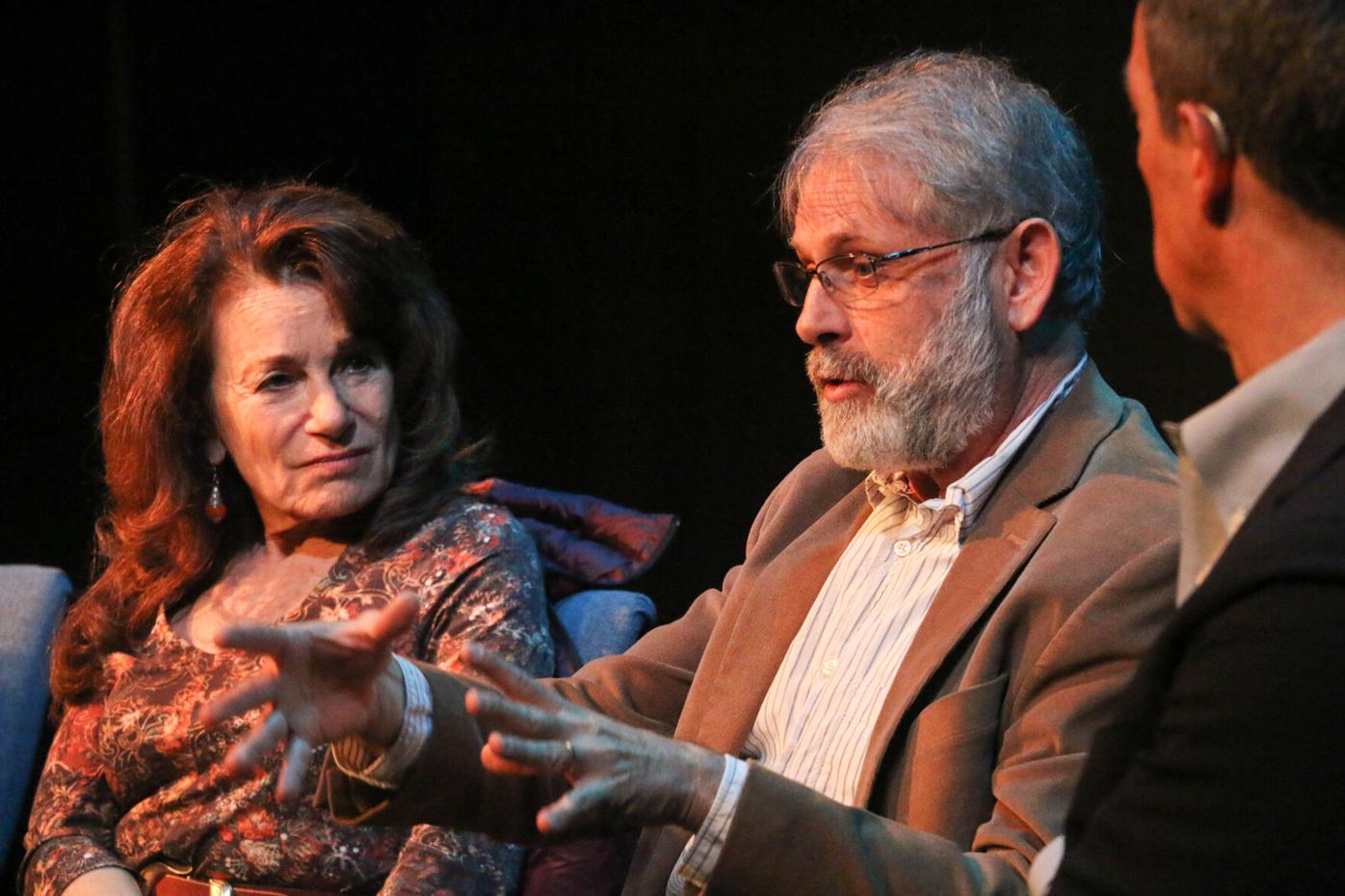
Sergio Atalla, of Christian Palestinian heritage, says he can never again feel empathy for Israel after its ongoing response to the Hamas terrorism has led to the deaths of at least 28,000 Palestinians. To his right is Tirzah Firestone, Rabbi Emerita of Congregation Nevei Kodesh. To his left is Carl Hofmann, is Senior Associate Pastor at Grace Commons Church. All three live in Boulder. Photo taken Feb. 11 at Buntport Theater in Denver.
John Moore, The Denver Gazette


Sergio Atalla, of Christian Palestinian heritage, says he can never again feel empathy for Israel after its ongoing response to the Hamas terrorism has led to the deaths of at least 28,000 Palestinians. To his right is Tirzah Firestone, Rabbi Emerita of Congregation Nevei Kodesh. To his left is Carl Hofmann, is Senior Associate Pastor at Grace Commons Church. All three live in Boulder. Photo taken Feb. 11 at Buntport Theater in Denver.
It was clear that all four of these Boulder-based faith leaders are friends despite their differing belief systems. Which made it all the more pin-dropping when one audience member asked the panel how often they find themselves empathizing with fellow Boulderites of differing faiths. That presumed softball took a major curve.
Atalla, the Christian Palestinian and peace activist, stopped the room with his honest response.
“You know actually, after that first day – I could never empathize with Israelis again,” he said.
After a long silence, he carefully continued.
“That’s because the reaction was revenge in the worst possible ways – which was, in some ways, perfectly understandable,” he said. “But then it kept going and going. Typically, when a Palestinian has committed a crime, the guilty party is shot – dead, obviously. Then the family’s home is destroyed, and the community is enclosed. But the (scale) of this response has been absolutely disproportional. It was exorbitant. So, when that happens, it takes away my capacity to feel empathy.”
Mari Brown, the actor who also facilitated the conversation, then carefully asked the director, himself an Israeli American, how that statement landed with him.
“I will say that (Israeli) Prime Minister Yitzak Rabin said, in his last year before he was assassinated (1995), that the IDF (Israel Defense Forces) has never been advocating for hatred,” Dayan said. “His thinking was: ‘There’s an enemy, we fight it. It’s not hatred.’ But what’s happening right now on the ground is rabbinic. The commanders on the ground are giving Torah lessons of revenge before they’re turning destroyed buildings into menorahs. That has never happened in the past. To me, this is not the Israel that I long for and recall. It’s changing.”
What’s not changing, apparently: The U.S. playing any meaningful role in bringing an end to the violence. Even when 61% of likely voters, including a plurality of Republicans, say they support the U.S. calling for a permanent ceasefire and a de-escalation of violence in Gaza. Leaving frustrated peace activists to bypass our gridlocked Congress altogether and instead go directly to cities large and small like Denver and ask their town councils to join the call for a ceasefire.
There are mothers on both sides of the fence who would thank them for doing so.
The play, translated by Shir Freibach and performed by Brown, Wendy Ishii, Tamara Meneghini and former Rocky Mountain News theater critic Lisa Bornstein, will be presented again on Feb. 21 and March 13 at Boulder’s Dairy Arts Center, and on Feb. 25 at the Bas Bleu Theatre in Fort Collins. An additional, separate performance will take place March 10 at the University of Colorado Boulder, with students and faculty performing.
All programs include a reading of poems – one by Mahmud Darwish, who was regarded as the Palestinian National Poet until his death in 2008:
“Eventually the war will end.
The leaders will shake hands.
And all that will remain is one old mother awaiting her combatant son.
And the wife who waits for her beloved husband.
And all those children that wait for their father.
I do not know who sold whom whose Homeland.
But I did see who paid the price.”
John Moore is The Denver Gazette’s senior arts journalist. Email him at [email protected]