







Fort Carson soldier’s wife could be deported
As the country’s largest immigration enforcement crackdown continues in Minnesota’s Twin Cities, a Fort Carson sergeant is fighting a personal immigration crisis — one that may implode his family.
Sgt. Tyler Garza’s wife, Jennifer Maradiaga Baca, is not a legal U.S. citizen and an immigration judge’s 15-year-old deportation order from 2011 hangs over her head.
Because of the order, she has been targeted for removal in a saga that started in August with a sparsely worded one-page form letter mailed to their townhome address.
The letter directed Maradiaga Baca, 31, to report to Centennial’s ICE facility at 9 a.m. Aug. 31 with her immigration documents.
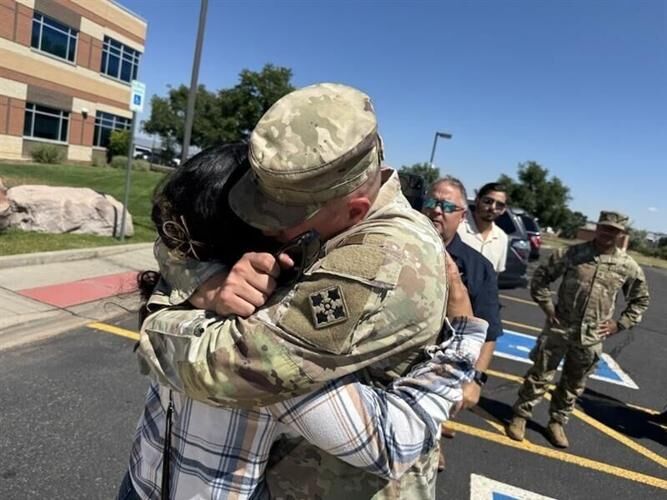
On a sweltering Colorado Sunday morning, she left her two daughters with a week’s worth of homemade food and forgot to grab even a toothbrush. On trembling legs, she walked through the door of the government building, accompanied by her husband, who was dressed in his khaki duty uniform, fully expecting to say goodbye.
Instead, she got a reprieve, with a warning that her stay in the U.S. was not guaranteed. The couple drove to Denver several days later, where Maradiaga Baca was fitted with a GPS watch that monitored her daily routine.
Two weeks ago, a second letter from the Department of Homeland Security arrived, signaling Maradiaga Baca to report again, this time to an ICE facility in Florence.
This document was signed by a deportation officer who only used an initial for his first name, his last name — Hammond — and a badge number.
This Thursday, the couple will again drive to an ICE facility with zero expectation that Garza will be walking out with his wife beside him.
“The situation is terribly unfortunate and disappointing,” Garza, 29, said. “It breaks my heart as someone who considers himself a patriot.”
The Office of Homeland Security and ICE media personnel did not respond to a request for comment.
MARRIED TO A SOLDIER, BUT NOT AMERICAN
The Garzas’ story is common. According to 2021 data from the group fwd.us, there are as many as 80,000 long-term undocumented spouses and parents of military members and veterans living in the United States.
According to fwd.us statistics, most of them are female and 45 years-old or younger. Like Maradiaga Baca, over half are from Latin-American countries. Around a third are Asian.
There are cases of military spouses who were deported but eventually rejoined their families through humanitarian parole.
But Maradiaga Baca wears a scarlet letter, one she and Garza have desperately fought to overcome.
In 2011, shortly after she arrived in the United States, an immigration judge ordered her removed, but the order was not enforced. Maradiaga Baca, then in high school and living with her family, flew under the radar.
United States Citizenship and Immigration (USCIS) documents provided by Maradiaga Baca show that she applied for a green card in December 2022 and was denied a year later. The reason? She still had the outstanding removal order.
Authorities informed her that there was no chance for appeal. The Garzas filed for asylum and also for a motion to reopen the case for reconsideration in the summer, but the couple has not heard anything.
Tyler Garza admits he “did things wrong the first time,” when they “went the cheap way” and hired an inexperienced paralegal to help them years ago. That effort did not amount to anything.
He has little money left to fight his wife’s removal order.
“I’ve drained my retirement, we maxed out credit cards, I work side jobs, and loans, you name it,” he said. “All the things I would tell my soldiers not to do for the sake of financial readiness is what I’m having to do to try and keep my family together as best I can.”
MARADIAGA BACA’S STORY
Maradiaga Baca’s history is one shared by tens of thousands of other undocumented immigrants. In 2010, the then-15-year-old Honduran citizen crossed the border illegally.
According to a Department of Homeland Security spokesperson, Maradiaga Baca allegedly entered the U.S. by “wading the Rio Grande River west of the Hidalgo, Texas Port of Entry, a place not designated as a port of entry.”
Immediately after entry, Mariadaga Baca was detained and placed into immigration proceedings. Immigration records show the teen was ordered to be removed on June 8, 2011.
GARZA’S DIFFICULT CHOICE
Garza has been torn between duty to country and family. The Army allowed the Fort Carson 4th Infantry Division squad leader to stay behind when his unit deployed to the Middle East last fall.
He said the biggest concern factored into the decision to keep him home was that he would not be able to lead his soldiers if he was worrying about getting a call that “the worst had happened back home.”
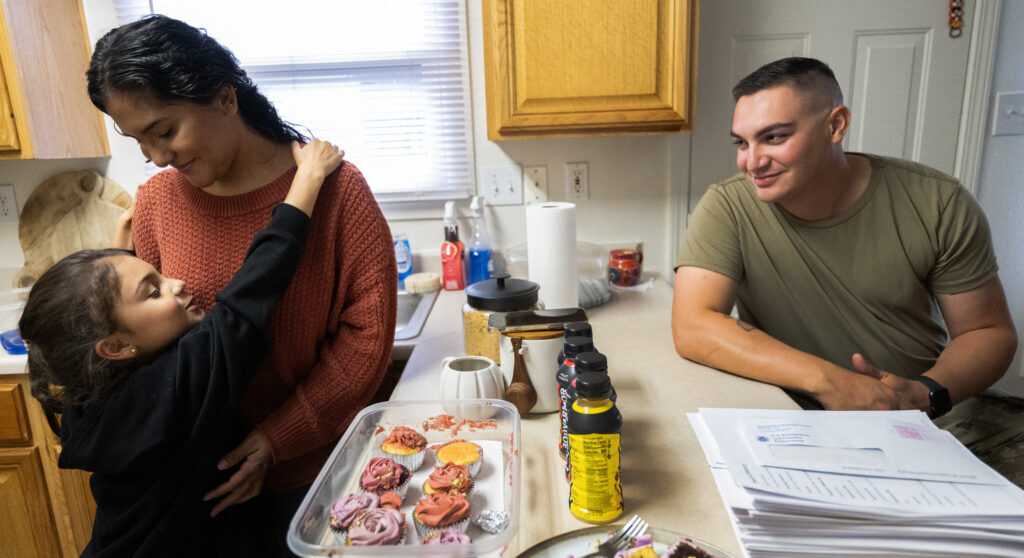
If Maradiaga Baca were deported, the couple’s children, who are U.S. citizens, would be left with no parents.
Danitza James, president and CEO of Repatriate Our Patriots, said that Maradiaga Baca should be treated differently from other undocumented immigrants in the United States simply because she is a soldier’s wife.
“When you’re in the military, you have to be able to deploy at any time. Jennifer is the caregiver for their children. Her removal from the family will impact Tyler Garza’s military readiness as a soldier,” said James, who is a veteran.
James said that marrying an active duty soldier does not guarantee U.S. citizenship, but such a marriage has been known to expedite the process.
During her four months in limbo, Mariadaga Baca’s viral surveillance has become a routine. She checks in with authorities by sending a photo. Sometimes, she’s told to send her fingerprints.
She rarely leaves home for fear she’ll be picked up by ICE agents and sent away.
Her life has become a flood of emotions, from gratitude to embarrassment to the stress of knowing she could be swept away any day.
“She’s worried she’s gonna miss a notification and agents are just gonna come storming through the door,” said Garza.
The couple is determined that no matter what happens Thursday in Florence, they will find a way to stay a family.