







Patrick Marold’s dreamy Denver sculptures
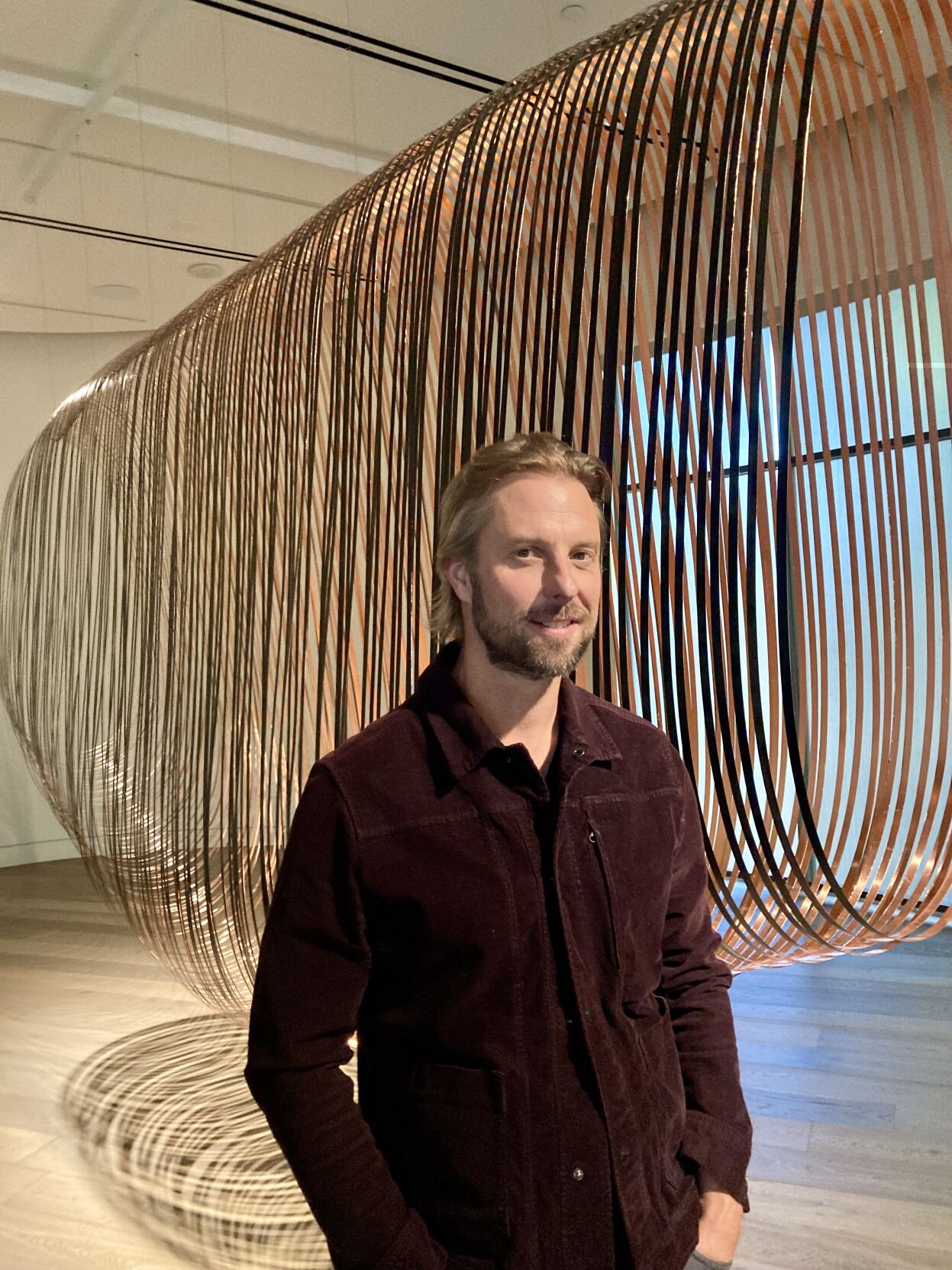
Denver sculptor Patrick Marold pictured at Denver Botanic Gardens with "Shadow and Light" exhibit. Though the exhibit ends its run in January, Marold's sculptures can be found at Denver International Airport, the Denver Zoo, City Park and more. (Photo by Colleen Smith/Special to The Denver Gazette)
Colleen Smith/Special to The Denver Gazette
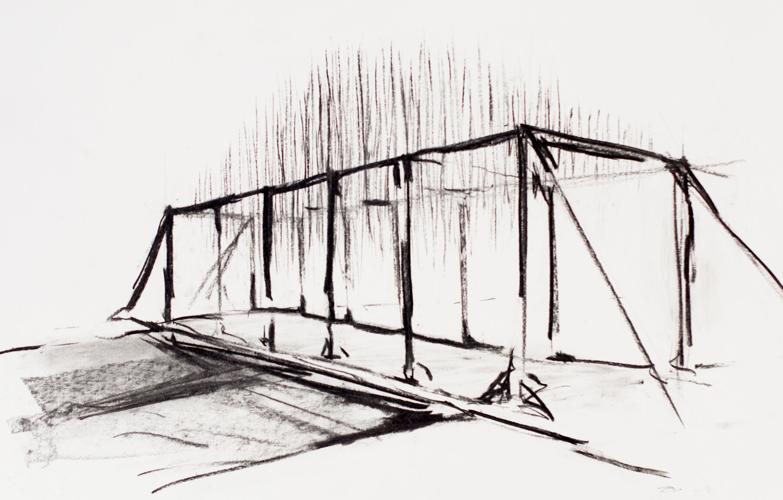
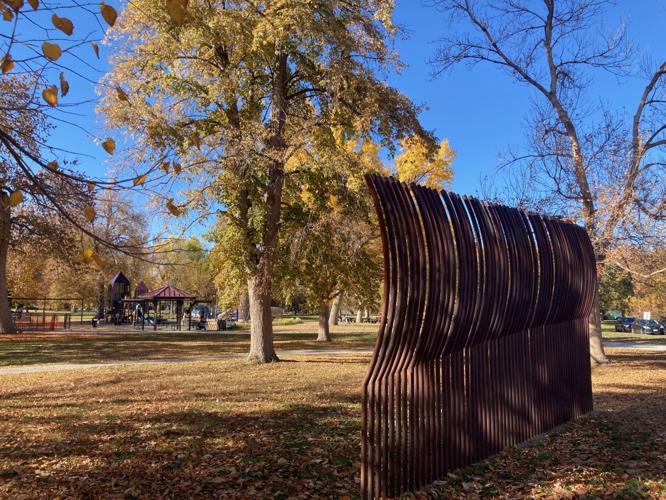
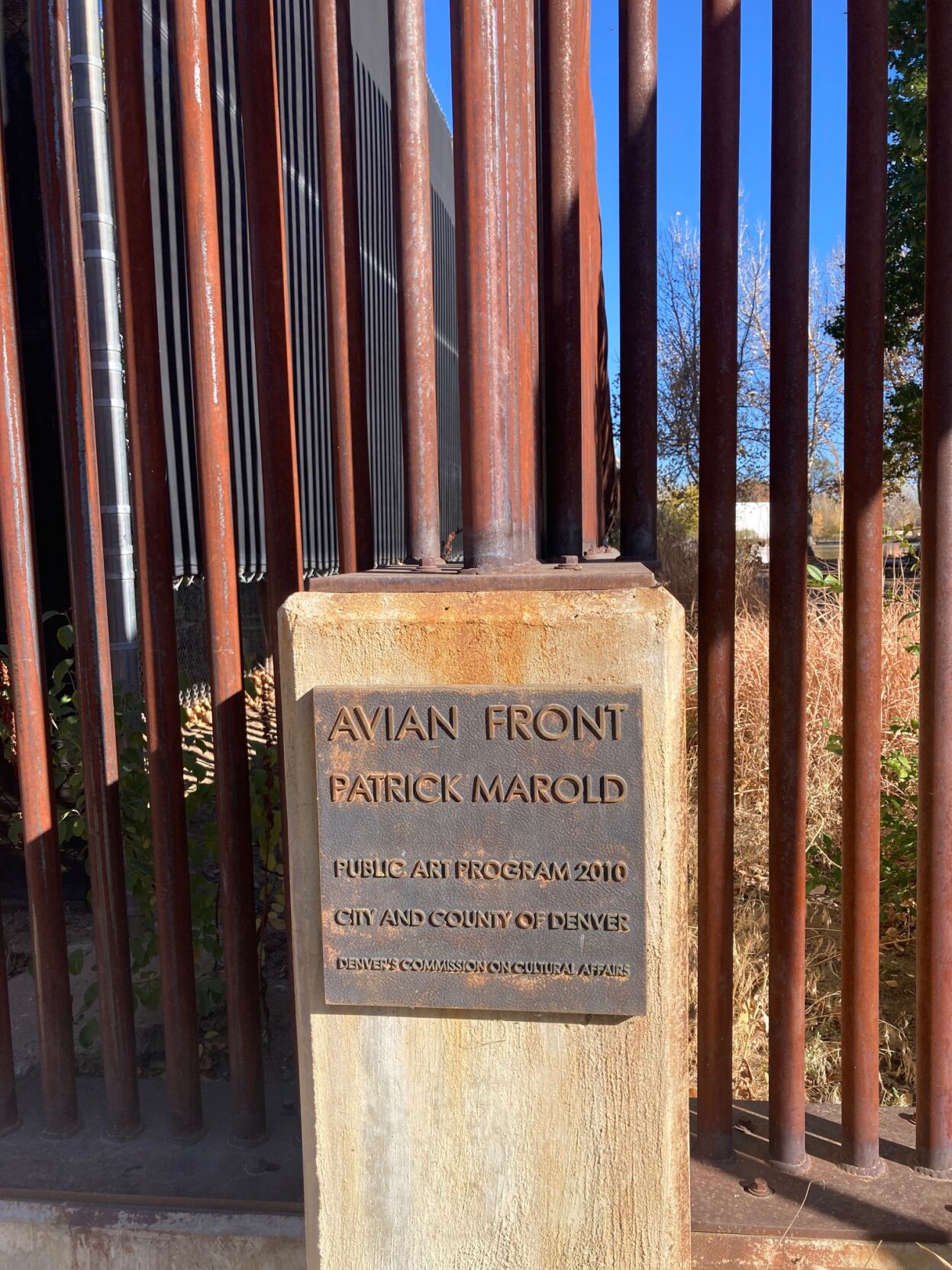
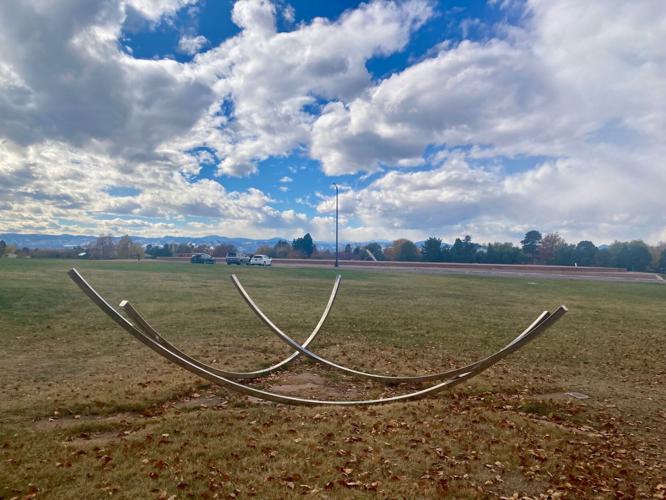
Patrick Marold’s site-specific sculptural installation titled “Shadow and Light” will be on exhibit at Denver Botanic Gardens through Jan. 5. The abstract work could call to mind a floating, coppery rib cage of a dinosaur. For Marold, showing at the botanic gardens is a career plum.
But even after the installation comes down, Marold’s large-scale works hybridizing art and architecture will remain prominently on permanent display around town at the Denver Zoo and City Park, Denver International Airport (DIA), Cranmer Park in Hilltop, the Delgany Pedestrian Bridge downtown and Gates Tennis Center in Cherry Creek North.
A Wheat Ridge, Colo., native, Marold earned his degree in industrial design from the prestigious Rhode Island School of Design. After graduation, he worked for three years with the world-famous artist Andy Goldsworthy. Marold’s job included chauffeuring the British eco-sculptor unaccustomed to driving on the right side of the road. And while steering Goldsworthy, celebrated for his often-ephemeral nature sculptures, Marold learned a thing or two about creative drive.
“Andy is known for his ego personally, but his lack of ego in making his work was hugely informative to me. Any failure was going to teach him something that day. As a young man, that was a huge lesson for me,” Marold said.
Marold worked on Goldsworthy’s serpentine Storm King Wall built in upstate New York.
“I worked three months building that wall. I was a laborer,” said Marold, who, like Goldsworthy, creates sculptures that nod to nature, environmentalism and the impact of time.
Marold even has a brief, non-speaking cameo in “Rivers and Tides,” the 2001 documentary film about Goldsworthy’s captivating work with sticks and stones, fallen leaves, melting icicles and other natural materials. Marold also assisted Goldsworthy in Scotland, France and South Korea.
“A lot of it was reinforcing respect for nature and our place in it,” Marold said, “and the understanding of time because everything will change.”
Marold went on to a Fulbright Fellowship in Iceland. But it’s Denver where Marold has most often left his mark with his public art. Marold’s sculpture graces places where his outdoor works often blend in so harmoniously, they might go unnoticed by casual passersby.
Shadow play at Denver Botanic Gardens
That’s not the case with Marold’s site-specific copper and steel sculpture installation titled “Shadow and Light,” indoors at Denver Botanic Gardens (DBG). The gleaming piece fills the elliptical gallery with perfect proportions suspended and shimmering with the warm metallic color of freshly minted pennies. Like many of Marold’s sculptures, the piece plays on the synergistic repetition of lines, along with gravity, tension and shadow play.
“Lisa Eldred knew this gallery was very attractive to me,” Marold said. “This is a response to this gallery.”
Eldred serves as DBG director of exhibitions, art and learning engagement and as head curator of art.
“Some artists document nature, others are inspired by it,” Eldred said. “Given Marold’s longtime interest in shadows, solar movement and sculpture, we knew he’d develop something fitting. His excellent craftsmanship and responses to space made a collaboration based on trust possible. The result is a singular, glowing installation.”
Marold fashioned the brilliant sculpture from strips of spooled copper tape laminated to steel banding. Seated in the gallery for the interview, Marold couldn’t help but get up to adjust one of the bands of the sculpture.
“That made it worse,” he said, taking his seat again.
When a toddler rushed in and couldn’t resist rushing to touch the sculpture, sending the bands of copper swinging and shaking, Marold could only laugh, delighted by the instinct to set the shiny bands in motion.
“Did you see the shadows?” the artist asked the little boy.
The shadows are, in fact, a serendipitous surprise revealed during the installation. Marold built the sculpture in his studio, a converted llama barn near Nederland — where he lives with his wife, Audrey, and their two children.
“I’ve been working with copper a lot in the past five or six years for the color and luminosity, the ability to reflect. The reflective light within the body of the piece has a bouncy glow,” Marold said. “It’s a very utilitarian strap, often used for shipping, for strapping down cargo. A lot of my work uses very utilitarian, easily accessible materials. A lot of my work is salvaged material. Reclaimed. It’s intentional.”
“Intentional” is a quality noted by Mathias Leppitsch, another Denver-based artist. Leppitsch met Marold around 2009 and has collaborated as his technical consultant, project manager, fabricator and sounding board.
“Patrick’s process is a balancing of free and playful exploration with meditative study and expression. This intent imbues his work with the potential to offer similar experiences to those who encounter it,” Leppitsch said. “His work is most impressive in its ability to bring sculptural form to observations of delicate nuance in nature, whether it be time passing, wind, gravity, or effects of atmosphere and light.”
Work at DIA soars
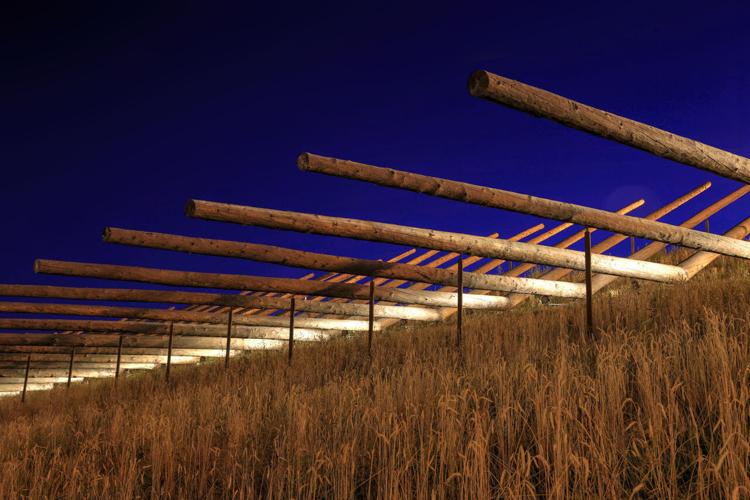
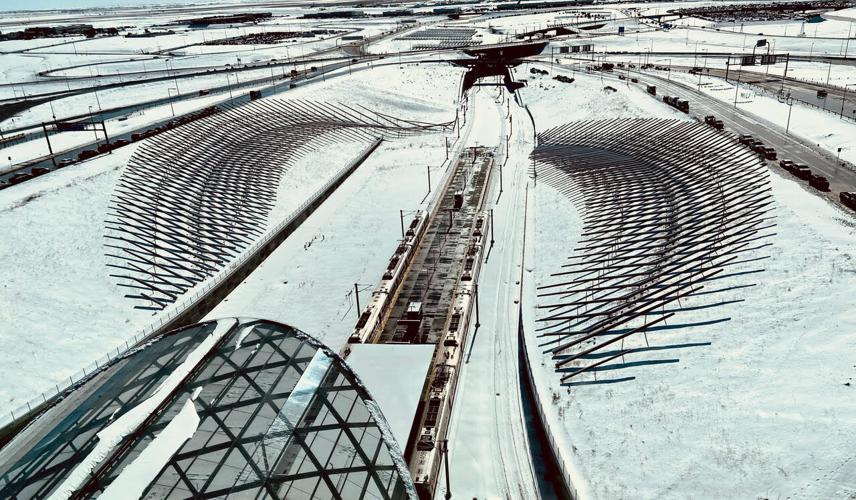
For “The Shadow Array” — the 7-acre sculpture Marold installed 10 years ago on a barren construction site at DIA — Marold used 235 hand-peeled logs from pine trees felled due to beetle kill in Colorado’s Rio Grande National Forest.
“I like the idea of working with material I don’t have to feel precious about because there is a percentage of failure or re-do. I embrace that, and it’s liberating,” he said. “It’s economy and ecology, minimizing waste and taking into consideration the impact on the environment when building. I’d like to see it happen all around us with everything we build.”
Marold was awarded the DIA commission without a proposal. Another finalist for the commission was Vito Acconci, whose work Marold had studied in college and whose installation at the Arvada Center was one of Marold’s first introductions to large-scale contemporary art.
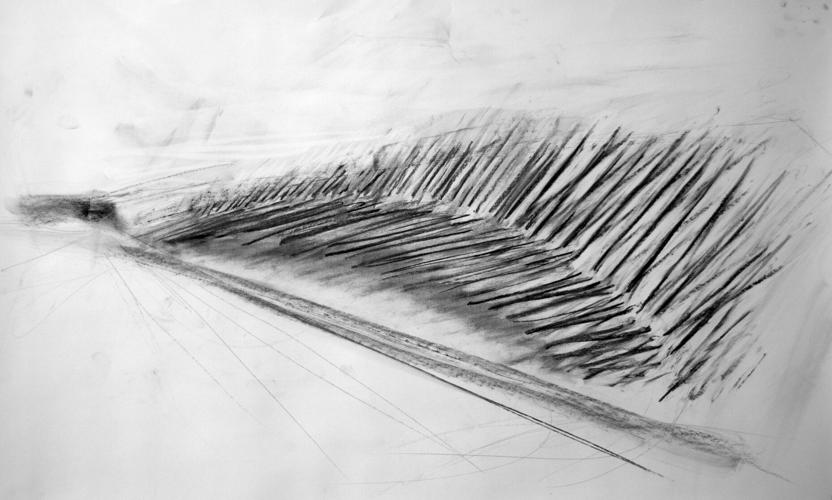
“DIA took a risk on me. They said, ‘Here’s the space.’ It was so apparent the solar exposure was going to be dominant, and the mass scale,” said Marold, who worked through six months of iterations before landing on his idea for the airport site.
“The logs bind the sky and horizon in this bowl and project shadows from the sun,” the artist said. “I wanted it to be sympathetic to the landscape.”
Thus Marold made a conscious decision to leave the logs untreated: “I didn’t want to soak them with creosote which is bad for the environment and bad for the people applying it. Creoste traps and kills the energy of the wood.”
After 10 years, Colorado’s weather has rendered the raw wood silvery. Marold intends to replace about 25 logs.
“The conversation we’re having presently is about some preservation steps. It is public art, but it’s not a 200-year piece. When I created the concept, I was shooting for 20 years. Some logs are sagged and twisted, and that’s intentionally very organic,” Marold said.
‘Denver has been good to me’
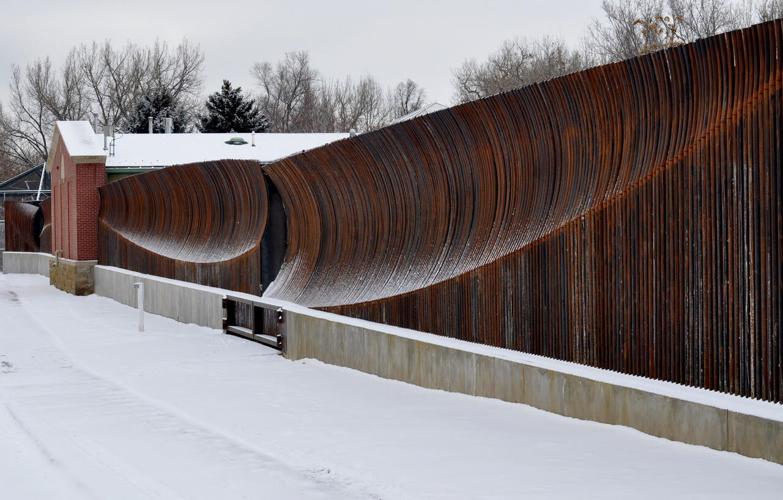
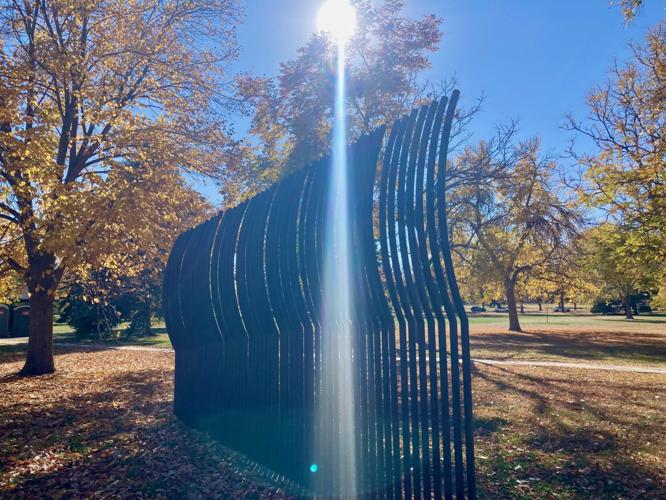
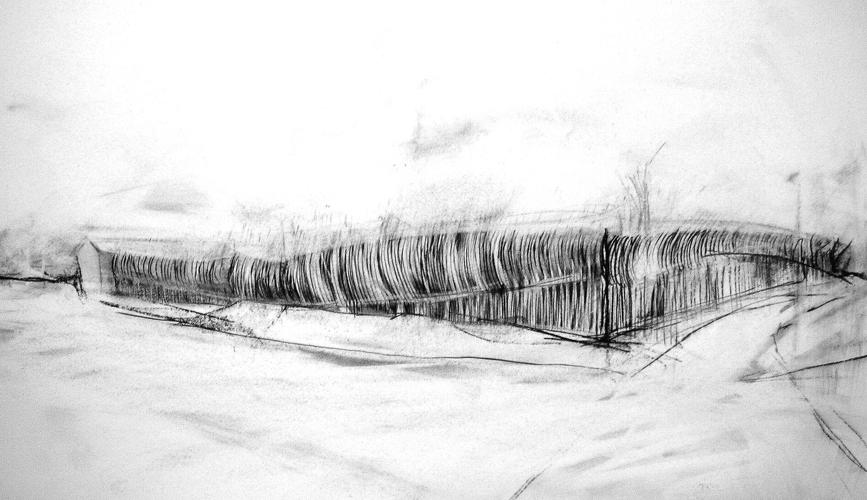
At Denver Zoo, Marold’s large-scale installation titled “Avian Front” camouflages the back side of the Avian Propagation Center. The microarchitecture of a feather inspired Marold’s design, though he constructed the wall from hundreds of heavy steel pipes salvaged from irrigation systems. The artist added two small isolated segments of the fence in the southwest portion of City Park on an axis with the zoo barrier.
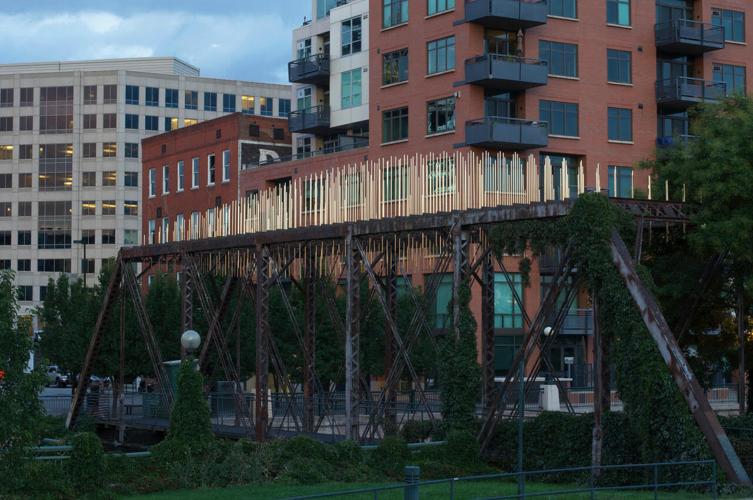
On the now-closed Delgany Pedestrian Bridge — an old train trestle spanning Cherry Creek not far from downtown’s Museum of Contemporary Art — Marold installed a work titled “Virga,” the name for rain that falls yet does not reach the ground. He used more than 300 stainless steel tubes to create a topiary armature for growing vines. Like virga, the sculpture sometimes seems to disappear depending on the weather.
The site-specific piece is a favorite of Rudi Cerri, the manager of Denver’s Public Art Program. “It’s either extremely dense or sometimes it almost vanishes,” Cerri said. “Around sunset, if you’re next to the artwork, the sun catches the bridge, and it explodes in light. People go to experience it at sunset.”
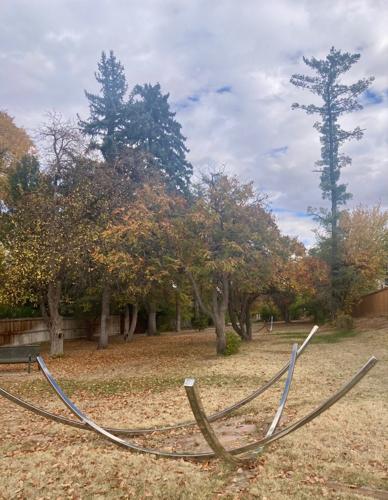
Cerri also noted “Bows,” a series of inverse arches of reflective steel in Cranmer Park, due east of the large sundial in a tree-dense passageway between the park and the neighborhood. Like silvery upside-down rainbows, Marold’s shiny 3-D lines draw attention up to the park’s panoramic vistas of the Front Range and the wide-open skies.
“These are minimal pieces that blend well with the environment,” Cerri said. “Patrick’s use of materials complements the site. He uses many different materials — glass, stone, wood, metal — and he’s very comfortable with all of them.”
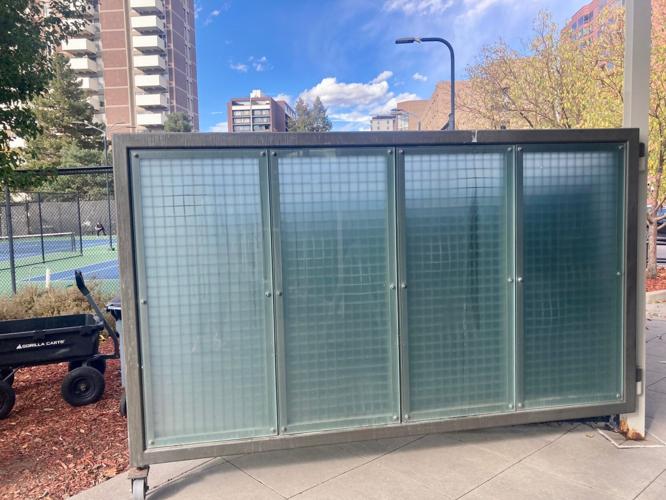
Cerri described the first piece the city commissioned: “Fault Shadows”— a gate at Gates Tennis Center.
“It’s a functional piece. It works as a gate. You have to look really closely in the grid of metal wires in the glass plates to see areas that look like a tennis ball hit it,” said Cerri.
“Sometimes with artists, if you see one work, you can pick out others. But with Patrick, his art is very varied,” Cerri added. “It’s always very well crafted, very original, very imaginative. It’s always a unique experience, and with his work, you have to look for a while and ponder to have your interpretation. We’re really privileged to have his work in our collection.”
“Denver,” Marold said, “has been good to me.”
The artist’s success seems to exist in the fulcrum between his grounded sense of industrial design and his flights of fancy. He’s fully in control yet he’s not. He’s simultaneously intentional and unintentional.
“My work continually keeps a pathway open for accidents to happen, and I allow time and space for that. Even with public works, I change something at the last minute when the site reveals a relationship I hadn’t anticipated,” Marold said. “That’s more rewarding when those things happen: allowing my work to have a life of its own. That’s what I love about doing the work I do: If I can allow for it to show me ‘this is why you made this piece.’”
DBG Meet the Artist video link. Here is a link to Patrick Marold’s process videos on Vimeo.