







What $180 million in illegal immigration cost means for Denver households and agencies
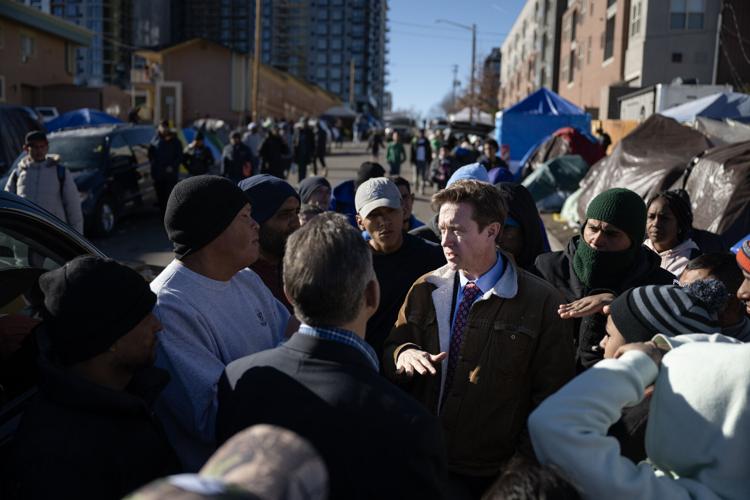
Mayor Mike Johnston, center, talks with a group of migrants at the encampment at West 27th Avenue and Zuni Street on Friday, Dec. 29, 2023, in Denver, Colo. (Timothy Hurst/Denver Gazette)
The Gazette


Mayor Mike Johnston’s projection that the city could spend up to $180 million this year on illegal immigration translates to more than $500 per Denver household, a new report said.
The estimate doesn’t include spending by nonprofits and health systems, which have also been groaning under the weight of “uncompensated care” in the form of emergency and other hospital visits by people without insurance.
The mayor’s projection, assuming it holds true, would easily swallow the entire budgets of several city departments, according to the report from the Common Sense Institute.
“It’s a large and growing issue that has an impact on local budgets,” said DJ Summers, the group’s director of policy and research.
Summers added, “This is a very substantial cost. We wanted to offer some context around the spending and how massive it is.”
Founded in 2010, the nonprofit organization based in Greenwood Village conducts fiscal and economic research.
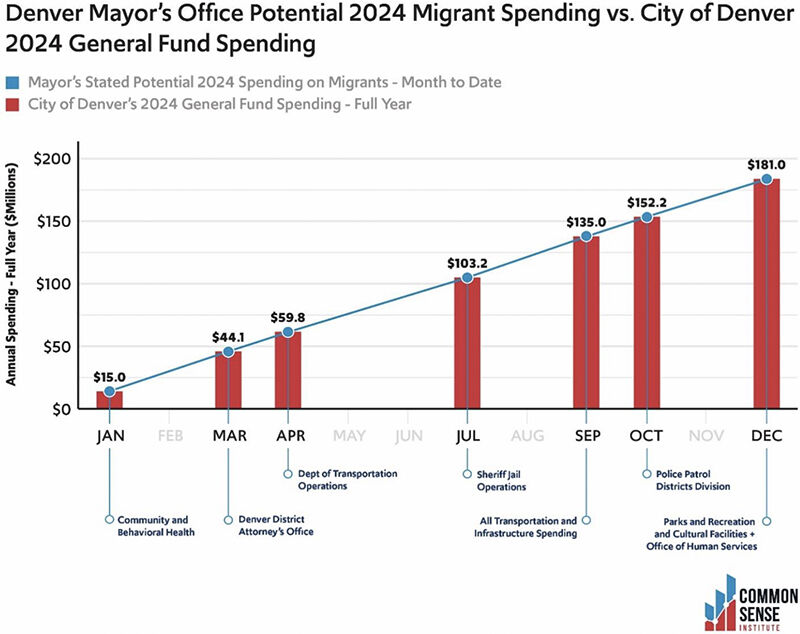
If Denver Mayor Mike Johnston's $180 million projection for the cost of accommodating immigrants who crossed the U.S. border played out in real time, it would equal the entire budgets of several departments.
Luige Del Puerto [email protected]


If Denver Mayor Mike Johnston’s $180 million projection for the cost of accommodating immigrants who crossed the U.S. border played out in real time, it would equal the entire budgets of several departments.
Johnston’s office took issue with pitting the projected costs against the budgets of city departments.
“Entire departments budgets are not on the table,” Jordan Fuja, a Johnston spokesperson said in an email to The Denver Gazette. “We have asked for agency leaders to assess where they can find savings.”
On Tuesday, Johnson warned councilmembers that the city has reached a breaking point with new immigrant arrivals — who illegally crossed the U.S.-Mexico border — ending up in Denver, a crisis that now threatens the fiscal health of Colorado’s most populous city.
As of Thursday morning, Denver was sheltering 4,650 immigrants.
The Common Sense Institute said Johnston’s projections are “alarming but highly uncertain,” noting that $180 million is more than five times the spending reported in December last year. The group added that the city’s illegal immigration expenses could reach $55.5 million at the current rate of immigrants arriving in the city, based on publicly available spending data.
For example, Denver reported spending roughly $3 million in December on these new arrivals, according to an analysis of the city’s weekly updates.
“Budgets reflect policy choices,” Summers said. “Policymakers and the public should carefully weigh trade-offs prior to turning projections into budgetary commitments.”
Summers’ report said if Johnston’s projection played out in real time, it would equal the budget of the Department of Community and Behavioral Health by January at a cost of $15 million.
By March, spending could reach $44.1 million, equal to the funding for the Denver District Attorney’s Office.
It would reach $59.8 million by April, the same amount as the Department of Transportation’s operations.
By July, the expense would stand at $103.2 million — the same amount as the funding for Denver County’s jail operations managed by the sheriff.
By September, it would equal all of transportation and infrastructure spending at $135 million.
By October, the spending would hit $152.2 million, the amount allocated for the Denver Police Patrol Districts Division.
And, by December, it would reach $181 million, equal to the funding for the Department of Parks and Recreation and Cultural Facilities, plus the Office of Human Services, the report said.
The projection doesn’t include spending by nonprofits, hospitals and emergency systems, the report said, adding that Denver Health, for example, noted a surge in the number of patients from Central America.
Dr. Steven Federico, chief government and community affairs officer for Denver Health, told The Denver Gazette Wednesday that the health system saw a $10 million increase in uncompensated care last year, largely attributed to the influx of immigrants arriving in Denver.
“It’s a difficult dilemma of how we best meet their health care needs when health care has not been part of the equation,” Federico said.
Federal regulations require hospitals to provide emergency care.
While the Denver Department of Public Health and Environment performs the bulks of the city’s health duties, Denver Health operates as the “safety net” system and, consequently, is partially funded by Denver taxpayers.
The mayor’s costs projection assumes the city will continue to temporarily house more than 4,500 immigrants a day throughout the year. That translates to roughly $40,000 per immigrant a year. That number could increase or decrease, depending on how many immigrants end up under the city’s care.
“If the pace of this humanitarian crisis need continues in 2024 as it has over the past few months of 2023, Denver’s migrant sheltering expenses could reach as high as $15 million per month or $180 (million) for the entire year,” Laura Swartz, a spokesperson for the City and County of Denver’s Department of Finance, said in an email to The Denver Gazette.
The costs associated with the immigrant response include expenses related to shelter and food, service providers, bus, plane and train transportation, rental assistance, staffing and more, Swartz said.
In comparison, the Johnston administration spent $45,000 per person to get 1,000 homeless individuals off of the city’s streets last year. Meanwhile, the state spends roughly $9,500 per student on average.
“We do not have space to add more folks that arrive nor do we have staff to support them,” Johnston said this week.
The city is under such a fiscal strain that Johnston said he asked city department heads to evaluate their budgets and come up with 10% to 15% in cuts.
The $180 million projection reflects about 10% of the city’s 1.74 billion budget.
“These resources would allow us to continue to meet the migrant crisis needs, while maintaining a balanced city budget this year,” Swartz said.
In addition to the fiscal belt tightening, the city will also likely hold non-essential positions vacant and closely review new or expanded contracts and programs.
Last month, the city sheltered — on average — 3,738 immigrants a day, according to the city’s dashboard.
In December, Denver first hit a record 4,000 sheltered immigrants, a number that has only continued to grow.
An unprecedented 37,335 immigrants from South and Central America — particularly Venezuela — have traveled to Denver since the U.S. began seeing a surge at the border with Mexico a year ago. Already, the city has spent more than $38 million on its humanitarian response, the bulk of which has been footed by Denver taxpayers, despite state and federal grants totaling $14.1 million.
Officials have speculated immigrants are drawn to Colorado’s most populous city because of its relative proximity to the Mexico border, while others believe its status as a “sanctuary city” is the appeal.
Generally, a sanctuary city is one that establishes a policy discouraging local law enforcement from reporting an individual’s immigration status to federal authorities.
The Denver Gazette Editor Luige del Puerto contributed to this report.