







Study shows twice as many state legislatures gerrymandered to favor Republicans | Cronin and Loevy
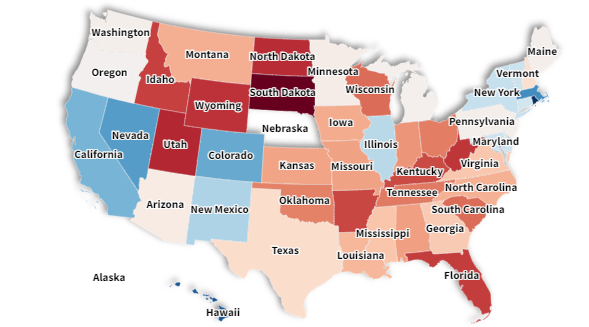
Most of the states in the United States (about 75%) have a legislature that has been gerrymandered to favor either the Republican or the Democratic party.
Gerrymandering is the drawing of legislative district lines in such a way that a political party elects more legislators than it would ordinarily be entitled to. Gerrymandering creates large numbers of “safe seats” for the dominant party in a legislature that cannot be lost, no matter how the voters are voting.
But there is a distinct partisan bias to the gerrymandering of legislatures in the United States. Roughly twice as many legislatures are gerrymandered to favor the Republicans as as are gerrymandered by Democrats.
Those are the results of a 48-state study conducted by the Center for Politics at the University of Virginia. Louis Jacobson was the lead commentator on the study.
The researchers started with the results of the 2020 presidential election between Democrat Joe Biden and Republican Donald Trump. They assumed the two-party election results in a presidential election were the best measure of party popularity in a particular state.
In states won by Biden, the researchers then calculated the Democratic percentage of seats in the state House of Representatives elected in 2022. The Democratic presidential percentage (Biden) was then subtracted from the Democratic percentage of seats in the state House. The result was the percentage of “excess-seat edge” for the Democrats in the state House.
The process was then repeated for Democrats in the state Senate. After that, the entire process was repeated for states won by Trump in 2020 and have been gerrymandered to favor Republicans.
For an example, let’s look at the Republican Party in the state Senate in Ohio. In 2020, Trump won Ohio with only 54% of the vote, but the Republicans swept 79% of the state Senate seats in 2022, thanks to gerrymandering. That gives Ohio Republicans an excess-seat edge of 25% in the Ohio state Senate (79-54) and puts the Democrats there at a great disadvantage.
The 48-state study did not include Nebraska, which has a nonpartisan unicameral legislature. It also excluded Alaska, where cross-party leadership alignments reduce party influence.
The researchers grouped Colorado with the small number of states that voted for Biden and whose legislatures had large Democratic majorities. The list included Rhode Island, Hawaii, Massachusetts, Nevada, New Mexico, California, Illinois, Vermont and Maryland.
The most significant result of this study was that about twice as many Republican states (25) as Democratic states (11) strongly exaggerated their presidential votes in their legislatures. States with heavily gerrymandered Republican legislatures included Florida, Wisconsin, Tennessee, Alabama, Missouri, Kansas, Ohio, Georgia, North Carolina and 16 more.
The researchers expressed concern over the impact of excess seats, both Democratic and Republican. In those cases where a party gains a significant advantage through excess seats, there is a tendency to go further than public opinion in the state when passing laws is concerned.
In Democrat-dominated legislatures, the legislature risks becoming much more liberal than the voters. The researchers noted excess seats create “legislative majorities that are more extreme than the voters.”
The researchers argued further that excess seats in Republican-dominated legislatures in the South have permitted those states to pass strong anti-abortion laws despite public opinion polls showing most voters in those states favor abortion rights.
Another problem is that powerful “excess” majorities in a legislative chamber will be “riven by ideological factions.” Arguments that used to take place between the two political parties are debated and decided in the majority party, thereby threatening party unity.
But the worst effects of “excess-seat edge,” according to the University of Virginia, are on the minority parties in the legislatures that fail to gain excess seats and drop into permanent positions of unimportance. They lose the ability to recruit strong candidates for the legislature and can no longer build a strong party infrastructure.
One might think that a legislature gerrymandered to unfairly favor one party over the other is a rarity, but the researchers found that is a widespread practice among states.
It also is notable that Republicans have succeeded in gerrymandering in about twice as many states as have Democrats. The inevitable conclusion is that these 25 or so gerrymandered Republican legislatures are conservative strongholds spread across the nation.