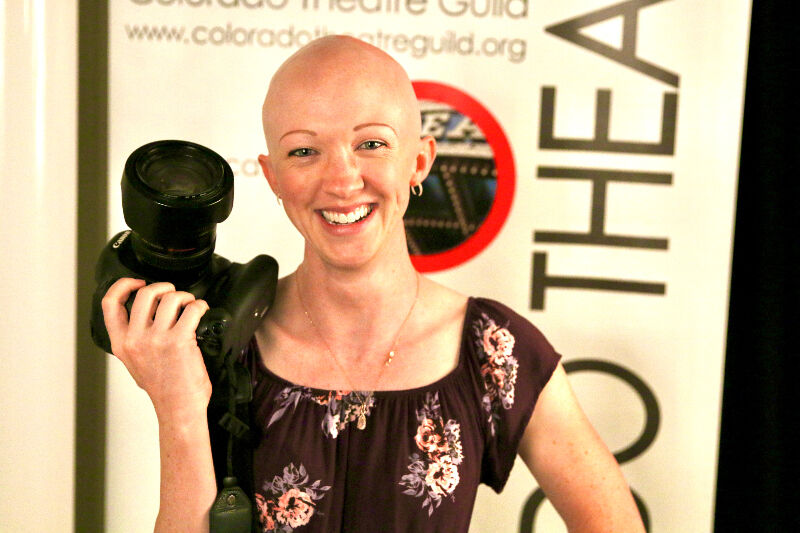
For Denver actors with alopecia, Oscars are a double gut-punch

Denver actor Rachel McCombs-Graham has been called G.I. Jane, too — and it hurt. But she’s tough. Living with alopecia for 25 years can be its own kind of boot camp.
She developed her first bald spot when she was 6. It would be 15 more difficult years before taking full ownership of her disease, a mysterious type of hair loss that occurs when your immune system mistakenly attacks your hair follicles.
“That’s when I just decided, ‘(Expletive) it. I look like this, and I don’t want or need to hide this in my daily life anymore,’ ” McCombs-Graham said.
But that doesn’t make leaving the house any easier. “People are rude all the time, and in the most unpredictable of ways,” she said. Like when she made a recent trip to the grocery store.
“One of the workers there passed me, turned around, walked back up at me and said, ‘Yo, dude, can you explain this to me? Why are all these chicks shaving their heads and stuff these days? Is it like this new fad? Do you guys think that actually looks good?’”
His comment, she added, “just hung in the air like a giant turd.”
Her husband was standing right next to her, much like Will Smith was seated next to his wife, Jada Pinkett Smith, at the Academy Awards on Sunday when Chris Rock made a crude joke about what he assumed was Pinkett Smith’s intentionally shaved head. Rock compared Pinkett Smith to Demi Moore, who famously sported a buzzcut in the film “G.I. Jane,” apparently unaware that Pinkett Smith has shaved her head as part of her own journey with alopecia. Seconds later, Smith delivered a vicious slap that left Rock, and millions watching, slack-jawed.
McCombs-Graham said she did not feel even one inkling of catharsis when Smith defended his wife by slapping Rock. Instead, her immediate thoughts went to Pinkett Smith.
“She did not look avenged,” McCombs-Graham said. “She looked like she had taken an arrow. But that punch didn’t get him anywhere. And it didn’t get her anywhere. I think it made an already uncomfortable situation for her infinitely more uncomfortable.
“Had my husband stepped forward and slapped that guy in the grocery store, would that have changed how I felt in that moment? No. I am still horrified, hurt and offended. That would have just added to the pain of that moment.”
McCombs-Graham is reminded by someone just about every day that she has alopecia, a mysterious disease that can be triggered by a variety of genetic, internal and environmental factors. People stare at her. Many assume she is sick. Some come right up to her and say things like, “How are your cancer treatments going?” Or, “Can I pray for you?” Or, “You are so brave to go out of the house like this.”
She wishes those people wouldn’t say anything to her at all.
In some circumstances, alopecia can cause bald spots and leave awkward patches of hair, so patients essentially have to choose whether to shave their hair off, cover it with a wig, “or go around feeling like you look like a drowned rat all the time,” McCombs-Graham said.
The graduate of St. Mary’s Academy and the University of Colorado went completely bald at age 12, but the disease comes and goes in waves. Most of her hair came back, but left again when she was 18, and again at 21, when she was diagnosed with a more rare and severe form of the disorder, called alopecia universalis. That’s when she decided to do away with wigs in her everyday life entirely — except for when she wants to be left alone. “If I am wearing a wig, it’s a huge signal to people: Nobody talk to me,” she said with a laugh.
McCombs-Graham won a True West Award in 2015 when she played the title role in a local children’s theater production of “Rumpelstiltskin.” In part because of her acting, and in part because she made the proactive choice to play the role with a fully exposed bald head. Each performance was followed by an audience talkback, which allowed the actor to tell children her story and bring awareness, understanding and empathy to the disease. She later received letters of thanks from several children who have alopecia themselves.

Nancy Evans Begley, another local actor with alopecia, called what she saw on the Oscars telecast “hideous” on many levels. “The joke was in poor, poor taste, but the slap was completely inappropriate,” she said, adding that she had zero tolerance for Smith’s violent response.
“When others offend and criticize me, I stand up for my own self, knowing my husband has my back but isn’t in the driver’s seat,” she said. “Both parties were at fault here — but in my opinion, one crossed a bigger line. Physical violence is never justifiable unless we are defending our lives.”
Alopecia makes what hair Evans Begley has too fine to grow out, so she keeps it short. She also has an even more rare autoimmune disease called pseudopelade that causes total body-hair loss. “If I had a dollar for every time I’ve been teased for my short hair, I’d be a millionaire,” she said. “I even had a client tell me I look like a gender-confused boy. The trauma and insecurity is very real, and that joke was in poor taste, whether Rock knew about the disease or not.”
Evans Begley and McCombs-Graham both say alopecia can be a particularly devastating disease for women. “Your hair is such a big part of being female,” said McCombs-Graham. “Your hair is part of your decoration and your self-expression. It’s a style choice. Jada came to the Oscars doing what her head is doing right now, and that put her in a very vulnerable place.”
If she could, McCombs-Graham would reach out to Pinkett Smith and say, “Let’s talk, vent, whatever.” “I want to offer myself up as a resource to anyone who is going through alopecia,” she said.
And what should those who are learning about alopecia for the first time take away from all of this? It’s pretty simple, McCombs-Graham said.
“How about: It is inappropriate to comment on anyone’s appearance, whether you know their circumstances or not.”