







Lockheed Martin lab in Colorado Springs paying dividends | Space Symposium 2023
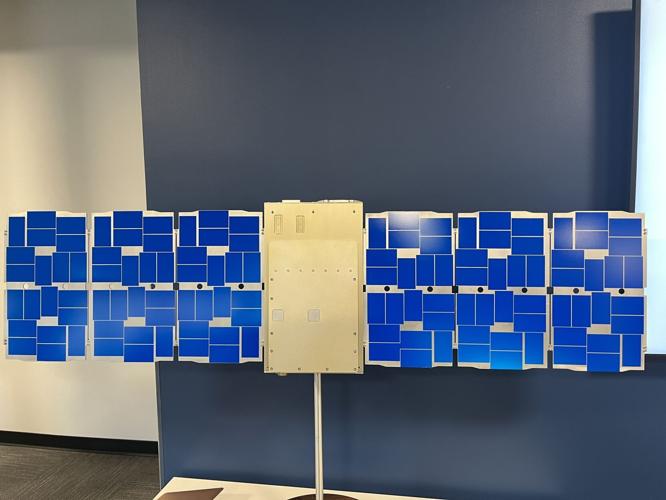
Two rows of solar arrays is Pony Express 2, which will show that Lockheed Martin can build a mesh communications network with satellites.
Wayne Heilman, special to The Gazette

A lab Lockheed Martin opened in downtown Colorado Springs two years ago to help it bring new space technology more quickly to the military, civilian and commercial customers is already paying dividends for the space and defense giant.
The 4,000-square-foot center in the Catalyst Campus for Technology and Innovation on downtown’s east edge was built to bring Lockheed Martin engineers, researchers and other employees together with small and startup businesses to develop technology to meet the latest challenges in space. The center includes a virtual lab for those working on projects either in person or remotely can test out ideas and plans to evaluate their effectiveness.
‘Greatest space show on Earth’ returns to Colorado Springs — bigger than ever | Space Symposium 2023
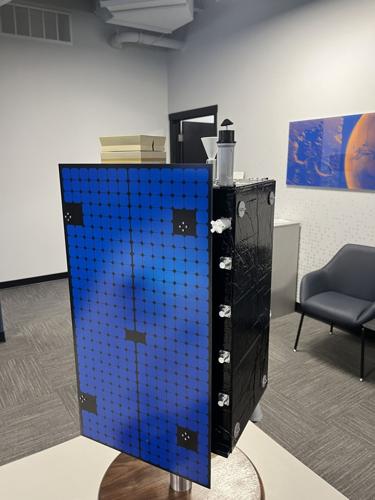
Lockheed already is incorporating some early results in small satellites it will soon be building in Littleton for remote sensing, imaging, communications and many other military, civilian and commercial uses and can be manufactured and deployed both more quickly and at a much lower costs than most of the military and commercial satellites now in orbit, said Paul Pelley, senior director for advanced programs at Lockheed Martin Space in Littleton.
“These satellites were developed digitally so they are adaptable, flexible and can be built on a production line instead of one, two or a handful at a time,” Pelley said Monday at a briefing at the center designed to highlight the company’s space-related projects. The company has already started the production line in Littleton and is testing the small satellites so they can move into full production, though the company hasn’t yet said when that will happen.
Lockheed Martin’s briefing came a day before the company will unveil virtual reality simulation of its Lunar Mobility Vehicle at the Space Symposium, which opened Monday at The Broadmoor. Symposium attendees will be able to experience driving on the moon, which has just 60% of Earth’s gravity.
Air Force general to assume command of Space Foundation
Dan Tenney, the company’s vice president of strategy and business development, said Lockheed Martin formed a team of engineers and technical staff to rapidly develop new technology and products needed to respond to new space challenges. He cited several new satellites the company is developing for quick deployment, including those that will service other satellites, enable communication on the moon and for intelligence, surveillance and reconnaissance.
Tenney said Lockheed Martin is developing many of the new satellites without receiving military, government or commercial contracts first so it can demonstrate the technology for potential customers and get them launched and operating more quickly. Many of the satellites company officials showed off Monday have already been launched or will be launched later this year to demonstrate a specific technology or capability.
The company is using the same rapid-development approach to a variety of technologies and space vehicles the company is producing for missions planned to the moon and Mars. That includes satellites that will enable communications on the moon, a lunar mobility vehicle, a nuclear reactor to provide power on the moon and a rocket propulsion system that will use nuclear thermal power instead of the solid fuels all rockets use now in spacecraft.
“Our vision is for a nuclear-enabled, water-based economy on the moon. We want to mine water for oxygen to breathe and hydrogen to burn. We will need a lot of power on the moon and be able to refuel there instead of having to only launch from Earth,” said Kate Watts, Lockheed Martin’s vice president for mission strategy and advanced capabilities. “We want to enable communication, transportation, surface mobility, power and habitation on the moon.”
Retiring Space Foundation CEO: Space a $1 trillion industry by decade’s end


Iranians in Colorado weigh in on Khamenei’s death
Mark Samuelson
mark-samuelson@denvergazette.com
Updated 1 day ago
As the joint U.S.-Israeli attack on Iranian targets continued into a second day following the death of leader Ayatollah Khomeini, Iranians living in Denver weighed in, saying they welcome the opportunity for a regime change in the Islamic Republic. “The...

Mark Samuelson
Reporter
What to know about U.S.-Israel attacks on Iran
The Associated Press
the-associated-press@denvergazette.com
Updated 4 days ago
The attack The U.S. and Israel attacked Iran on Saturday in what President Donald Trump said was a massive operation to destroy the country’s military capabilities and eliminate the threat of it creating a nuclear weapon. Iran’s Foreign Ministry said it would...

The Associated Press
Reporter

World leaders react cautiously to US and Israeli strikes on Iran
The Associated Press
the-associated-press@denvergazette.com
Updated 4 days ago
BRUSSELS • World leaders reacted warily to U.S. and Israeli strikes on Iran on Saturday that triggered worries of a broader conflict. European leaders held emergency meetings and took measures to protect their citizens in the Middle East, with key leaders calling...
The Associated Press
Reporter

Secretary Hegseth promises to unleash small defense companies during Colorado visit
Mary Shinn
mary-shinn@denvergazette.com
Updated 1 week ago
Secretary of Defense Pete Hegseth visited Colorado space companies Monday and promised to cut bureaucracy within the Pentagon to ensure smaller defense businesses have a chance to compete for contracts. “If we are going to have space dominance and deterrence,...

Mary Shinn
Reporter

20 years after Fort Carson soldier’s death, family seeks answers
Mary Shinn
mary-shinn@denvergazette.com
Updated 1 week ago
Amber Stone reported her husband missing on Valentine’s Day 20 years ago. A week later he was found in a sewage treatment pond on Fort Carson. Stone is certain her husband, Joseph Eric Barker, didn’t walk barefoot across Fort Carson...
Mary Shinn
Reporter

Colorado Democratic candidate submitted 1,600 signatures — only 29 were valid
Marianne Goodland
marianne-goodland@denvergazette.com
Updated 2 weeks ago
When he turned in some 1,600 signatures last month, Eric Nelson said it demonstrated “strong grassroots support from voters” across the district and a “growing momentum” for his “inclusive, community-centered leadership.” On Thursday, the Secretary of State rejected Nelson’s petition...

Marianne Goodland
Reporter

Grand jury refuses to indict Democratic lawmakers in connection with illegal military orders video
Eric Tucker
eric.tucker@associatedpress.com
Updated 3 weeks ago
WASHINGTON (AP) — A grand jury in Washington refused Tuesday to indict Democratic lawmakers in connection with a video in which they urged U.S. military members to resist “illegal orders,” according to a person familiar with the matter. The Justice...

Eric Tucker
Reporter

Outside Aurora VA hospital, hundreds memorialized nurse killed in Minneapolis
Mary Shinn
mary-shinn@denvergazette.com
Updated 1 month ago
Outside the Department of Veterans Affairs Hospital in Aurora on Wednesday night, soft light from battery-powered candles illuminated hundreds of mourning faces. The crowd of nurses and other community members gathered to remember Alex Pretti, a VA nurse, who was...
Mary Shinn
Reporter

Greenland is now Colorado’s problem. And that’s a good thing. | Vince Bzdek
Vince Bzdek
vince-bzdek@denvergazette.com
Updated 1 month ago
The conclusion to the dizzying odyssey over Greenland this week reminded me a little of the ending of the “Wizard of Oz.” If you recall, Dorothy, the Scarecrow, the Lion and the Tin Man finish a great and frightful quest...

Vince Bzdek
Reporter

Report finds Air Force Academy should improve due process for those facing discipline
Mary Shinn
mary-shinn@denvergazette.com
Updated 1 month ago
The Air Force Academy does not provide consistent access to open hearings or clear guidance on the right to remain silent to cadets facing accusations of misconduct, a Government Accountability Office report found. The report released shortly before Christmas reviewed...
Mary Shinn
Reporter
PREV
PREVIOUS
Maj. Gen. Maurice Rose honored with monument at Colorado Capitol
The rumble of decades old radial engines, followed by the crack of rifles rendering a military salute and the ever mournful “Taps” set the stage for the dedication of a monument to Colorado’s own Maj. Gen. Maurice Rose. Rose was noted for his bravery, leading troops from the front during World War II and being, […]

After a recruiter laughed at her, one of the first female missileers retired as a lieutenant colonel
One of the first female missileers, retired Lt. Col. Linda Aldrich, was 30 when she decided to call a recruiter to ask about joining the Air Force. He thought it was a prank call and then he told her: “Lady, it would take a four-star general before I would waste time talking to you,” she […]