







Pulitzer-winning play a call for ‘Empathy in America’ at Vintage Theatre
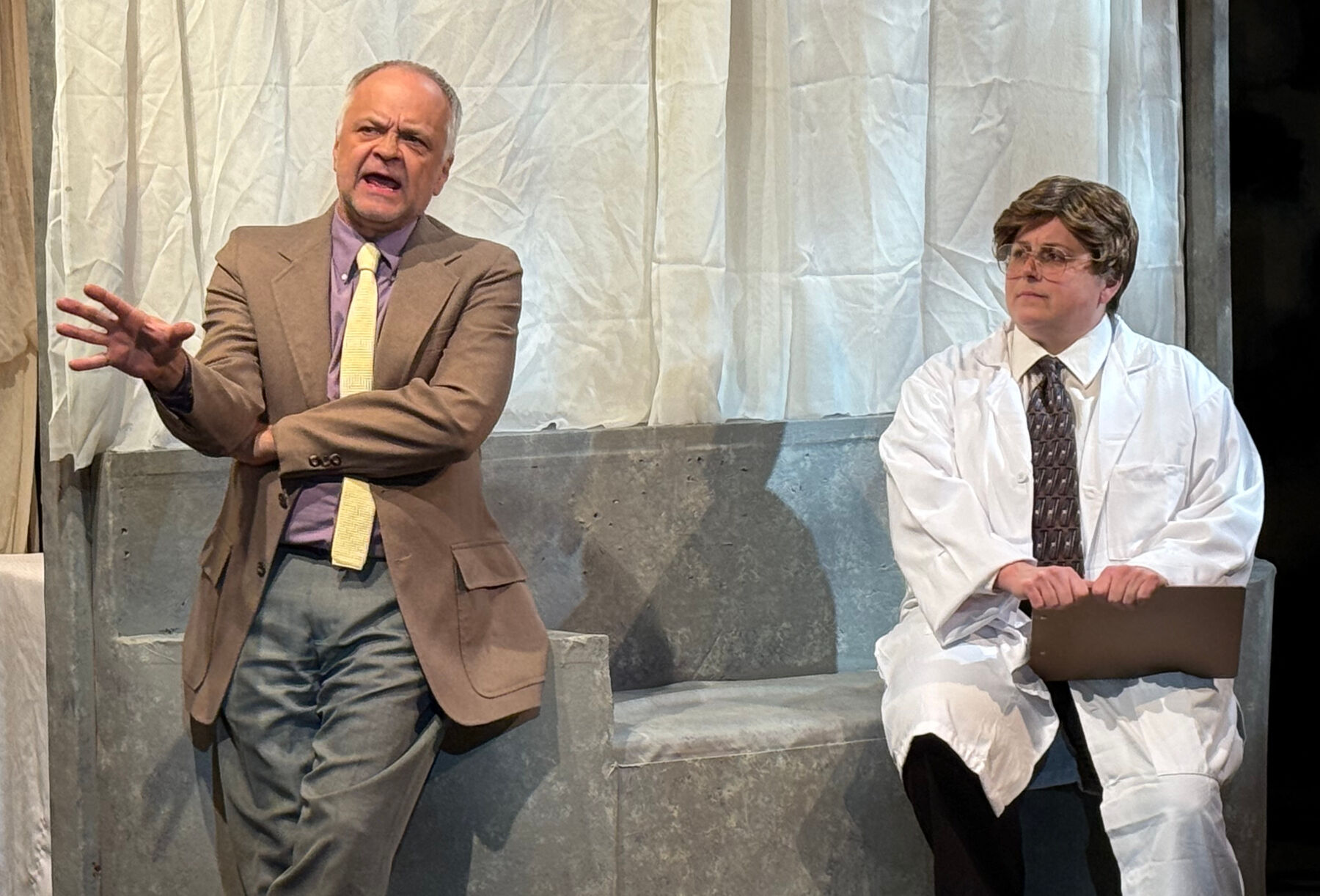
Vintage Theatre will revisit the play that put it on the map when it stages ‘Angels in America’ in two parts with two cast members returning
Back in 2010, local theater director Bernie Cardell called his landmark staging of the two-part opus “Angels in America” “a renewed call to action.”
Revisiting Tony Kushner’s masterpiece now, 16 years later, he says, is “a renewed call to empathy.”
“Empathy and understanding, I think, are the two things we’re most missing right now as a society,” Cardell said.
The play won the Pulitzer Prize in 1993 for its impact on the American theater, and in 2010 was named in a national survey as the second-most important American play ever written, behind only “Death of a Salesman.”
“Angels in America” is now one of the most-studied, yet least-performed plays in the American canon – but not because the story, which focuses on the AIDS epidemic in the 1980s, has lost any relevance.
“There’s never a wrong time to address acceptance,” said actor Casey Board, who plays Prior Walter, the play’s protagonist.
No, it’s because of the huge logistical challenge of staging any six combined hours of live theater at one time.
Which does not mean this massive creative undertaking requires a massive production budget to pull off. The capacity was only 63 when Vintage first staged the play at its previous home at 17th Avenue and Vine Street. And the capacity will be only 67 when Cardell opens Part 1 on Friday night at 1468 Dayton St. in Aurora. (Part 2, directed this time by Troy Lakey, opens a week later.)
The twin plays will then be offered on an alternating basis through May 10, with several Saturday opportunities for audiences to catch both three-hour plays on the same day.
Back in 2010, it was a national surge in gay suicides that filled and fueled Cardell with a kind of eloquent rage.
“Near the end of the play, Prior Walter says, ‘We won’t die secret deaths anymore,”‘ Cardell said then. “But that is exactly what is happening again. And what that is all bringing home to me is our increasing reliance on digital technology. We have to actually gather and find ways of connecting with other people.”
And to think: That was Cardell in 2010. Before Instagram. Before Snapchat. Before TikTok. Even then, Cardell saw live theater as an antidote to our increasing digitally driven isolation. “What theater can do like nothing else,” he said, “is to change people’s awareness.”
What’s it all about?
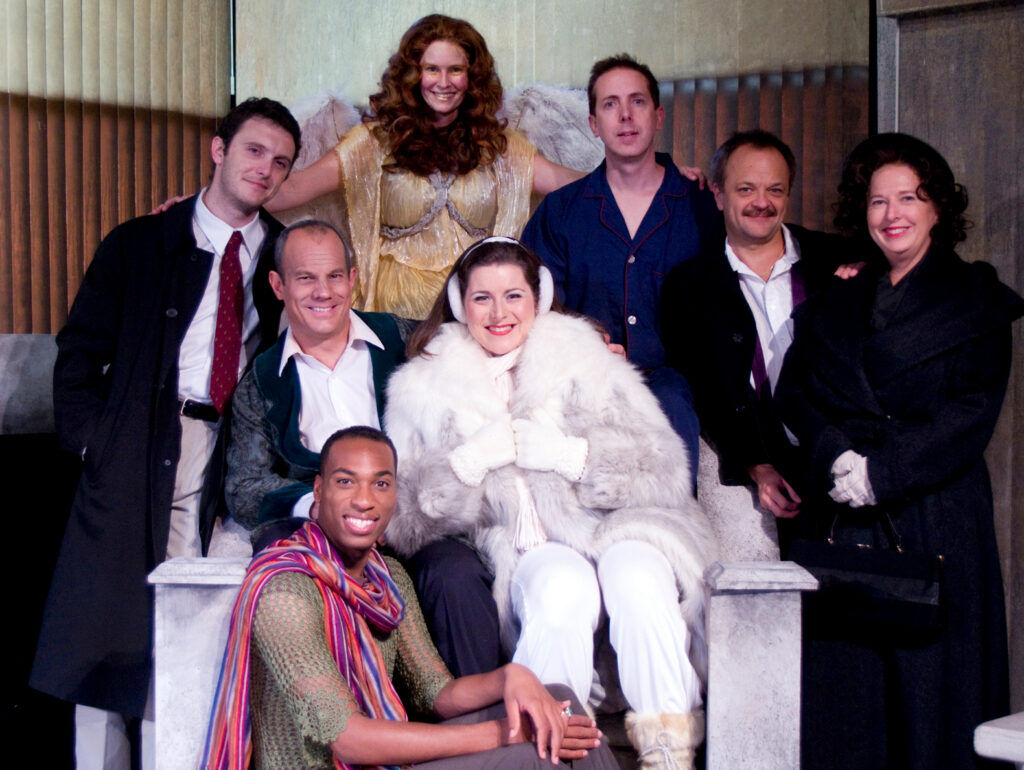
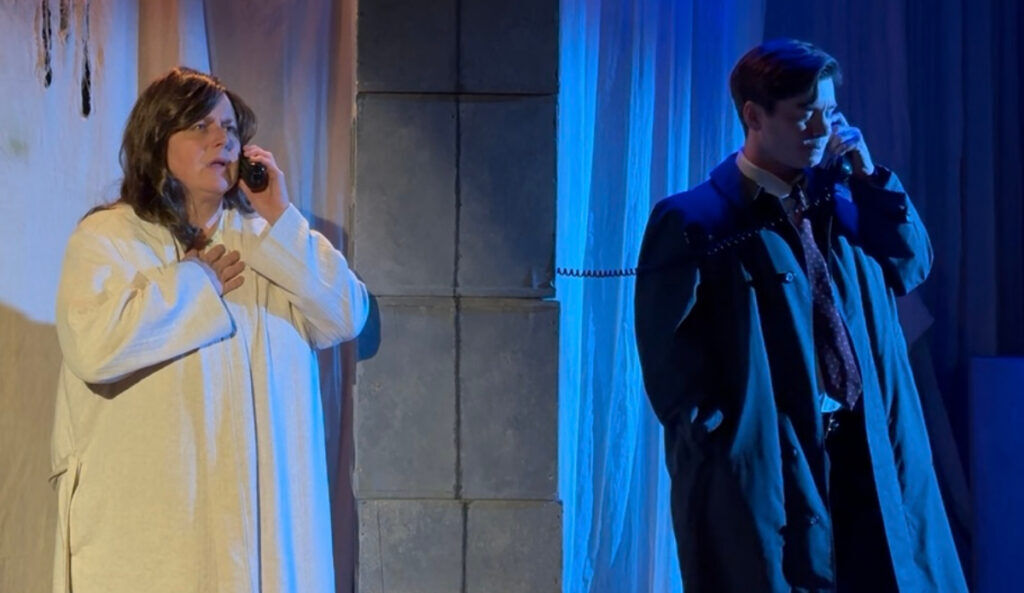
“Angels in America” is a sprawling story that plays out on stage in both realistic and metaphysical forms. It begins with Prior, a man with AIDS who is abandoned by his lover, Louis. In his fevered descent toward a horrible death, Louis is visited by an Angel who anoints him as a prophet and tasks him with no less than stopping human progress. Why? Because this Angel believes that relentless human innovation has caused God to abandon Heaven. Stagnation, the Angel believes, will force God’s return.
Along the way, we also meet the fictional Joe Pitt, a closeted Mormon Republican lawyer and protégé of the nonfictional Roy Cohn. If that name rings a bell, it should: Cohn was the ruthless, real-life lawyer and political power broker who targeted suspected communists, spies and closeted government employees during Sen. Joe McCarthy’s anti-Communist hearings.
Cohn was disbarred for unethical conduct shortly before dying of AIDS himself. In the play, the damned Cohn has hallucinations of Ethel Rosenberg, whom he helped to be executed as a spy.
Cardell’s ensemble of actors includes two crossovers from 2010 who act as a kind of a bridge between the two halves of Vintage’s past. In 2010, Andrew Uhlenhopp played spineless Louis. In 2026, he is playing Cohn, one of the meatiest roles in all of the American theater.
“It is tremendously fun to revisit this show from a different character’s perspective,” Uhlenhopp said. “It feels like returning to a great vacation spot from 15 years ago, but you’re staying in a new vacation rental. The new place is just as good as the one you stayed in 15 years ago, but it’s different and rich in new ways.
“Not that either role is a vacation for a performer, but they are both great adventures, and Tony Kushner has provided all of us with a topography that, as an actor, is tremendously satisfying to explore, whether it’s for the first time or the second.”
In 2010, castmate Haley Johnson played Harper Pitt, the agoraphobic, sexually-frustrated and Valium-addicted wife of All-American boy Joe Pitt. Johnson describes Harper as “a very lonely, isolated housewife longing for some sense of human connection, whether it’s from her husband or from any passing hallucination.
“And now I’m playing her mother-in-law, Hannah Pitt, who is a more traditional, conservative, Mormon mother from Utah who travels out to New York to try to figure out what’s going on with her son.”
And Johnson is now a mother herself.
“It’s very surreal,” she said. “It’s kind of this weird, beautiful, cyclical moment of, in essence, going from playing the daughter to playing the mother. I mean, I’m just fundamentally changed as a human being from who I was 15 years ago. I have a different job, and I’m in a different relationship. And becoming a parent has fundamentally changed every molecule of my body.”
Johnson said it’s been a trip being in rehearsal with old friends like Cardell and Uhlenhopp alongside newcomers like Nicole Kaiser, the actor who is now playing Harper, “I’ll sit there and watch Nicole, who is just so lovely as Harper, and when I hear her say those lines, I can hear those same words echoing in my mind from when I was saying them.”
Going through this experience now, with 16 more years of life under her, is making “Angels” 2026 feel completely new to Johnson.
“The first time we did the play, I saw the story through the lens of these people dealing with the AIDS crisis in New York,” she said. “Now, I feel like that’s a less urgent backdrop to the text and to the story. I feel like now it’s more a story about acceptance, humanity, loneliness, isolation and connection – both the lack of, and the desire for. I see all of that more now than I ever did before.”
Johnson is particularly pleased to be going on this ride with Uhlenhopp, especially for the shared memories it conjures. “There’s usually at least one time during any rehearsal, where we’ll kind of look at each other and there will be an, I don’t know, a sense of understanding, and we’ll just kind of wink and think, ‘This is just really cool.’
“And it’s fun to watch Andrew work. Watching him go from Louis to Roy – that is a really big jump. It’s a joy to actually get to work with him on stage and share in this sort of weird experiment together.”
Here we come again
Cardell had originally eyed 2020 as the perfect time for Vintage to revisit “Angels,” as that year marked 10 since the production that, it could be argued, put Vintage on the local theater map. But, you know … 2020.
“We put it on the season when almost all of the shows got canceled,” said Cardell. And then coming back out of the pandemic shutdown, he added, “it didn’t feel like the right time to be doing a play about a pandemic (AIDS) while we were still so in the middle of another pandemic (COVID). But then, for this season, it felt like the right time, considering everything that’s going on in the world and how marginalized voices are being shut down more and more.”
Back in 2010, any small theater company staging “Angels in America” was considered risky business. Up to that point, only Curious Theatre in Denver (then called Hunger Artists) and Fort Collins’ Bas Bleu in partnership with OpenStage, had tried.
And no matter how spare, money would certainly become a factor if no one came to see it. This is a play that undeniably challenges prevailing social, religious and political norms, and that makes it dangerous to stage for any nonprofit that is dependent on both donors to give and audiences to fill seats. The controversial subject matter left the potential for severe community and financial backlash.
That didn’t happen to Curious – instead, it announced that revolutionary theater company like an Angel crashing through the roof of the house. It didn’t happen at Bas Bleu or Vintage, either. Today, Cardell can’t think of staging “Angels” as particularly risky when it is now one of the most celebrated plays ever written. And was made into a major motion picture by HBO. And won the Pulitzer Prize.
“I think when it comes to risk, the answer is somewhere in the middle,” Cardell said. “I think obviously more people know about ‘Angels in America’ now. And it has taken its place as a great work of literature.”
But there is a risk, and it’s the same steroidally-boosted threat that Cardell identified 16 years ago: The threat of the short-attention span.
“There is a reluctance people have when I tell them, ‘Oh, it’s 6 1/2 hours long,’” Cardell said. “I’ve had way more people kind of buckle at hearing that this time.
“I think in today’s TikTok society, where people get their media in three-second bites, asking them to sit with us for six hours is a big ask. The audiences that decide to take the journey are always grateful for it in the end – but getting them to commit to it is the trick.”
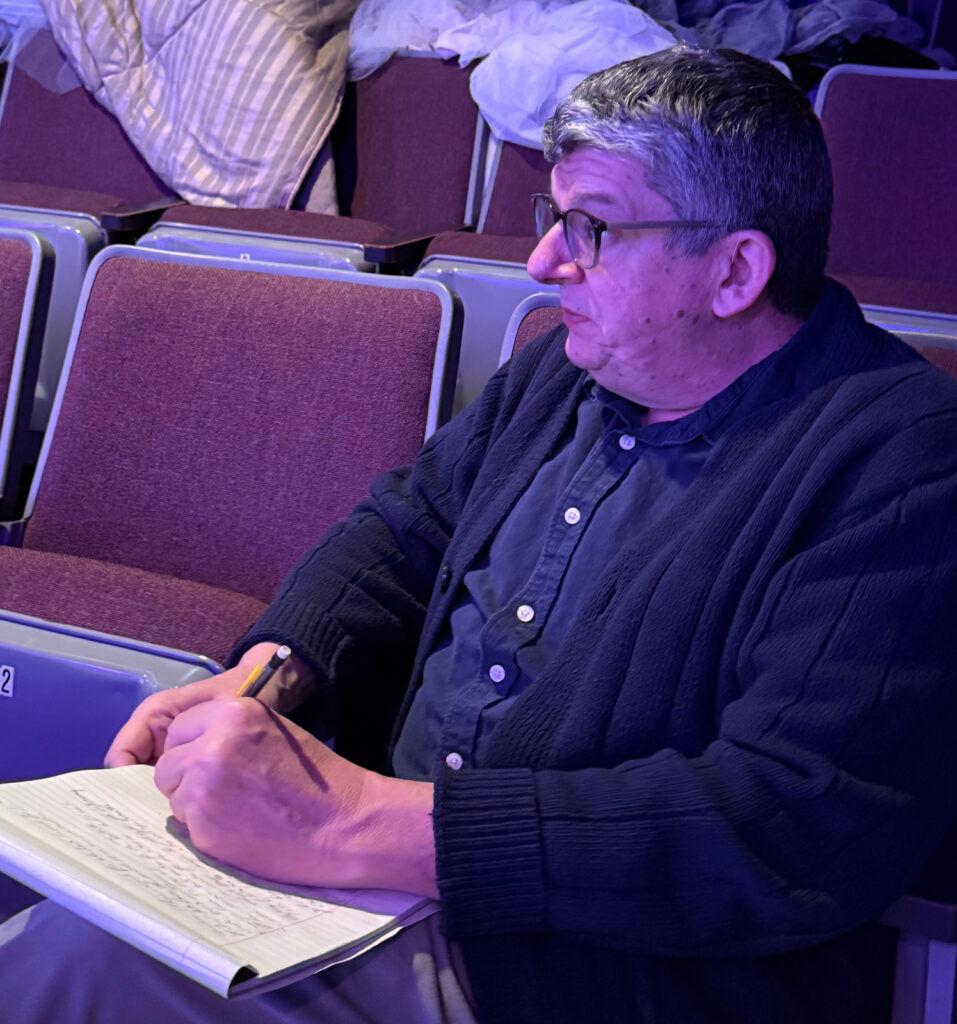
Just as his actors, Cardell sees the play’s themes in 2026 differently in terms of relevance than he did in 2010. Themes like climate change and health care in America.
“I was so struck at the first rehearsal, when Andrew has a line that says, ‘America: It’s no country for the infirm,’” Cardell said. “I had to write it down because it was unbelievable to me that this line exists in this play that was written in the late 1980s.”
What Johnson sees more brilliantly in “Angels” 2026 is hope, and from the most unlikely of places: In the transformation of a rigid, stern and homophobic Mormon mother into a compassionate, empathetic figure. And Johnson gets to show the power of her character moving from Utah to New York and both broadening her world view and shedding her bigoted exterior. And really, she says: That’s why the play still matters.
“It’s just really cool watching that arc for her because she was able to open her eyes and change her perspective,” Johnson said. “So why can’t other people also maybe do that? Why can’t people sit in a play like this and say, ‘Well, if she can do it, maybe I can try to do it, too.’”
John Moore is the Denver Gazette’s Senior Arts Journalist. Email him at [email protected].
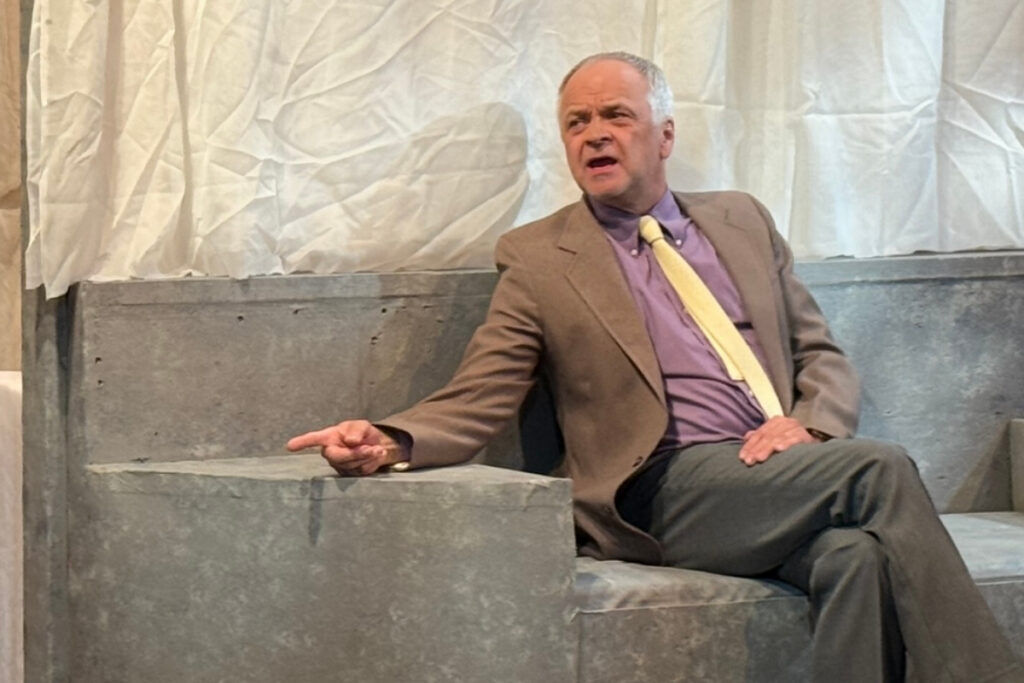
‘Angels in America’
- What: Pulitzer Prize-winning play presented in two parts
- Written by: Tony Kushner
- Presented by: Vintage Theatre, 1465 Dayton St., Aurora
- When: Part 1 opens Friday and runs through May 9; Part 2 opens April 4 and runs through May 10
- Directed by: Bernie Cardell and Troy Lakey
- Featuring: Casey Board, Dakota Chase Hill, Chad Hewitt, Nicole Kaiser, Johnathan Underwood, Andrew Uhlenhopp, Haley Johnson and Kelly Uhlenhopp
- Tickets: vintagetheatre.org
- Advisories: Each part runs three hours long. Story includes simulated sex, nudity and graphic depictions of staged violence and illness. Mature topics addressed including discussions of addiction, homophobia, antisemitism, racism and pregnancy loss. Rated “R”: No children under 17 admitted.