







Three problems facing Rockies after being swept by Padres
As the Rockies prepare for a Monday off day before taking on the Astros in South Texas on Tuesday, it might be cliché to start with the line, “Houston, we have a problem.”
Cliché? You bet. Truthful for the Rockies after being swept in a four-game series in San Diego? Absolutely as well.
In fact, Colorado has more than one problem after losing the first four games of a seven-game road swing through San Diego and Houston. Some glaring deficiencies showed themselves in San Diego, and Colorado needs to find a way to eliminate them to grab back some of the momentum they had after sweeping the Astros before heading to San Diego.
Problem 1: Colorado’s outfielders
Jordan Beck, Brenton Doyle and Jake McCarthy were expected to be among the offensive leaders for the Rockies, not only with the trio expected to hit near the top of the order but also use their individual speed to create chaos on the basepaths.
However, when you aren’t getting on base, it’s hard to be a stolen base threat.
Entering Sunday’s finale, Beck was hitting .103 (3-for-29), Doyle was hitting .182 (8-for-44) and McCarthy was hitting .138 (4-for-29) on the young season. Those are numbers that won’t do for three players who were penciled in as regular starting outfield options.
Mickey Moniak and Tyler Freeman both started the season on the injured list and, thankfully for the Rockies, both came off the IL swinging a hot bat. Moniak was hitting .300 and had five home runs in his first 30 at-bats while Freeman posted a .375 average in his first 16 at-bats.
Getting production from Moniak and Freeman has helped soften the blow from the slow starts from Beck, Doyle and McCarthy. However, they can only mask the inefficiencies for so long.
If the Rockies are going to have an offense that puts fear into its opponents, those three outfielders must find their collective rhythm at the plate soon.
Problem 2: Finding more rest for the bullpen
In the final two games of Colorado’s sweep of Houston at Coors Field last week, the Rockies used just two pitchers in each of those games. On Tuesday, it was Kyle Freeland going 6 1/3 innings and Antonio Senzatela finishing off the last 2 2/3 innings for his first career save. One day later, Michael Lorenzen logged 5 2/3 innings before Zach Agnos took over for the final 3 1/3 innings to earn his first save of the season.
It was a perfect scenario on both days, with the starter providing a solid outing followed by a reliever being efficient enough to finish off the game and keep the rest of his bullpen colleagues from having to enter the game.
Those two days were the ideal blueprint, but there have been few optimal bullpen usage days so far this season.
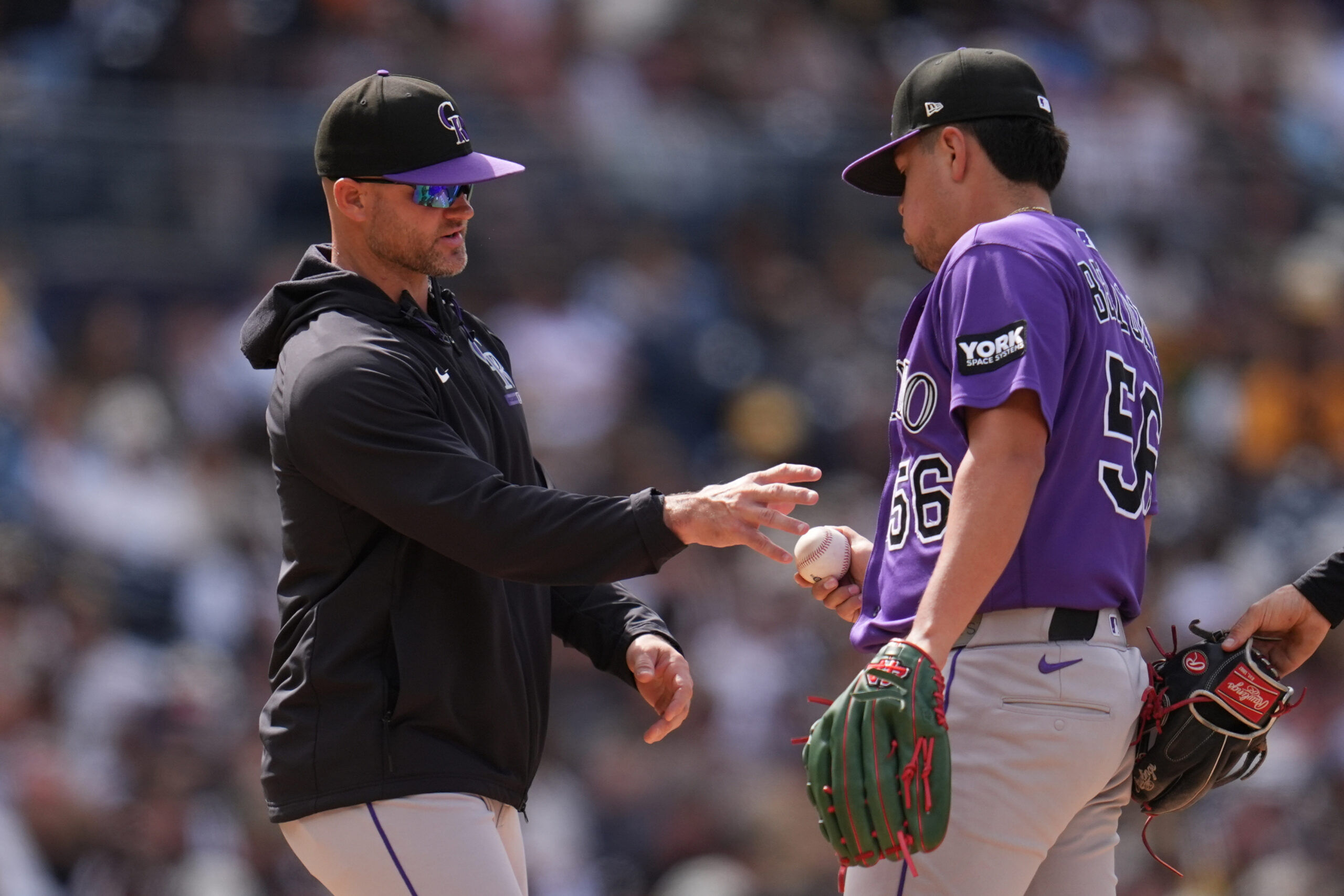
Freeland being unable to pitch on Sunday because of left posterior shoulder soreness forced the Rockies into yet another bullpen game, like what the team has done since Jose Quintana went on the injured list after his season debut on March 29.
Quintana reportedly had no issues with his bullpen session in San Diego on Sunday, opening the door for his potential return in Houston on Wednesday. However, Freeland’s shoulder issue raises the question of what that could mean for his next scheduled start on Saturday at Coors Field against the Los Angeles Dodgers.
Even before the unexpected bullpen game on Sunday, Colorado relievers had accounted for 69 2/3 innings, a number that paced the National League and was the second-most in all of baseball. The bullpen, however, has been effective while being used heavily, posting a combined 3.36 ERA through the first 15 games of the year.
However, while it’s a formula that may be working now, it could be problematic moving forward as the inning totals keep climbing.
Colorado’s starters must go deeper into games to flip the script. Their 63 2/3 innings in the first 15 games ranked 28th among MLB’s 30 teams. That must change for the Rockies to not burn through the bullpen.
Problem 3: Not winning the close ones
So far this season, Colorado is 1-4 in one-run games and 0-3 in games decided by a walk-off hit. It may be early, but the Rockies have already endured some crushing defeats, including a pair of wins for the Padres in the first two games of the series that came in their last at-bats.
Last year, Colorado was 18-23 in one-run games, a remarkable number during a 119-loss season.
Currently battling through a stretch of 29 consecutive games through the end of April against teams that finished the 2025 season with a record above .500, Colorado must find a way to not only hang on to leads when they have them but also find ways to steal a close win where they can.