







Elizabeth Schlosser built her reputation on Colorado architecture and art
New book celebrates 100 public art treasures of early Denver
To refer to Elizabeth Schlosser as a Renaissance woman is particularly fitting given her part-time residency in Italy, along with her impressively multifaceted curriculum vitae.
A private art dealer and appraiser, Schlosser is the former executive director of Historic Denver and the Historic Paramount Foundation. She has curated and juried many major art exhibitions and served as senior editor for Gallup House Fine Art and Publishing’s “Documents of Colorado.” Denver Public Library has archived her personal papers. Schlosser even ran for mayor of Denver — a campaign she lost to John Hickenlooper in 2003.
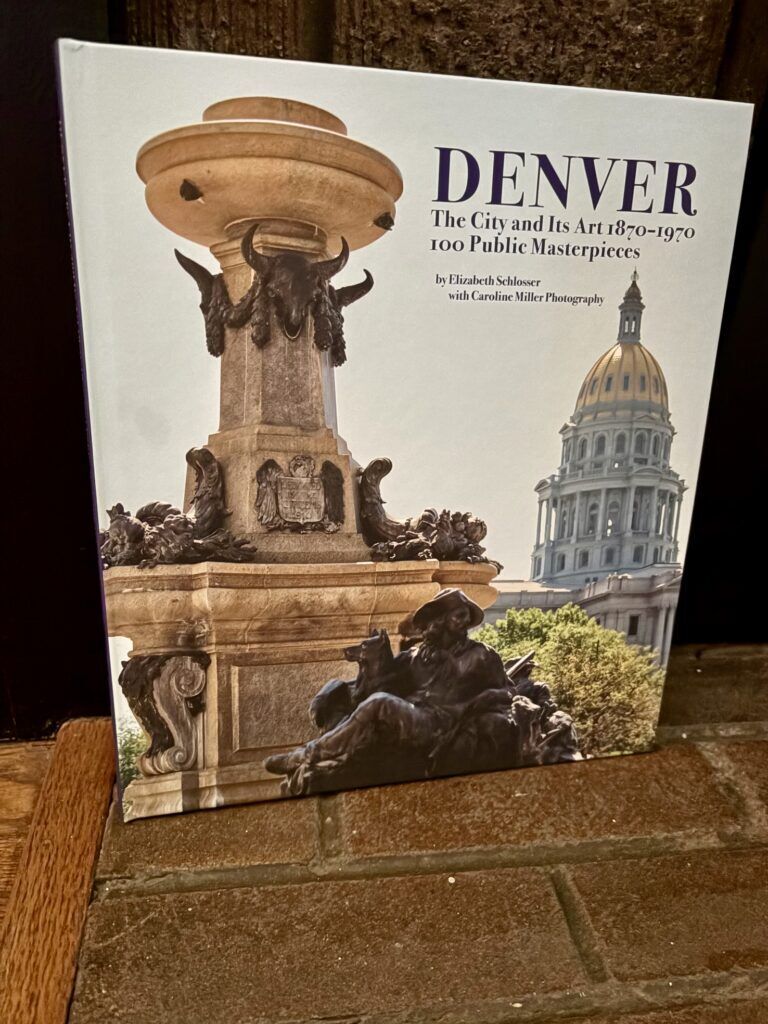
Earlier this year, Schlosser released her fourth book: “Denver: The City and Its Art 1870-1970, 100 Public Masterpieces.” The author was inspired, she said, by a book she found in Florence, Italy, the epicenter of the Renaissance.
Schlosser champions the Mile High City’s cultural richness. Her book celebrates 100 public artworks of various media: sculptures, murals, paintings, ceramics, works as small as a coin and as monumental as the fountain in City Park. Many artworks are in the permanent collections at the Denver Art Museum or the Denver Public Library.
Schlosser’s top-100 list also includes architectural gems from the Colorado state Capitol, Union Station, the Brown Palace and the Oxford hotels, the Equitable and the Vault buildings, the Paramount and Mayan theaters and numerous Denver parks. Schlosser’s top-100 over 100 years is a comprehensive if not exhaustive list including local artistic luminaries such as Albert Bierstadt, Alan True, Vance Kirkland and Herbert Bayer.
But Schlosser began her book with her number one choice: a clay pot low-fired by an anonymous indigenous artist circa 200—1000 CE. Her second selection is a lithograph depicting encampments along the confluence of Cherry Creek and the South Platte River circa 1859.
Denver’s roots in indigenous art
“We have to honor that the Native Americans, of course, had artists here making art or being artistic before European settlers,” Schlosser said.
Her unexpected yet defensible third selection in the book is a $10 coin minted in Denver in 1860, a tiny bas-relief sculpture of Pikes Peak adding an artful element to the gold piece.
“Art of the first 100 years is about Native Americans, native animals — bison — pioneers, frontiersmen and women with guns protecting the homestead,” Schlosser said.
“And the grandeur of mountains. Historically, artists were trying to capture the majesty of the mountains,” she added. “It’s almost impossible to do. Bierstadt can do it, but he overdramatized it. The mountains can’t translate, though the artists tried. They cubist-ed the mountains, impressionist-ed them, realism-ed them. But people love their own mountains. I’m not interested in the White Mountains or the Adirondacks.”
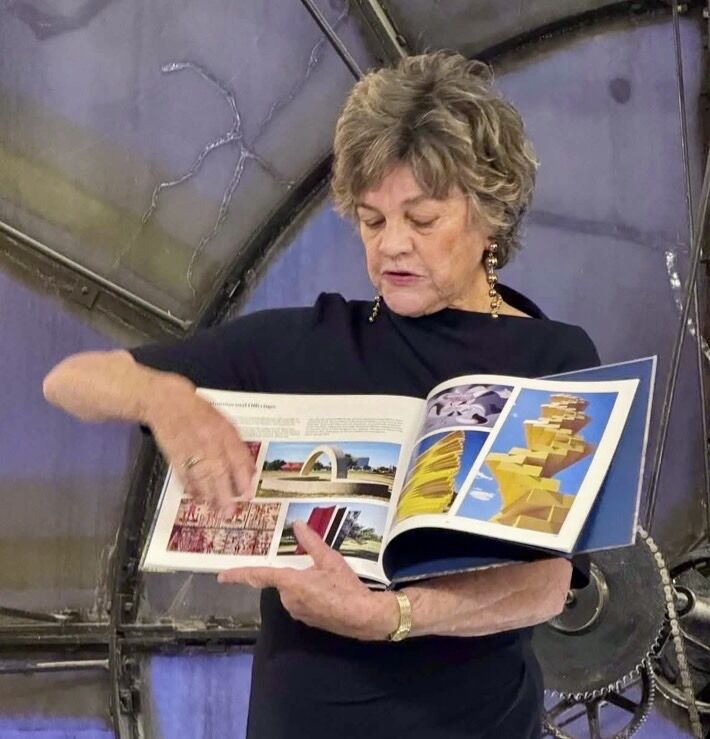
What Schlosser is interested in is Colorado regional art. In an interview at her artful Hilltop residence where Schlosser lives with her husband, Charlie Jordan, the author and authority on Denver art and architecture flipped through her new book.
Landscape paintings document Denver development
“If I could steal one, I’d take this watercolor,” she said, pointing out a painting of a trio of women dressed in Victorian-era garb in the foreground, the fledgling city of Denver, the Platte River and Cherry Creek in the middle distance and in the distance the foothills and the Front Range. Schlosser looked dreamily at the image and said, “Two artists worked on this.”
The artists were Paul Frenzeny and Jules Tavernier. The year was 1891, and the watercolor and gouache painting is titled “Denver from the Highlands.” The painting is part of the permanent collection held by Denver Public Library.
Schlosser didn’t steal the painting, but she did select the image for the back cover of her new book.
“These landscapes are a great historical record,” she said.
Long gone are the days depicted in the early artworks when Denver consisted of a few buildings, Indian encampments and the Front Range.
Her artful Hilltop home exhibits Colorado collection
No surprise, Schlosser’s Hilltop home is chock-full of art and her house is in and of itself artful — an ambitious renovation designed by David Wise, a Harvard-trained architect.
Wise previously served as the director of design and planning for the Downtown Denver Partnership. He praised Schlosser’s new book.
“What’s effective in spending time with Elizabeth’s book is that she sets up a network of point-to-point relationships around the city,” Wise said. “Exploring one thing leads to another and eventually becomes this whole, somewhat jumbled and discordant set of places and experiences, but that is real urbanism.”
Asked why Schlosser was the ideal person to write the book on Denver’s public art, Wise said, “Number one on the list of why Elizabeth is well suited is that she is so tenacious and excited. If only we all could drink some of what she’s drinking and stay passionate. She’s very motivated.”
“What empowers Elizabeth is that she was in the art business for many years,” he said. “That put her face-to-face with the local social structure and local sensibilities and some great people. It means she knows her audiences, and you don’t learn that studying art history. She’s been on the front lines.”
Wise noted that he agreed with the majority of Schlosser’s top 100 choices for the book.
“Elizabeth didn’t take cues from exactly what a particular academic might see as important things and what matters,” Wise said.
“She came at this book from a different direction. Given her choices in her own collection, she’s really very good at finding what strikes a chord. She’s not just a traditionalist or in love with Colorado’s Victorian gilded past,” he added.
The author possesses architectural and artistic authority
“Elizabeth has a totally different sense of what is considered meaningful over time and what’s loved and appreciated and what’s never quite caught on because she’s been at it a long time,” Wise said. “She’s very intelligent and well-educated and writes and speaks incredibly well and is so funny and witty and yet has a lot of authority.
“Nobody’s questioning Elizabeth. She is a unique and particularly well-informed source, and we can learn from her book.”
Schlosser’s previous three titles — “Modern Art in Denver,” “Modern Sculpture in Denver” and “Modern Clay in Denver” — were published by Ocean View Books as a matched set of paperbacks.
The new book, however, is a self-published, hardcover, large-format picture book, for the most part, with photography by Caroline Miller, a Colorado native.
“I did this book on my own. I didn’t want anybody else’s damn opinions,” said Schlosser, who voices plenty of her own strongly held opinions.
She’s of the mind, for example, that Denver lacks design continuity.
“Our architectural style is chaos,” Schlosser said. “I wish we would have held to brick as a material and to red brick because ‘Colorado’ means ‘red.’”
Protecting, preserving Denver’s artistic past
Schlosser also feels Denver hasn’t done a good job of preserving the city’s artistic past. The back cover dedicates the book “in honor of those who came before, both to protect our artistic heritage and to help shape the future.”
As for the present, Schlosser said, “We’re in a ‘fugly’ movement. I don’t like negativity. I deal with positivity and rewards, but people don’t like a lot of what is happening and to me it’s a mishmash of a train wreck.”
Schlosser holds an undergraduate English degree from Stanford University and a master’s degree in city planning from the University of Colorado. She frets over the lack of formal plans to safeguard the city’s historic art and architecture.
“There’s no protection for the city’s public art. I see increasing threats,” she said.
Asked about possible solutions for protecting historic buildings, she said, “Historic Denver should evolve and get more involved in all historical decisions on any buildings 50 years or older. They’re the soul of the city. And they should make some exceptions for beautiful buildings and grant them landmark status before 50 years.”
She added, “It almost should be its own group of people who don’t change politically and have taste and know what we’re looking at. When applying for permits, historic buildings should be put to a different group because the Landmark Commission is understaffed and can’t catch everything and doesn’t move predictably.”
Another of Schlosser’s strongly held opinions: “I wish we had an ordinance to protect this public art, a pot of money to help maintain these pieces of history and incentivize people to restore historic buildings. If people could get money to renovate or additional tax credits to keep a façade looking historic, this would help save our art history.”
Putting her money where her mouth is, her family bestows a $10,000 Hereford Prize to projects exemplifying preservation and sustainability in Colorado.
Why art and architecture matter so much to her
Schlosser has filled her architecturally sublime home with an enviable art collection including Colorado and New Mexico artists such as Frank Vavra, Amy Metier and Dale Chisman. Her personal space reflects her personal passion for art, for architecture, for books, for beauty bound and unbound.
“I’ve got to have art,” she said. “People have to find what’s worth living for, and art elevates the human spirit. Everyone wants to live with beautiful things and in places to enjoy.”
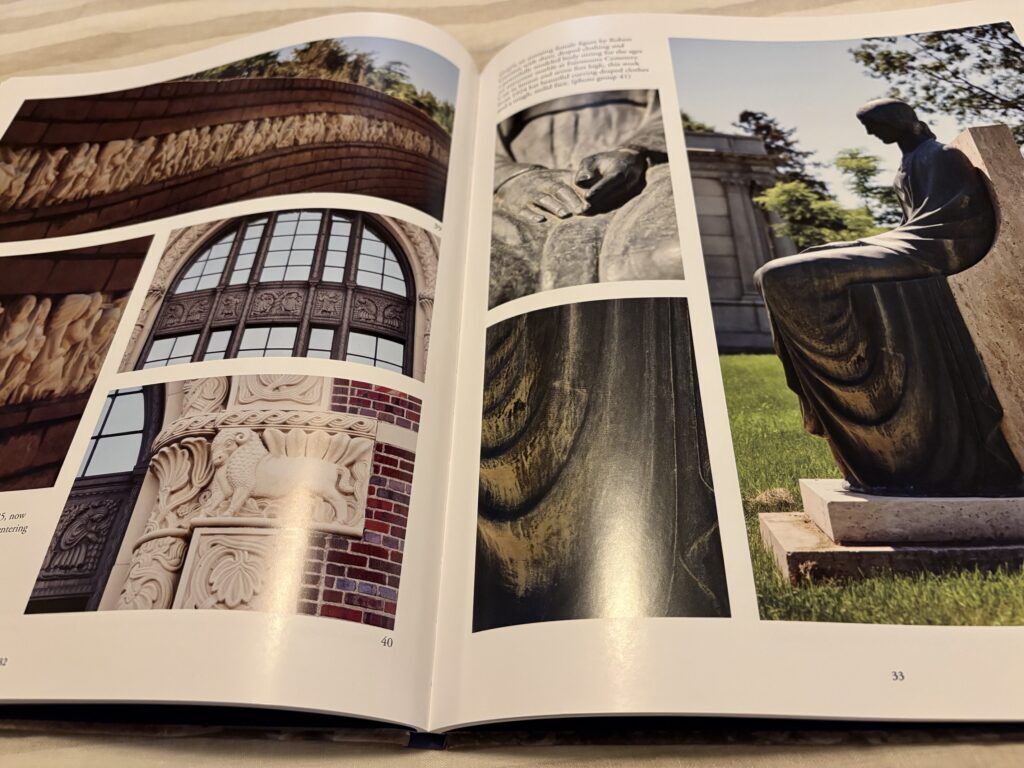
“Art creates tourism. Art has its own economy and is a source of community pride,” Schlosser said, pointing out in the book a photo of the masonry on South High School. “Look around at all this embodied energy. Look at this brick building. It took a lot of effort to make. It’s labor-intensive and created a lot of jobs and was a matter of pride.”
Asked whether Denver has good taste, Schlosser deferred.
“Chicago has great taste and great architecture and great clients. Chicago does more to train the population about great design and how it pays for itself and is a better investment. In Denver, we’ve been a Western transient city.”
That said, she emphasized, again, all that Denver does have to offer by way of public art and architecture.
Book inspires self-guided tours of Denver’s historic art
“Denver is so wonderful. This book is a great place to start. We have so much public art, but it’s hard to see from a car. It’s better to get out and walk,” Schlosser said. “It takes a lifetime to see Denver.”
Wise offered a game plan to get started or to continue discovering Schlosser’s top 100 picks of public art in Denver.
“Use the book,” Wise said. “You could sit at breakfast on a weekend and do your own map and make your own tour and carry the book with you. You could see all the bronzes. Or all the murals. You could see a particular neighborhood. I never visit cemeteries unless I have to, but Elizabeth’s book has me thinking of it now as a casual activity. Her book is amazing.”
“Denver: The City and Its Art 1870-1970, 100 Public Masterpieces” is available at the following locations: Denver Art Museum, History Colorado, the Molly Brown House, Barnes & Noble on Colorado Boulevard, Modern Nomad, The Den and David Cook Fine Art.