







RTD to consider ending 16th Street FreeRide service
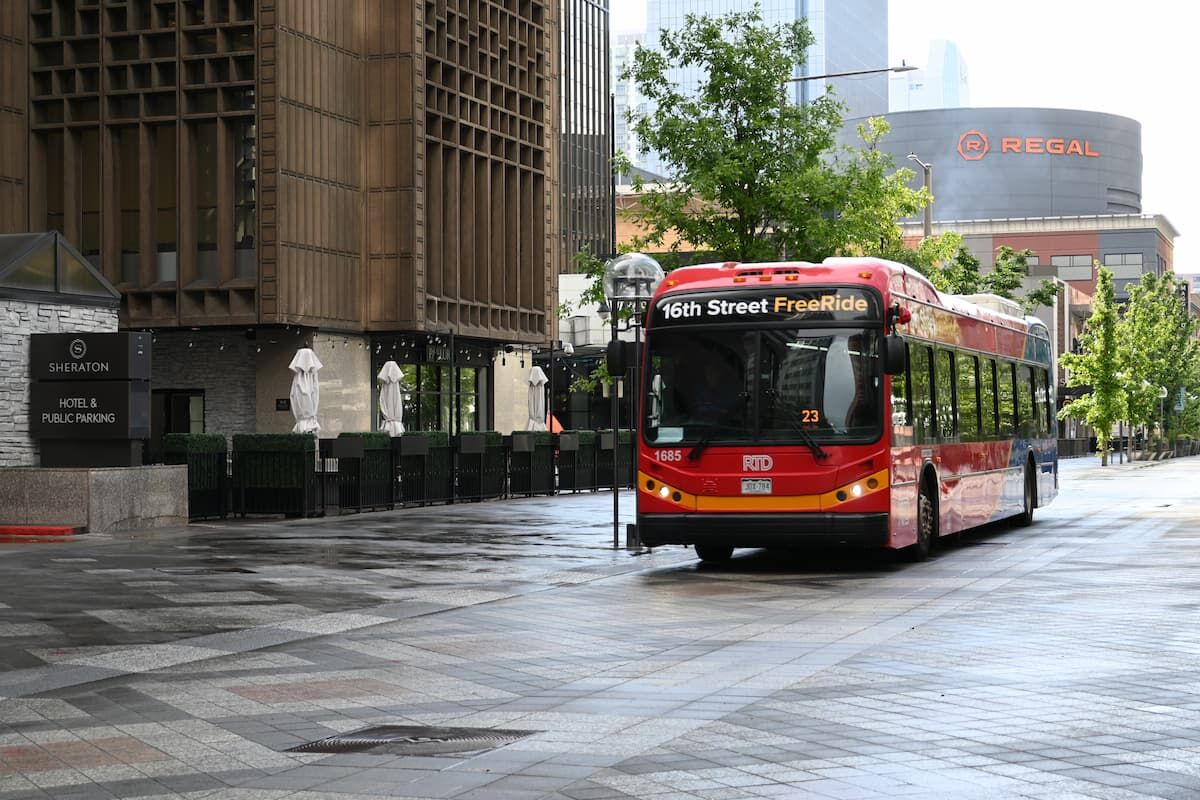
Nine months after 16th Street celebrated its full reopening, transit officials are weighing the fate of one of the promenade’s most notable features — the FreeRide.
In an agenda packet set to be reviewed by the agency’s Finance and Planning Committee Tuesday, agency officials proposed several service reduction scenarios — zero, 5%, 10%, 17.5% and 20%.
The 20% scenario would reduce service on 19 routes, discontinue 39 routes and save the agency upward of $62 million.
The FreeRide’s service would be maintained in the zero and 5% reduction scenarios and fully discontinued in the other scenarios.
Other routes slated for potential discontinuation in the scenarios include several FlexRide bus routes, as well as the B and R light rail lines.
Last year, the FreeRide service attracted over 2.3 million boardings, more than all but two other bus routes, RTD said. No other transit route slated for full discontinuation saw more than 1.2 million.
Traversing a 1.2-mile stretch of downtown Denver between the Capitol and Union Station, the FreeRide was promoted as a key feature of the new 16th Street renovation, which finished last summer.

But with the RTD facing a $200 million-plus budget deficit and undergoing an 18-month Comprehensive Operational Analysis (COA) to determine the priorities of its service moving forward, the reduction proposals aim to help the agency gain financial ground.
Chris Nicholson, RTD’s District A director, said the proposals are not indicative of the board’s current position on the service.
“We need to make cuts, but I don’t think what’s in the packet reflects the values of the current board,” Nicholson said. “These proposed cuts are based on service standards written years ago and have not received any board feedback.”
FreeRide model not unique to Denver
Marked as “duplicative” in the agenda packet, the RTD estimates that cutting the FreeRide service would save the agency north of $9 million annually, more than the discontinuation of any other individual bus route.
The service provides a vital connection along Denver’s urban corridor, better facilitating the opportunity for locals and visitors alike to access hundreds of downtown businesses, said Eric Boschmann, chair of the University of Denver’s Geography and Environment Department, who has researched cities and transportation in relation to accessibility and mobility.
“While it may be duplicative, nearby (paid) bus lines and the 16th Street FreeRide generally serve different purposes and different ridership,” Boschmann said, adding that free transit lines are common throughout many cities in Colorado and across the country.
Jon Ewing, a spokesperson for Mayor Mike Johnston’s Office, said the city wants RTD to continue operating the FreeRide service.
“We are deeply sympathetic to RTD’s budget situation, but cutting a popular service used hundreds of thousands of times a month and millions of times a year isn’t the answer,” Ewing said in a Tuesday statement.
Outpacing other RTD routes
The COA, which began in April and is expected to produce final recommendations by the fall of 2027, comes at a turning point for the RTD, which has struggled to bring ridership back to pre-2020 levels.
Total ridership across the agency’s three main transit options — bus, light rail and commuter rail — decreased nearly 42% from 2021 to 2024 compared to that seen from 2017 to 2019, according to annual agency profile data submitted to the Federal Transit Administration.
Part of that decrease can also be attributed to the reconstruction of 16th Street, which began in 2022 and ran through 2025. The RTD’s Free MallRide, as it was then known, served 40,000 riders daily or over one million per month before lengthy construction rerouted the service and discouraged people from visiting the area.
Even before 16th Street’s full reopening last October, the Free MallRide/FreeRide was already comparable in ridership to the RTD’s most ridden bus routes, according to public agency data — and in the first three months of 2026, it recorded more total boardings than any other line.
In addition to the low post-pandemic ridership numbers, the agency has used up the over $500 million in federal stimulus money granted in 2020 and 2021. Moreover, per-mile operating costs spiked in 2020 and have continued to grow since.
Scenarios include RTD cutting light rail, raising fares
In the scenarios, the RTD is also looking at cutting service on the B, R, L and T light rail routes, saving over $51 million and letting go of nearly 1.5 million annual boardings.
The agenda packet included projected fare revenue increases of 10% and 25%, which would result in additional revenue bumps of $4.8 million and $12.2 million, respectively.
By increasing the base fares to either $3 or $3.40, RTD would have relatively high public transit fares in comparison to other U.S. transit agencies, the packet staff report notes.
Despite modeled boardings not falling dramatically in either scenario — either by 1.3 million or three million, respectively, before taking into account any service reductions — the report highlights the potential public pushback that raising fares to such a level could generate.
Proposals are not final
With the proposed service cut scenarios in hand, two RTD committees will meet in the coming days to discuss the proposals and make recommendations for reducing service by a certain percentage, as well as an annual savings target dollar amount.
While all options are on the table, Nicholson noted that the agency may not even be able to cut the FreeRide service, given that the 16th Street renovation project utilized federal funds.
If implemented as currently written, the proposed changes would go into effect by the middle of 2027.
Denver Gazette reporter Bernadette Berdychowski contributed to this report.