







The passing of Pat Schroeder reminds us how far we’ve come | Vince Bzdek
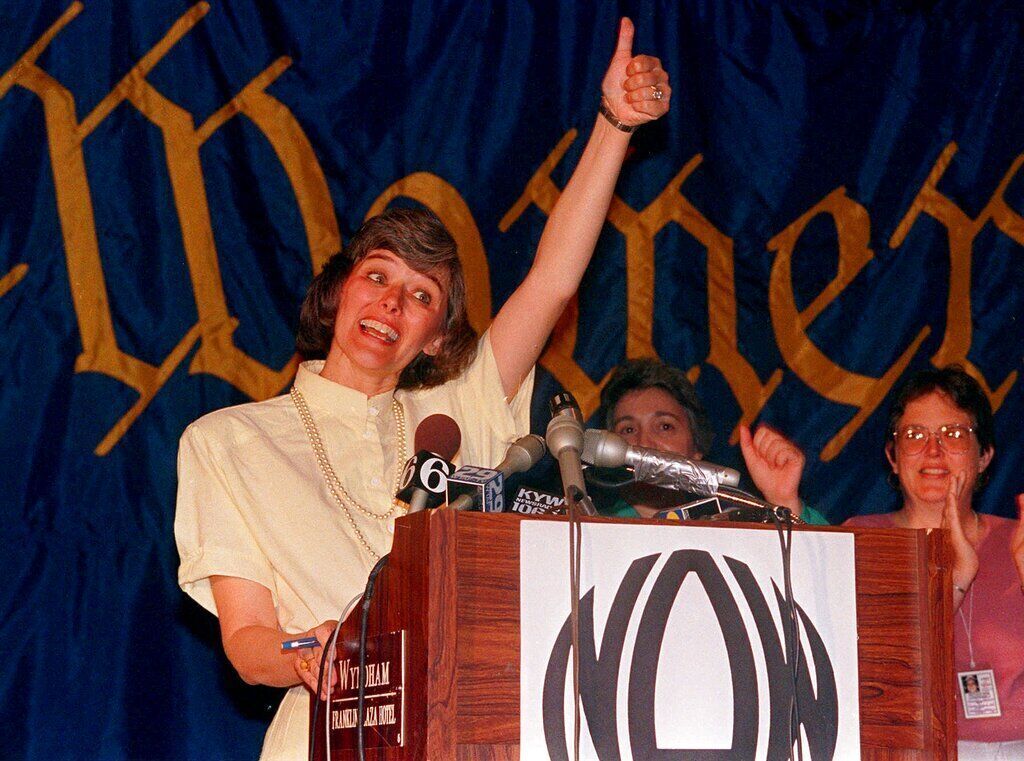
associated press file
It wasn’t that long ago.
Many of us who read this paper regularly can remember back to 1973, back when Pat Schroeder took office as the first women to represent Colorado in Congress. Schroeder’s passing this week at 82 reminds us that we’ve come a long way.
When Schroeder first took office 50 years ago, she was one of only 14 women in a 435-member fraternity. “I felt as though I had broken into and entered a private club,” she told me once in an interview. “Most of my new colleagues considered me a mascot or novelty, as if in Denver voters had mistakenly thought “Pat” meant “Patrick.”
In the House parking lot when she first arrived, “They’d always say the secretaries can’t park here. Or you can’t get on the elevator” because it was for “members only,” she told me. “I had to show my ID everywhere I’d go,” she said.
Now there are 125 women in the House, 28.7 percent of the total.
Schroeder’s introduction to the Congressmen she was to serve with was rough. One male colleague remarked, “I don’t understand why you are here. This place is about Chivas Regal, $1,000 bills, beautiful women, and Lear jets. Why did you come?” Another asked how she could be a mother of two small children and a member of Congress at the same time. She replied, “I have a brain and a uterus and I use both.”
Schroeder became the first woman on the House Armed Services Committee. But committee chairman F. Edward Hebert, D-La., didn’t think the committee was any place for a woman, or an African American. So Hebert actually forced Schroeder to share a chair with U.S. Rep. Ron Dellums, D-Calif. As she recounted in her memoir, she and Dellums had to sit “cheek to cheek” because the chairman “said that women and blacks were worth only half of one ‘regular’ member.”
That wasn’t that long ago.
It wasn’t until 1993 that women were allowed to wear pants on the Senate floor.
That was only 30 years ago.
“The women in Congress had to wage virtually every battle alone,” Schroeder wrote in her memoir of those early years, “whether we were fighting for female pages (there were none) or a place where we could pee.”
That’s right. For many years, women didn’t have a bathroom off the House floor like the men did. When Schroeder was there, women were forced to use the restroom inside the women’s reading room far off on another floor. Female members of the House didn’t get a women’s bathroom off the House floor until 2011.
That was 12 years ago.
Sometimes it takes an agitator like Pat Schroeder — with her rapier wit, talent for political theater, and willingness to take on the power structure — to move our country along. More than anyone in Congress, she forced the institution to acknowledge that women had a role in government. She was justly lauded Tuesday as a fitting heroine for Colorado, the second state to officially grant women the right to vote and the first to do so through a voter referendum in 1893.
Yet during her own time, she was every bit as controversial as some of our current members are. She and Sen. Barbara Boxer of California and New Jersey Congresswoman Marge Roukema were derided and mocked just as much as Alexandria Ocasio-Cortex and her “Squad” of Congresswomen are today.
For one thing, Schroeder was renowned for her sharp tongue. It was Schroeder who branded President Ronald Reagan the “Teflon” president for his ability to avoid blame for major policy decisions. She thought of it while scrambling eggs in a Teflon frying pan for her kids .
She was an early practitioner of performance politics as well. When House Republicans gathered on the U.S. Capitol steps to celebrate their first 100 days in power in 1994, she and several aides clambered to the building’s dome and hung a 15-foot red banner reading, “Sold.”
But Schroeder also got things done.
She and Roukema initiated the Family Leave Act requiring employers to grant up to 12 weeks unpaid leave to a family for the birth of a child. The landmark bill passed in February 1993, but at the presidential bill signing, only male members of Congress shared the stage with President Clinton and Vice President Al Gore. At the time, Schroeder observed: “Often you see when women start the issue, educate on the issue, fight for the issue, and then when it becomes fashionable, men push us aside. And they get away with it.”
She also helped pass the 1978 Pregnancy Discrimination Act, which barred employers from dismissing women because they were pregnant.
Schroeder, who was also a pilot who operated her own flying service to pay her way through Harvard Law School, persuaded the Armed Forces committee to recommend that women be allowed to fly combat missions. Defense Secretary Les Aspin ordered it so in 1993, and by 1995 the first female fighter pilot was flying in combat.
“Pat Schroeder blazed the trail. Every woman in this house is walking in her footsteps,” said Rep. Nita Lowey, D-N.Y.
In this weird period of retrenchment and recrimination we’re currently in, where some of our country’s unfortunate episodes of negative history are being erased left and right, Schroeder’s passing is a good moment for us to remember where we were not so long ago so we don’t forget how far we’ve come. Revisiting Schroeder’s many battles tells me we need to hold on tight to our collective memory, even the bad memories; they are mile markers with which we can mark our progress as a nation. And those mile markers need to be tended to with care to keep us from backsliding into places we’ve fought hard to put into the rearview.
Coincidentally, the night after Schroeder’s death, my wife and I watched Chris Rock’s new Netflix standup comedy show, “Selective Outrage.” During one long sad/hilarious rant, he reminded his audience that when his mom was a little girl, the black kids where she lived weren’t allowed to go to the white dentist. When no black dentists were available, she was sent to the veterinarian to have her teeth fixed.
Just another reminder: It wasn’t that long ago.
Vince Bzdek, executive editor of the Denver Gazette, Colorado Springs Gazette and Colorado Politics, writes a weekly news column that appears on Sunday.