







Colorado oil production sees uptick since COVID19 pandemic, but industry is wary of regulations
Fracking, Drill, Drilling Rig, Silhouette
sasacvetkovic33
Though oil production in Colorado has inched up this year, the state has still not recovered from the COVID-19 pandemic — and the industry is blaming regulations as the culprit.
Colorado oil producers said changing regulations has whipsawed the industry and they are struggling to cope with uncertainty that is slowing the recovery from the days of the COVID-19 shutdowns.
“We have undergone a massive amount of regulatory changes in rule makings since the governor signed Senate Bill 181 into law in 2019,” Dan Haley, president and CEO of the Colorado Oil and Gas Association told The Denver Gazette. “We have about 10 new rule makings on the books for this year alone across three different agencies. All businesses need certainty. We want to know what the rules are.”
In a statement, Gov. Jared Polis said he is is committed to regulatory certainty, such as by speeding up permitting processes. The governor also pointed to a grand compromise among lawmakers, the major companies and environmentalists to impose production fees on oil and gas drilling, with the proceeds directed to improve transit service, frequency, and ridership, fund passenger rail projects, and fund wildlife and land remediation services.
“Earlier this year, Governor Polis brokered a consensus agreement between the oil and gas industry, environmental advocates, and legislators to provide certainty for the industry and Colorado,” said Shelby Weiman, a gubernatorial spokesperson.
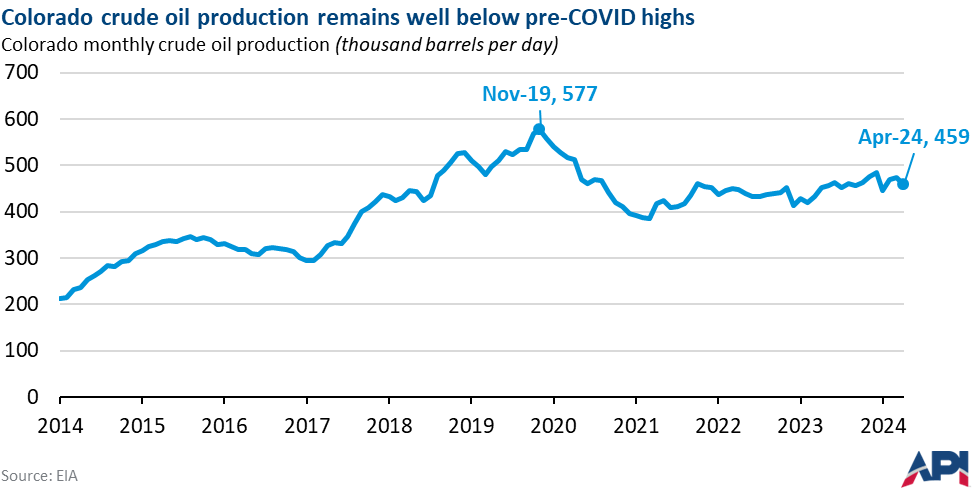
The American Petroleum Institute told The Denver Gazette that overall oil production in the first quarter of 2024 is down 65,000 barrels per day from the pre-COVID-19 high of 577,000 barrels per day in November 2019.
Production crashed during the pandemic and hit a low of 388,000 barrels in the first quarter of 2021.
Production has slowly recovered to 463,000 barrels per day in the first quarter of 2024, but it still hasn’t reached pre-pandemic levels.
American Petroleum Institute said that, while production has been slow, the number of uncompleted wells — meaning wells that have been drilled but not completed, which includes the fracking operations and installation of wellhead equipment — has been steady.
“Well completion activity picked up in mid-to-late 2023, helping production reach a post-COVID peak in December 2023,” said an API representative in an email. “However, completion activity has slowed since the beginning of the year, making it difficult to maintain the same level of production gains.”
The group also noted that the number of active drill rigs is down, but Haley said improvements in technology have increased efficiency.
“The number of oil rigs operating in Colorado are the lowest level since 2021. The effect of the decline in rig count has been partially mitigated by the available DUC inventory and consolidation in the sector which has helped with efficiency,” the group said.
“I think that their data points out that the higher production numbers that we’re seeing are really a result of two things: The amazing high-tech innovations that have powered the American shale revolution for the past decade or more, along with completing wells that have been drilled earlier,” Haley said. “The fact that we’re now able to produce more of the resources that we all need each day with fewer rigs and less of a physical footprint really is a testament to the amazing technology that we’ve seen developed.”
Permitting of new wells takes a long time — as long as two to three years or more. One reason, Haley said, is that the drilling permit must be issued before consideration of the air pollution control permit even begins. The well permitting approvals, he added, went from an average of 229 days in 2022 to 262 days in 2023.
Industry representatives said the regulatory difficulties had been ramping up since before the pandemic. In particular, they pointed to two measures they described as the most sweeping legislative changes to the natural gas and oil industry in Colorado’s history.
They also cited the governor’s greenhouse “playbook,” saying it has rewritten every year with up to 10 rule-makings each year.
The governor, Democrats and their allies have defended the “Greenhouse Gas Reduction Roadmap,” a set of goals that, among other things, outlined an aggressive timeline to transition Colorado away from carbon energy in favor of “renewable” sources, such as solar and wind power.
They argue the transition — although they acknowledge it might be painful in the short term — positions Colorado for a more sustainable and energy-efficient future. They also say it helps wean the country from dependence on foreign oil. Ultimately, they add, the transition toward green energy is good for the environment and people’s health.
In his introductory letter to version 2.0 of the roadmap, the governor said: “Climate action is not merely a matter of numbers and goals; what matters is that we set up Colorado’s economy, workforce, and way of life to thrive in the 21st century. We are already feeling the impacts of climate change, and yet the solutions are not only achievable but affordable.”
Critics, meanwhile, maintain the quick transition is failing to protect American consumers, particularly low-income residents, who already contend with soaring inflation, and that the singular focus on alternative energy is short-sighted.
The oil and gas industry is in the state’s sights as part of the goal to achieve a 50% reduction in greenhouse gas emissions by 2030.
When asked for a comment, Polis pointed to the agreement brokered earlier this year. The deal, struck in secret with environmental groups and three of the state’s largest oil and gas companies, levies a fee on every barrel of oil and cubic foot of natural gas extracted to fund Democratic priorities on rail, housing, wildlife habitat conservation, as well as for acquiring private lands for public use.
The agreement had come as a complete surprise to many in the industry.
An oil and gas industry insider, who talked to The Denver Gazette on the condition of anonymity to be able to speak freely, said many “weren’t privy to the conversations held between the environmental groups, Chevron, Oxy, Civitas, and the governor’s office regarding this deal.”
The deal resulted in the withdrawal of several ballot measures proposed for the November general election by the oil and gas industry and by environmental groups.
It remains to be seen if the deal would mean future legislation seeking major regulation or sweeping changes in the industry would go nowhere.
One such proposal this year gained a lot of attention but ultimately died at the state Capitol.
Senate Bill 159, sponsored by Democrat Sen. Sonya Jaquez Lewis, would have completely phased out oil and gas production in Colorado by 2030.
“The reason why we are wanting to phase down is because Colorado needs to be a participant in what many other countries have pledged to do, which is to do something to reduce greenhouse gas emissions,” Jaquez Lewis told The Denver Gazette in February. “We have the Paris Accord of 2015. We had COP 28 where hundreds of countries agreed to reduce fossil fuel production and try to decrease greenhouse gas emissions. And we know that oil and gas industry is one of the largest polluters when it comes to greenhouse gas emissions. So we have to take steps to fall in line with what other countries and other states are doing.”
Haley of the Colorado Oil and Gas Association urged policymakers to stop changing the rules and allow the industry to figure out how to adapt to what’s already been passed.
“The governor has stated publicly that he wants to see across the board permitting reform and increased efficiencies, and we would agree with that and stand ready to help in that process,” Haley added. “The state is working on a process right now on that permitting efficiencies, and we want to be a part of that and be helpful wherever we can be.”