







Colorado’s ties to NASA’s Artemis I launch
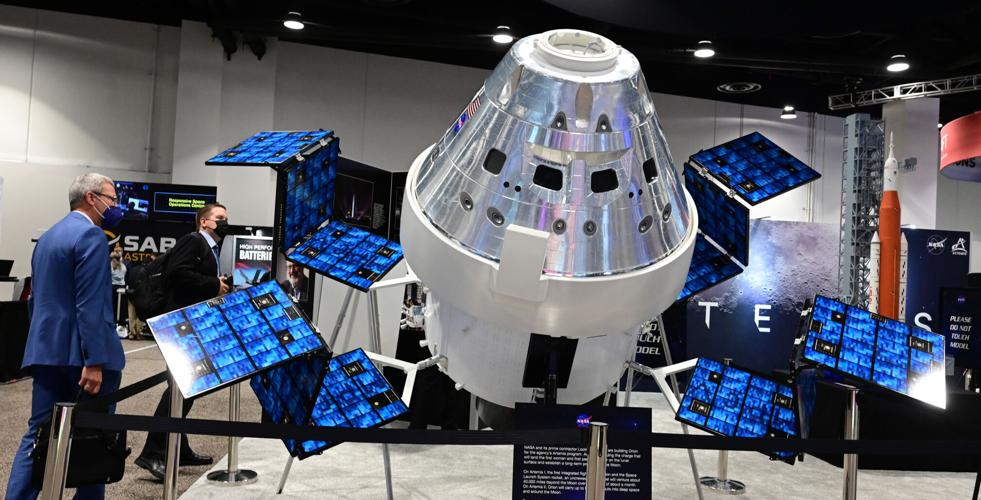
A model of NASA’s Orion spacecraft on display at the Space Symposium in Colorado Springs in August of 2021. The spacecraft, designed and built by Lockheed Martin, will be built to take humans farther than they’ve ever gone before. Orion will launch on NASA’s new heavy-lift rocket, the Space Launch System. (Photo by Jerilee Bennett, The Denver Gazette)
JERILEE BENNETT/ THE DENVER GAZETTE

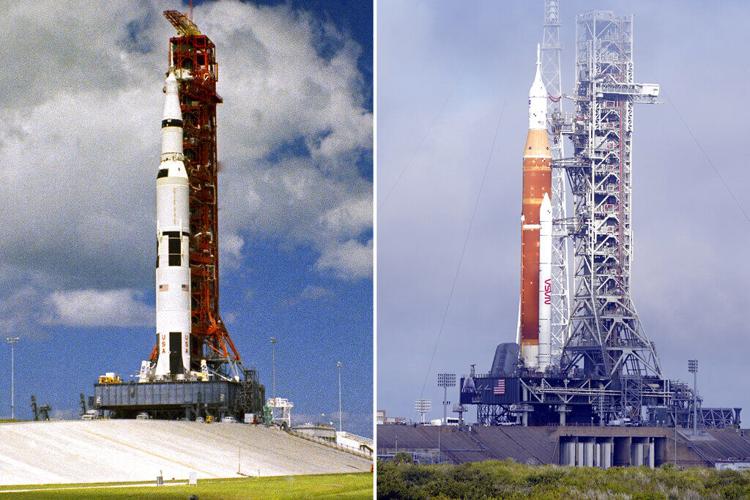
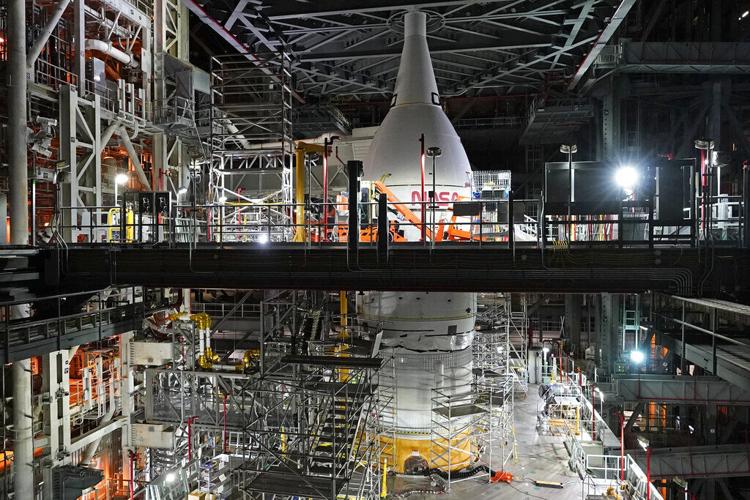
When the world’s most powerful rocket engine blasts off from Kennedy Space Center Monday, carrying the Orion spacecraft on NASA’s pioneering Artemis I mission to moon orbit, it also carries years of hard work by many Colorado-based aerospace industry members.
Artemis I is an un-crewed test flight to see if the Orion spacecraft can carry humans farther into space than they’ve ever gone, then successfully return to Earth after the 42-day mission.
Colorado aerospace companies land weather forecasting contracts
More than 184 Colorado companies support the Artemis mission’s supply chain, according to the Metro Denver Economic Development Corporation.
“Artemis is Apollo’s twin sister, and she’s going to take it to the next level,” said Lockheed Martin Corp.’s Rosemary Tetreault Sargent, Orion International Integration and compliance senior manager.
Much of Orion was designed and manufactured at Lockheed Martin’s (NYSE: LMT) Waterton Campus, in the southwest corner of Littleton. At the company’s Human Spaceflight Center in Highland Ranch, engineers will be able to monitor and participate in Orion’s lunar adventure.
“This is happening in your backyard,” Sargent said of Colorado residents. “It’s really worth a look. I would recommend you check out the streaming opportunities on NASA TV and see what it’s all about.”
Just a couple miles away at Centennial-based United Launch Alliance, Julia Paez talked excitedly about the launch as she prepped for the trip to Florida to watch in person. She is the ULA Propulsion System Design Lead for the Artemis program.
“I’m really excited we’re going to be going back to the moon and I cannot wait for this launch,” Paez said. “It’s going to be so epic. It’s the most powerful rocket we’ve ever had.”
ULA worked with Boeing to design and build the Interim Cryogenic Propulsion Stage (ICPS), the “stage two” rocket that will blast Orion towards its moon orbit after the main Space Launch System (SLS) rocket gets it to low Earth orbit.
Boeing designed and built the SLS, which Orion sits atop until the ICPS propels it beyond Earth’s orbit.
Blast off in Berthoud: Rocket manufacturer cranking out more affordable, re-useable rocket engines
Both engineers marveled at the partnerships between NASA, all the companies and all the countries involved to launch Artemis I. Future Artemis missions will carry astronauts to the moon — and beyond.
“It’s just a huge collaborative effort and this program is bringing so many different awesome contract companies together to return us to the moon,” said Paez. “It just goes to show how incredible of a feat this is.”
Many of those contractors are based, or have operations, in Colorado.
“The Artemis mission has been years in the making for Colorado companies,” said Morgan B. Alu, director of International Business Development and Special Projects for the Metro Denver Economic Development Corporation, in a statement. “The Metro Denver Economic Development Corporation and Colorado Space Coalition are excited to see Colorado’s 500+ aerospace companies paving the way for the future of space economy to the moon and further explorations.”
ICPS
“I think the ICPS is a really, really important piece of the mission because it actually put the spacecraft where it needs to be,” said Paez, a University of Colorado Boulder graduate.
The “single-engine liquid hydrogen/liquid oxygen-based system” will provide up to 24,750 lbs. of thrust to get Orion where it needs to go, then drops away on a path to burn up in the sun’s orbit.
By way of comparison, the SLS can provide up to 9.5 million lbs. of thrust to clear Earth’s gravity with payloads weighing up to 38 tons (83,700 lbs) — Orion and its crew.
“If you were going to design a rocket to maximize the viewing and listening experience, this would be that rocket design,” said NASA’s Andy Schorr, the manager for the Spacecraft Payload Integration and Evolution Manager. “It’s going to be fantastic to witness.”
After that almost-nine-minute rocket launch, the ICPS will handle the rest from low Earth orbit.
“It operates exclusively in space, so we don’t really get to see it,” Paez said. “But this is like the pinnacle of the last seven years of my career.”
After the burn, there’s a bit of a delay to start collecting all the data necessary to see how the ICPS performed.
“We get like a moment of reprieve where we get to appreciate what’s happened, celebrate the mission, then you turn around the next day and it’s right back to work,” Paez said.
“In Colorado, we’re really fortunate there’s so much of the aerospace industry around, you get the opportunity to see a lot,” she said. “We are literally on the forefront of, essentially, the next era of space and it’s just an incredible and humbling experience to be a part of.”
Orion
“We’re really pushing a lot of boundaries,” said Lockheed Martin’s Sargent on the Orion spacecraft. “This equipment is all new technology. We’re pioneering and learning as we go.”
Orion is scheduled for a 42-day, un-crewed mission — much longer than one with astronauts aboard, which would typically be a 10-day mission. Engineers are going to “shake test” everything about the spacecraft and push it through tests far beyond what crewed missions will undergo.
“This is a brand new spaceship, so we’re testing guidance, navigation and control, as well as crew life support,” Sargent said. “A big one is when we come back. We’re hitting Earth’s atmosphere at a really high speed.”
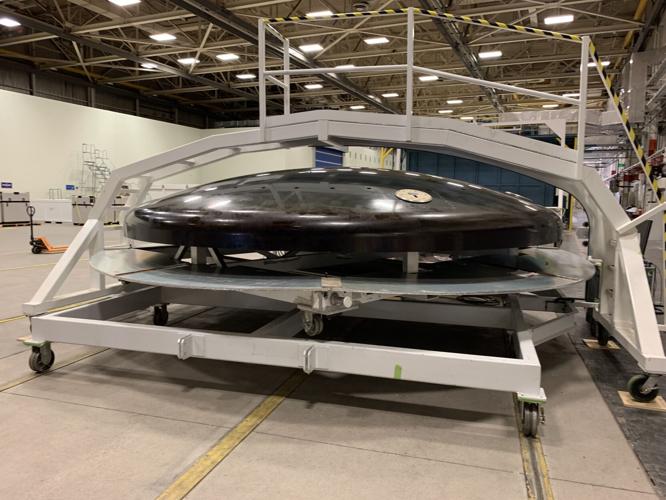
The heat shield was designed and built at Lockheed Martin’s Waterton campus.
Instead of live crew, the Artemis I mission will carry a “moon-equin” (mannequin) named Compost. He’ll be strapped with sensors to test vibration, the acoustic environment and radiation levels.
“Because we’re going way beyond lower Earth orbit, where the space shuttle missions have gone and the International Space Station is,” she said. “We’re getting into deep space missions and the radiation environment there is no joke.”
Orion is not designed to land on the moon. Instead, it will dock with a future orbiting station around the moon. The crew will then move to a lunar lander ship, which is being designed by SpaceX.
“We’re learning to live on another planet, and this will eventually be the jumping off point to Mars,” Sargent said.
NASA’s Schorr said they found a way to tie the Apollo missions to Artemis. Apollo 13 astronaut Fred Hayes and Apollo 17’s Harrison Schmitt, the next-to-last man to walk on the moon, were able to sign inside one of the aluminum plate pockets on the spacecraft.
“We’ve got that connection from the last exploration class vehicle NASA fielded to the one we’re fielding today,” Schorr said.
Blue Canyon Technologies unveils expanded small satellite manufacturing factory
NASA partnered with the European Space Agency on the service module, which provides Orion with power, propulsion and “consumables” for astronauts — oxygen and water. Sargent’s job as the European Service Module Engineering Senior Manager for Commercial Civil Space/Human Spaceflight involved her coordinating with that Agency, as well as with Airbus in Germany – which built the service module.
“This is everyone’s program,” Sargent said. “We’re building the spacecraft for humans right now. We’re really focusing on accelerating scientific discovery of our solar system. That technology is really going to improve life on Earth as well.”
NASA officials hope the Artemis missions inspire a new generation of aerospace industry workers and space explorers.
“I think it’s going to be inspiring to this new generation,” Schorr said. “That’s part of NASA’s mission — to inspire. We want to inspire that same excitement and energy Apollo gave to people like me to this new generation.”