






Major Colorado transportation bill faces first committee test
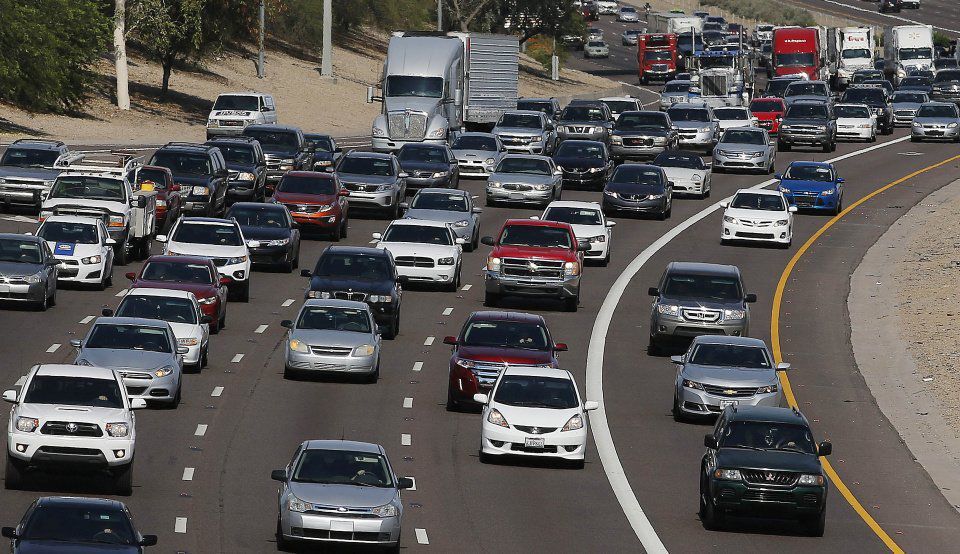
Gazette file
The Senate Finance Committee passed the bill on a 4-3 party line vote after more than seven hours of testimony and debate on the most aggressive attempt to money into transportation in decades.
“This is about fixing structural issues that impact every single Coloradan,” said Senate Majority Leader Steve Fenberg, a Democrat from Boulder, who is sponsoring the bill.
The bill goes next to the Senate Appropriations Committee, before the full Senate would have to vote on it twice before it starts over in the state House. Legislative leaders have indicated they will adjourn on May 28, with a number of major bills still in play.
A $5.2 billion package for the long-neglected transportation system in this fast-growing state directs 18% of the windfall going to new charging stations and moving vehicle fleets and transit to electrification, and alternative ways of getting around, rather than wider interstates.
Critics, especially Republicans on the committee, said the bill is a partisan play for more environmental regulations and sandbagging highway projects with added costs and delays.
Coloradans face more than $3.7 billion in new fees to pay for the package over the next decade. The rest would come will come from state stimulus money and operating budget.
The package would put $660 million into the state highway fund, $84 million for state and local multimodal projects and chip in $2.5 million to pay for studies and other momentum builders for Front Range commuter rail.
RELATED:
Transportation bill lays out fees, fares and inflation
Governor, major municipal leaders back billions in fees for Colorado transportation
INSIGHTS | What we spend on roads is overly complicated
INSIGHTS | Public dollars are a public good when they're applied to public roads
CALDARA | On transportation, we're getting played
Move beyond conventional transportation solutions
Highway director talks 10-year wish list with Colorado Concern
He said the plan “future proofs” a system that is changing fast, from gas to electricity and how people use the roads for commuting and shopping, but indexing the costs for inflation and revisiting the situation in five years to make adjustments, if necessary.
Future-proofing means ensuring electric vehicles contribute the same as combustion engines, collecting money from deliveries, indexing for inflation so the fund grows and committing future money from the state budget.
The fees that would begin in the 2023:
- A road usage fee is 2 cents that would ratchet up annually to a maximum of 8 cents after a decade, then be indexed for inflation.
- 3.5 cents per prearranged ride in a zero-emission vehicle and 7.5 cents for every other vehicle.
- 6.9 cents for retail deliveries.
- 5.3 cents for each delivery to support a fund to transition government fleets to electric vehicles.
- Raising the $50 registration fee for electric vehicles with an index that puts EVs on parity to what combustion vehicles pay.
- Indexing the current $2 fee per day on vehicle rentals to inflation, exempting car-sharing programs.
- Changing the Statewide Bridge Enterprise to the Statewide Bridge and Tunnel Enterprise, and authorizing its board to use a fee on diesel and deliveries.
Transportation will reach into Coloradans’ pocket, whether the bill makes it into law or not.
Suzanne Kutsch, vice president of her family’s CAST Transportation in Commerce City and chair of the Colorado Motor Carriers Association, said the 650 companies in her trade group were divided on the bill, but saw the need as so great they supported the bill.
Delays lead to higher fuel, maintenance and driver pay, she said.
The cost of those delays get passed on in the freight rates that eventually trickle down to customers.
“This unseen expense represents a hidden tax we all pay whether you drive or not,” she said, “since it’s buried in the cost of every product we buy or use.”
Colorado is way more congested than surrounding states because those states are investing more in their highways.
Republicans on the committee offered amendments to avert a fee hike. Scott proposed taking $2 billion from the state’s federal stimulus money and applying it to roads and bridges. The legislature could leverage some of the money and put the decision before voters.
“Let’s leave the taxpayer alone and get this show on the road,” said Sen. Ray Scott, a Republican from Grand Junction.
Fenberg said guidelines won’t allow previously approved stimulus money to be spent on transportation, and the federal infrastructure bill hasn’t been introduced in Congress.
Scott proposed another amendment in vain to use all the money in the state’s existing 10-year priority plan, which is all projects.
Sen. Paul Lundeen. R-Monument, said electric vehicles, typically driven by people with more money, are being favored in the bill as a policy choice over combustion vehicles driven by people who have less.
“There is a thumb on the scale that is driving a particular human behavior,” he said.
Sen. Faith Winter, a bill co-sponsor, agreed it was a policy choice, but it’s a choice that’s being driven by climate goals and changes in the market, with Ford and General Motors both moving to produce more vehicles.
Fenberg noted that the bill raises fees on electric vehicles to put them on par with combustion vehicles. “The last I checked, this has been the No. 1 request of Republicans in this building,” the Senate Democratic leader said.
After Mike Kopp, president and CEO of Colorado Concern who is leading a transportation coalition called A Way Forward, spoke in support of the bill, Scott and Lundeen questioned the former Republican senator about his support for environmental aspects of the bill.
“We recognize it’s impossible to write a bill like this that’s free of political flaw,” Kopp said to Lundeen.
After Scott brought up that many Republicans would like to see more money going directly to roads and bridges, Kopp responded, “We will do our best to work through that, as we have many other parts of the bill.”
Fix Colorado Roads and the Northern Colorado Legislative Alliance said the bill requires duplicative environmental requirements that would slow projects to add lanes and add unnecessary costs.
“We seek the opportunity further amend this bill,” Sandra Hagen Solin, who represents the two organizations, told the committee, with no luck. “At present these provisions are untenable and it’s a bridge too far.”
From the income, 60% will go to the state. The other 40% will got to municipalities and counties, including $85 million for local “Main Street” projects. The Metro Mayors Conference and the Colorado Municipal League endorsed the bill.
Denver Mayor Michael Hancock talked about a “decade of stagnation” in dealing with Colorado’s transportation needs, as lawmakers fought to a standstill on how to fund roads and bridges.
He added the city’s endorsement to the package and congratulated those who crafted the legislation for finding a solution.
“We see it really as difference between leadership and partisanship,” Hancock said. “Every year we watch as the legislature goes into session with our collective breath held in high hopes that we will finally have a breakthrough on a transportation bill.”
Boulder Mayor Sam Weaver called the bill “transformative” added cited its lean into electric vehicles and multimodal travel as a reason for the city’s official support
“Colorado is known for our beautiful outdoor spaces,” he told the committee. “And a true Colorado transportation system is one that helps us protect the lands and nature we cherish so much. It is a system that helps us get to those places both efficiently and in a variety of different ways.”

Aurora to hold first council meeting with new members
Kyla Pearce
kyla-pearce@denvergazette.com
Updated 7 hours ago
Aurora’s four new councilmembers and an incumbent will be sworn in Monday night, marking the beginning of a progressive-majority council rule in the city that has been led by conservatives for years. In November’s election, Aurora voters chose progressive candidates...

Kyla Pearce
Reporter
Residents brace for change as Salvation Army transitions from operating Denver’s hotel shelters
Deborah Grigsby
deborah.smith@denvergazette.com
Updated 10 hours ago
It was a scorching day in Denver on Sept. 1, 2023, when Bernadette McMurrin’s aunt, Christina Martinez, passed away in a small apartment provided by the Denver Housing Authority. McMurrin, 41, who considered Martinez more of a godmother than an...

Deborah Grigsby
Reporter

Salvation Army’s Harbor Light Center helps addicts get back on their feet
Deborah Grigsby
deborah.smith@denvergazette.com
Updated 1 day ago
Dustin French walked through the doors of The Salvation Army’s Harbor Light Center in downtown Denver in July after 16 years as an addict. It had taken him more than half a year to muster the courage to do so,...
Deborah Grigsby
Reporter
Experts doubt the Pentagon can punish Kelly over the ‘illegal orders’ video
Ben Finley
ben.finley@associatedpress.com
Updated 1 day ago
WASHINGTON (AP) — The Pentagon’s investigation of Sen. Mark Kelly over a video that urges American troops to defy “illegal orders” has raised a slew of questions, and some criticism, from legal experts. Some say the Pentagon is misreading military...

Ben Finley
Reporter
Denver Council to consider $400 million in infrastructure contracts
Deborah Grigsby
deborah.smith@denvergazette.com
Updated 6 hours ago
The Denver City Council returns on Monday afternoon for its weekly meeting, approaching a full agenda that reflects several ongoing city priorities: homeless shelter operations, housing, infrastructure and police overtime. The agenda this week spans roughly 35 pages and includes...
Deborah Grigsby
Reporter
Campaign finance complaints add up for Bennet campaign
Marianne Goodland
marianne-goodland@denvergazette.com
Updated 1 day ago
Three state campaign finance complaints have been filed against U.S. Sen. Michael Bennet, D-Denver, tied to his campaign for governor in 2026. A fourth is likely, sources have told Colorado Politics. The first two were filed on Sept. 24 and...

Marianne Goodland
Reporter

Here’s what to know about the federal ban threatening the market for THC-infused drinks and snacks
Gene Johnson
gene.johnson@associatedpress.com
Updated 3 days ago
MINNEAPOLIS (AP) — The production lines at Indeed Brewing moved quickly, the cans filling not with beer, but with THC-infused seltzer. The product, which features the compound that gets cannabis users high, has been a lifeline at Indeed and other...

Gene Johnson
Reporter
Denver is one step closer to getting a history museum just about the city
Bernadette Berdychowski
bernadette.berdychowski@denvergazette.com
Updated 3 days ago
Denver could soon have a history museum. The city is home to the History Colorado Center that recognizes the state’s heritage, but Denver is one of few cities without a history museum dedicated just to the city itself. Aurora has...

Bernadette Berdychowski
Reporter
Lakewood swears in new city councilmembers
Sage Kelley
sage-kelley@denvergazette.com
Updated 4 days ago
Lakewood City Council got a new member Monday when Liz Black was sworn in. The City Council swore in five members during its normally scheduled meeting Monday evening, with Black being the only new councilmember to join the board. Black...

Sage Kelley
Reporter
Auditors, Denver City Council mince words regarding spending policy
Deborah Grigsby
deborah.smith@denvergazette.com
Updated 4 days ago
Denver’s councilmembers continue to give city funds to local organizations using a process lacking clarity and accountability, weakened by inconsistent terminology and legal opinions around donations, sponsorships and grants, according to city auditors. City Council officials countered that no definitions...
Deborah Grigsby
Reporter
PREV
PREVIOUS
Colorado Springs delegation weighs in on shooting
Facebook Twitter WhatsApp SMS Email Print Copy article link Save Facebook Twitter WhatsApp SMS Email Print Copy article link Save Lawmakers from the Colorado Springs delegation led the General Assembly on Monday in mourning the six victims from a Mother’s Day shooting at a trailer park in east Colorado Springs. Sen. Pete Lee, a Colorado […]
Lincoln Park to gain new name and a new statue under House bill
Facebook Twitter WhatsApp SMS Email Print Copy article link Save Facebook Twitter WhatsApp SMS Email Print Copy article link Save Lincoln Park, across the street from the state Capitol, has been referred to by various names over the past several years, most recently, Liberty Park and Veterans’ Park. It has been closed off and on […]