







Colorado-built NASA Lucy spacecraft begins journey
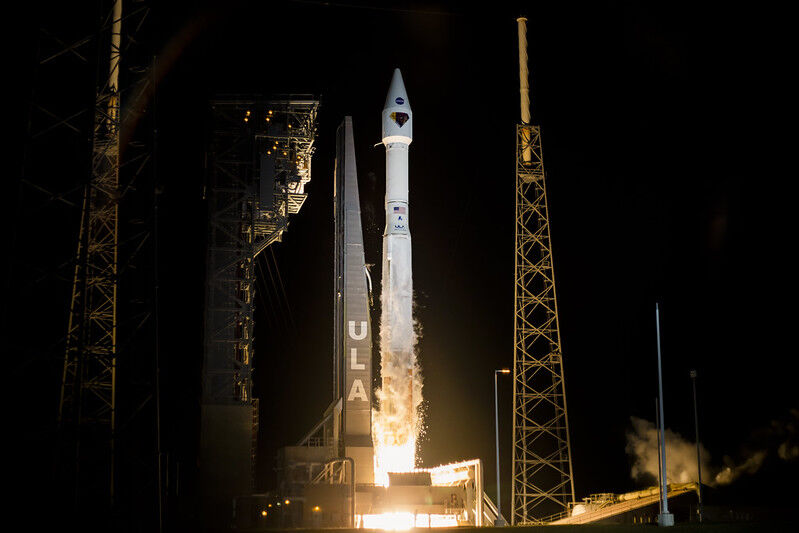
CAPE CANAVERAL, Fla. — A NASA spacecraft named Lucy rocketed into the sky with diamonds Saturday morning on a 12-year quest to explore eight asteroids.
Seven of the mysterious space rocks are among swarms of asteroids sharing Jupiter’s orbit, thought to be the pristine leftovers of planetary formation.
The 12-year mission to study the ancient Trojan asteroids near Jupiter is a joint effort by NASA Goddard Spaceflight Center, NASA’s Launch Services Program and Boulder-based Southwest Research Institute. Lockheed Martin designed, built, tested and will operate the spacecraft from its Waterton Canyon campus southwest of metro Denver.
It launched aboard a Centennial-based United Launch Alliance Atlas V rocket, which blasted off before dawn sending Lucy on a roundabout journey spanning nearly 4 billion miles (6.3 billion kilometers). Researchers grew emotional describing the successful launch — lead scientist Hal Levison said it was like witnessing the birth of a child. “Go Lucy!” he urged.
“We are honored to partner with NASA to launch this one-of-a-kind mission and are proud to add the Lucy mission to the Trojan Asteroids to our list of exploration launch successes,” said Gary Wentz, ULA vice president of Government and Commercial Programs, in a statement. “We are very proud to launch this spacecraft on its historic 12-year journey to eight different asteroids, and thank our mission partners for their teamwork.”
Lucy is named after the 3.2 million-year-old skeletal remains of a human ancestor found in Ethiopia nearly a half-century ago. That discovery got its name from the 1967 Beatles song “Lucy in the Sky with Diamonds,” prompting NASA to send the spacecraft soaring with band members’ lyrics and other luminaries’ words of wisdom imprinted on a plaque. The spacecraft also carried a disc made of lab-grown diamonds for one of its science instruments.
In a prerecorded video for NASA, Beatles drummer Ringo Starr paid tribute to his late colleague John Lennon, credited for writing the song that inspired all this.
“I’m so excited — Lucy is going back in the sky with diamonds. Johnny will love that,” Starr said. “Anyway, if you meet anyone up there, Lucy, give them peace and love from me.”
To date, ULA has launched 146 times with 100% mission success, according to the company.
“We are honored to partner with NASA to launch this one-of-a-kind mission and are proud to add the Lucy mission to the Trojan Asteroids to our list of exploration launch successes,” said Gary Wentz, ULA vice president of Government and Commercial Programs, in a statement. “We are very proud to launch this spacecraft on its historic 12-year journey to eight different asteroids, and thank our mission partners for their teamwork.”
The paleoanthropologist behind the fossil Lucy discovery, Donald Johanson, had goose bumps watching Lucy soar — “I will never look at Jupiter the same … absolutely mind-expanding.” He said he was filled with wonder about this “intersection of our past, our present and our future.”
“That a human ancestor who lived so long ago stimulated a mission which promises to add valuable information about the formation of our solar system is incredibly exciting,” said Johanson, of Arizona State University, who traveled to Cape Canaveral for his first rocket launch.
Lucy’s $981 million mission is the first to aim for Jupiter’s so-called Trojan entourage: thousands — if not millions — of asteroids that share the gas giant’s expansive orbit around the sun. Some of the Trojan asteroids precede Jupiter in its orbit, while others trail it.
Despite their orbits, the Trojans are far from the planet and mostly scattered far from each other. So there’s essentially zero chance of Lucy getting clobbered by one as it swoops past its targets, said Levison of Southwest Research Institute, the mission’s principal scientist.
“She’s got state-of-the-art instruments and a pointing platform to read thermal images, spectrometers (which measure light), picture imaging all for scientists to take data,” said Lockheed’s Emily Gramlich, an electrical test engineer for Lucy, in an interview. “We’ll get a full-blow map made up, which will include terrain data that we can determine what its made of and where that fits in the formation and location of the galaxy.”
Lucy will swing past Earth next October and again in 2024 to get enough gravitational oomph to make it all the way out to Jupiter’s orbit. On the way there, the spacecraft will zip past asteroid Donaldjohanson between Mars and Jupiter. The aptly named rock will serve as a 2025 warm-up act for the science instruments.
The wing-like solar arrays (panels) are each 24-feet wide – almost 50 feet when both are deployed with the 2-foot spacecraft in the middle. They were designed and built by Northrop Grumman in Goleta, California, and will supply about 500 watts of power throughout the 12-year mission – about the energy needed to run a washing machine.
NASA states Lucy will be “operating farther from the Sun than any previous solar-powered spacecraft.” It will travel some 4 billion miles at speeds of 17,000 mph.
It’s the only long-range spacecraft that will actually return to Earth’s orbit in about 2030, as it slingshots back to the Trojans. It won’t even get there until 2027, as it must make two trips around the Earth to get enough speed to reach the Jupiter area.