




Eron Johnson Antiques: A treasure trove of unique and antique items
Denver's Johnson has bought and sold antiques for 50 years, starting with stain glass windows at age 15

When designing his home, Eron Johnson has the enviable option of choosing from roughly 3,000 works of art and objects at his store, Eron Johnson Antiques. A native of Wheat Ridge, Johnson began buying and selling antiques at age 15. Over the past half-century, he accumulated more and more and more to amass the extraordinary array stockpiled at his enchanting store at 377 S. Lipan Street in Denver.
Tucked into an industrial area, the red brick building with a Kelly-green roof and wood trim houses Johnson’s singularly styled home rich with eclectic maximalism. The majority of the building’s interior serves as Johnson’s showroom of assemblages he creates with his refined taste and age-old items among his venerable merchandise. The structure is itself antique with architectural charms of yesteryear.
“The building was the Duffy Crane Company, and it was full of heavy machinery, giant cranes, and this was the welding shop,” Johnson said of the enormous space now chock-full of antique furnishings and curious curios. “The building shows up on records as built in 1911, but it could be before that 10 or 15 years.”
It’s Johnson’s seventh location, and possibly his last large-scale showroom. Johnson has resided in and conducted business in the building for the past 12 years.
Part of Johnson’s collection of treasures is displayed outdoors. A pair of 15-foot-tall limestone obelisks salvaged from Chicago stand guard. An 18th-century stone and bronze sundial from Scotland marks the time. A sign notes “Centuries of Design,” and the bygone era is evident in a conglomeration including decorative ironwork with the patina of generations, a pair of weathered stone sphinxes, charmingly chipped Corinthian columns and aged concrete garden ornaments. Ornate Asian doors open to a courtyard where another hodgepodge of wonders awaits.
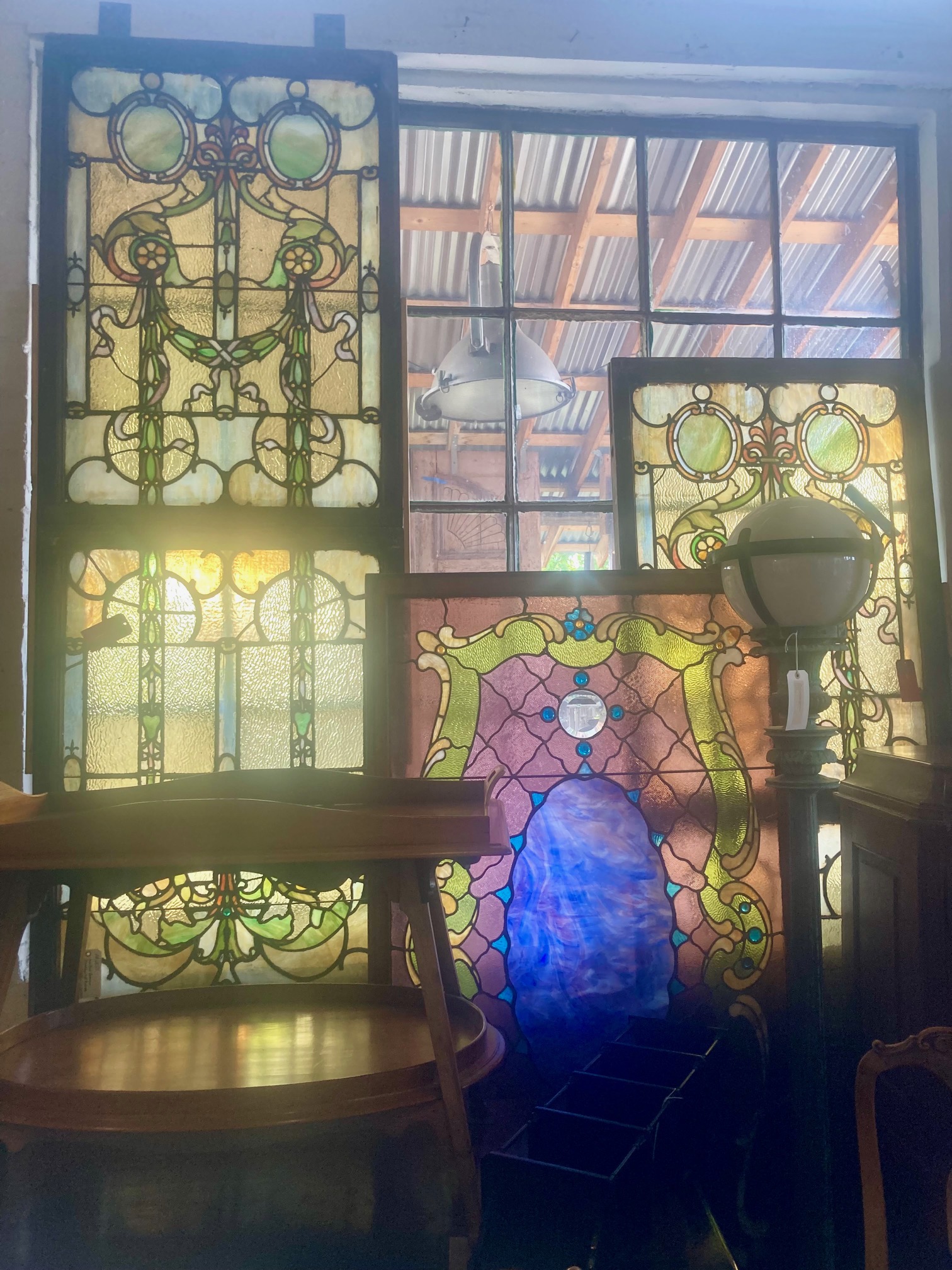
Windows of the building hold antique stained-glass panels.
Collector started in stained glass
“I always liked stained glass, and in high school I taught myself to repair stained glass windows. That’s how I started,” said Johnson. “Urban renewal was tearing everything down, and I found people who wanted to buy things.”
For Johnson, trading in antiques never grows old. Inside, the high-ceilinged space is an assortment of antique paintings in gilded frames, vintage marble sculptures on handsome pedestals, hand-crafted furnishings, old-fashioned clocks, clusters of candlesticks tinged with verdigris, richly filigreed mirrors, carved ornamental mantels, benches and friezes, an assortment of lamps of every size and shape and vintage, bronze statuary, gleaming crystal chandeliers and sconces, a medley of ceramic vases and figurines. From medieval to baroque Italian to Art Deco, it’s all in Johnson’s mix.
“This is the original recycling,” Johnson said of his antiques. “The furniture is like sculpture, but the trees were cut two or three hundred years ago. There is no carbon footprint except getting it shipped.”
Johnson carefully curates each acquisition and arranges the dreamy vignettes in the store. Browsing the selection is akin to time travel. Here is a rare oil painting from the 1500s. Here is a rustic French table, late 1700s. Here are turn-of-the-century bookends by Tiffany Studios. Every item is singular, artisan-made, seemingly possessing stories of bygone eras. Sometimes, an item’s provenance is known. Many times, not.
Curating “the romance of history”
After years of what some call “the Apple Store aesthetic” — futuristic sterility typified by white-walled minimalism — the design pendulum is swinging back toward discerningly layered maximalism. Ubiquitous, mass-produced items in home furnishing catalogues from chain stores are being shunned in favor of artisan-made goods.
“My phrase is ‘the romance of history.’ I like things that look like someone made it. I don’t have anything mass-produced. It generally has to have a human touch. I like timeless materials and traditional techniques. It has to have something that you can’t dismiss,” said Johnson. “Art, in general, has to have something that catches my eye. That can be attention to detail and being very talented craftsman. Technically proficient always appeals to me.”
Vanessa Marck has worked for Johnson for the past 25 years.
“Craftsmanship is the difference in why things hold up over time,” she said. “These pieces are intriguing, and something makes it special. It’s rarity. Everything is one of a kind. There’s not a shelf of them.”
An online antiques market
While the store is a delightful experience tantalizing the senses and tickling nostalgic memories, much of Johnson’s business now is e-commerce.
Marck said: “Eighty percent of our business is online.”
Online shopping is positive and necessary with trade-offs. The website can show things all over the world.
“We’re shipping French silver flatware to Dubai,” Johnson said.
Marck added: “A lot of people shop online now. A lot give gift cards. We used to see more collectors, but people aren’t collecting as much. People used to like to buy something interesting on vacation. Now they hop on e-bay.”
“It’s not as meaningful when you find something, when you go online and find 10 of them,” Johnson said. “There’s no hunt.”
For Johnson and Marck, the hunt has been part of the challenge. But oftentimes, people come to them to purvey their personal belongings when downsizing. Family heirlooms get folded into the lifestyles of others.
Antiques personalize private spaces
Johnson’s private quarters — a blend of the elegant and the rustic — appear more like someplace in Europe than anywhere in the Mile High City. He transformed the industrial space into a jaw-dropping design of unexpected grandeur.
Marck mixes antiques into her home.
“I think it’s important to surround yourself with things that you’ve chosen, things that mean something to you for whatever reason, things you enjoy being around,” she said. “That’s what creates your home and the comfort of being in your space.
“Make it interesting.”
It’s safe to say everything in Eron Johnson Antiques is interesting.
“Our furniture especially is 3-D like sculpture. The forms are different from what’s available today,” said Johnson, who has little time for newfangled belongings lacking character. “I’d rather have an empty room with one thing in it that I really care about than a bunch of stuff that is simply space-holders.”
Johnson’s showroom features primarily European and Asian antiques. Marck explained: “It’s about 85% European and Asian with a handful of American pieces because there was only a short window before the United States went into mass production.”
Given the magnitude of the miscellany, customers can feel overwhelmed if they don’t know what they’re looking for, so Johnson and Marck encourage visitors to browse with an open mind and an eye for the unusual.
Johnson’s tips for ferreting out finds
• “You have to train your eye to know what you like so you’re not overwhelmed by the quantity. Have confidence in what you want and what actually makes you smile. Be willing to try something different. Trust your own taste. Like what you like. A space should reflect the person, not the decorator.”
• “One thing can bring a space to life. It could be a brilliant little red glass vase with color that you pick up somewhere else — in pillows or artwork.”
• “A piece has to affect you emotionally — and you don’t have to like it. It’s a successful piece if it talks to you even if it tells you something you don’t want to hear.”
• “Whether you find something at a garage sale or a gallery, you feel like you discovered something that doesn’t fit, something that jumps out at you. If you’re at a gallery or flea market, if you look at something twice or three times, pay attention to that. My theory is if you look at something and really it like for whatever reason in your heart or brain that says ‘I really like this,’ it will fit with everything else you have.”
• “Look for texture. If you see something that makes you go, ‘Oh, I’d like to touch and feel that,” whether you like shiny brass or bronze or silver or ceramics.”
• “Look for something that sets itself apart from the rest of your interior so it becomes an artistic item of interest, a statement piece with character. You always want point and counterpoint. If you have a sleek room, add a rustic bowl or table so you have tension between two textures and two dimensions. If there isn’t much tension, or if you tried to match and miss, it’s not successful. It’s better to juxtapose to make sure it’s obvious it isn’t meant to match.”
Visit Eron Johnson Antiques online or at the brick and mortar store open 10 a.m. to 5 p.m. Tuesday through to Saturday.




Get OutThere
Signup today for free and be the first to get notified on new updates.