







Hug a paramedic. Every one of them has an award-winning story | John Moore
If you don’t have a first-hand paramedic story, consider yourself blessed.
If you do have a first-hand paramedic story, consider yourself blessed.
Because it might have saved your life.
Mine took place in 2009, when I was the theater critic for The Denver Post. I was heading home from a play at Buntport Theater on my scooter – the motorized kind, not those battery-powered green things now terrorizing our sidewalks.
I was heading west through an ordinary intersection on a green light. The driver heading east simply missed or ignored me, taking an illegal left turn that knocked my scooter over and me into the next morning. I woke up hours later in an MRI machine.
When I first bought the scooter, my brother, Brian, insisted we split the cost of a full-head helmet – and it saved my face, if not my life, because I landed chin-first on the pavement. The scooter was totaled and my brain was scrambled, but I was alive.
I often think about the paramedics who responded to the scene, scooped me off 10th Avenue and safely transported me to the hospital. What was surely a routine, forgettable call to them became a seminal line of demarcation in my life – the night before and after my brain injury. It haunts me still that not only did I never get to thank them, but that I don’t know their names, or even what their faces look like. Because for those few hours after impact, the VCR that is my memory was shut down, and I won’t ever get that recording back.
I think about that night every time I see a paramedic at a concert or a sporting event – and I make a point to say thanks. Because to me, by process of non-elimination, every paramedic is now my collective paramedic.
I thought about that night again last week when I heard the Denver Health Foundation was hosting an event at the Denver Center for the Performing Arts to honor the everyday heroism of paramedics – all of whom wake up every day not knowing what danger awaits or what courage they might have to summon to save a life that might turn out to be their own. The stories they told were as harrowing as anything I’ve seen performed on a stage or screen.
We learned about paramedic Matthew Ludtke, who saved the life of a teenager threatening to jump from atop a multistory parking structure. We learned about paramedics Julia Drahn and Laura Gehm, who intervened on behalf of a patient they believed to be a victim of human trafficking.
We learned about Denver Police Department Corporal Brandon Reyes, who applied a lifesaving tourniquet to a fellow officer whose femoral artery had been severed when he was shot in the leg during a trespassing call. And we learned about paramedics Jesse Wright and Justin Bell, who treated and transported that wounded police officer to the hospital — with an armed suspect still on the loose in the vicinity.
Story after story about our friends and neighbors whose job description calls for them to respond to sudden, serious situations that demand immediate action with lives at stake.
My job description, by comparison, calls for me to type.
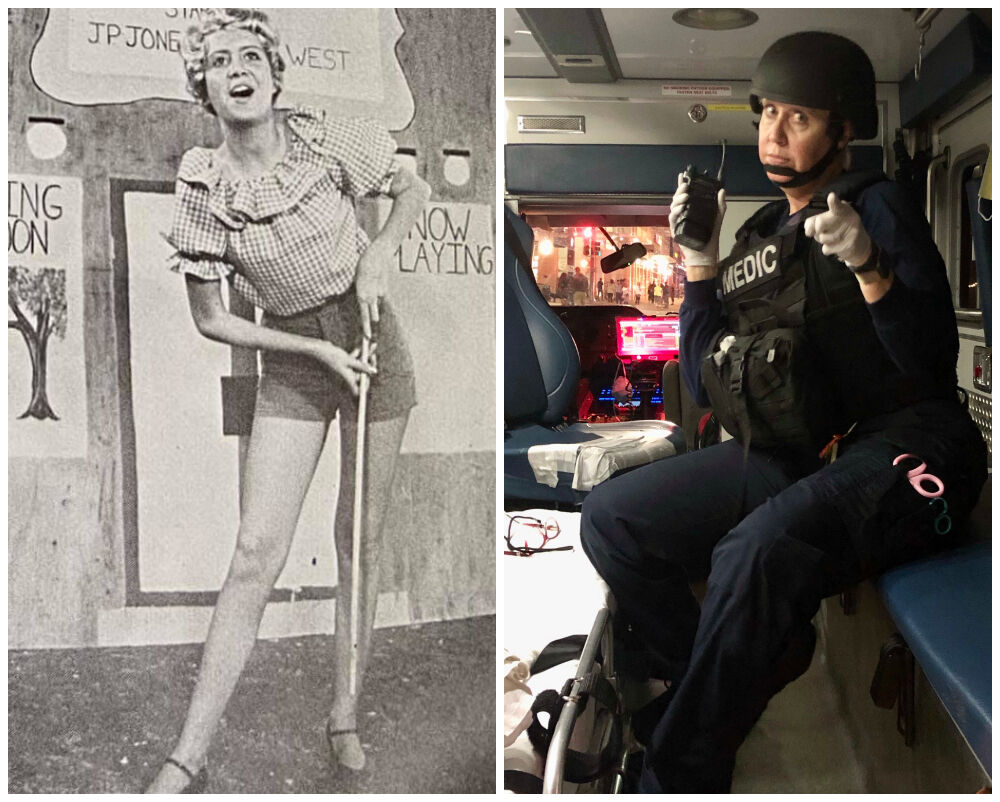
My friend, neighbor and collective paramedic is Maryanne Leuschner Davis. I met her in her college years, when she was a rising star at Loretto Heights College, then the premier theater school in the state. She could sing, she could dance and she could make you laugh at the most inappropriate things. In 1992, more than 36,000 saw Davis perform in the musical “Chess” at the San Jose Civic Light Opera. And for years, she was a comic foil in the popular melodramas at the late Heritage Square Opera House in Golden. She had gams (ang grit) of steel.
Davis was born for both stage and service – literally. Her mother, Reggie Leuschner, was hired as a young woman to teach at Arthur Murray’s New York dance studio, and later performed ballet at the La Scala Opera House in Milan. When her dance partner was drafted into World War II, she joined Women’s Army Corps, serving as a nurse and reconditioning instructor for psychologically wounded servicemen.
Had Reggie pursued a dance career instead, “I have no doubt that she would have had a long career on Broadway,” said her daughter. And the same could be said for her.
“But I was always interested in emergency medicine,” said Davis. “When I went to college, I was torn between the nursing program and musical theater.” To that point, Davis had lived and breathed theater for her entire life. But there were no female role models or apparent paths for a woman to a career in emergency medicine, so she pursued her second love of the stage. Until, as a young mother, she took a class in CPR that changed the direction of her life.
Her neighbor happened to be Bob Hose, a friend and fan who regularly attended Heritage Square shows. He’s now Deputy Fire Chief for the city of Westminster.
“I asked Bob, ‘Is there something more I could do besides CPR?’” Davis said. “And he said, ‘Yeah, you could go to EMT (Emergency Medical Technician) school – but you’ll never pass it.’ So I called Red Rocks Community College the next day and enrolled. Honestly, it all started on a dare.”
Davis got her first job as an EMT in 1999. She has been a paramedic for Denver Health since 2008. Ever since, her call partner has been her husband, Matt Davis. And here’s just one of their harrowing stories:
“We responded to a woman in cardiac arrest,” Davis said. We’re talking opiates, alcohol, meth and cocaine. “She was pulseless and not breathing and everybody in the house was evidently intoxicated and yelling at us. It was a super dangerous scene. We did CPR on her, got her pulse back, and ended up carrying her two flights of stairs before running her to the hospital.”
When they got there, the resuscitated woman cursed at her rescuers.
We joke in the theater that if the crowd doesn’t like you, they throw tomatoes. (For the record, I have never seen anyone throw a single tomato at a performer on a stage.) Davis has been spit at, cursed at, kicked, punched and had a gun pointed in her face. She’s even been hit by a drunk driver who sent her flying 10 feet while she was on the scene of another 911 call.
“Last summer, we were sent to the scene of a car chase in Englewood that ended in a crash,” she said. “When we approached the car, the occupants went running, and they fired at us as they fled.”
Every day, paramedics are stuck by needles and knives. They are exposed to COVID, HIV and hepatitis. Every one of them has a story. And to Davis, they are all award-winning stories.
“I think there is heroism in just running the simple calls every day,” she said. Because there are no simple calls. “Even someone who is simply intoxicated can potentially die on the spot,” she said.
And then there’s fentanyl.
The Wall Street Journal recently reported that drug-overdose deaths in 2021 topped 100,000 for the first time in a calendar year, a record fueled by the spread of illicit forms of fentanyl. Paramedics have long carried NARCAN, which can rapidly reverse an opioid overdose. But now more than ever, paramedics bear the burden of saving lives with seconds to spare.
Davis can’t even hazard a guess how many people might have died without the intervention of herself or another paramedic over her 23 years on the job. That’s just not a number she can wrap her head around. And here’s one that I can’t: Denver Health paramedics responded to 123,000 calls to 911 last year alone.
I asked Davis what she would want people to know about the life of a paramedic.
“I don’t think people know how hard we work,” she said.
“We’re a family, and honestly, my paramedic family is a lot like my theater family. Everybody is in it together, especially during this pandemic. Because people out there are a lot more violent now. People will kill you, and they won’t think twice about it.”
A life on the stage can be tough, but it would have been far easier on Davis than this. Why does she keep doing it?
“I keep surviving somehow,” she said.
Today, while stopped at a red light, I made eye contact with a paramedic in an ambulance next to me. I smiled and gave an enthusiastic thumb’s up, like an 8-year-old pulling my arm down in the hope that a semi-truck driver might toot his horn. She didn’t quite know how to react to my overt gesticulation, so she just smiled politely and looked away.
Just my awkward way of thanking my collective paramedic who lifted me to safety 13 years ago. And if I made this one smile, that was enough for today.

