







Aurora celebrates groundbreaking of Colfax Bus Rapid Transit project
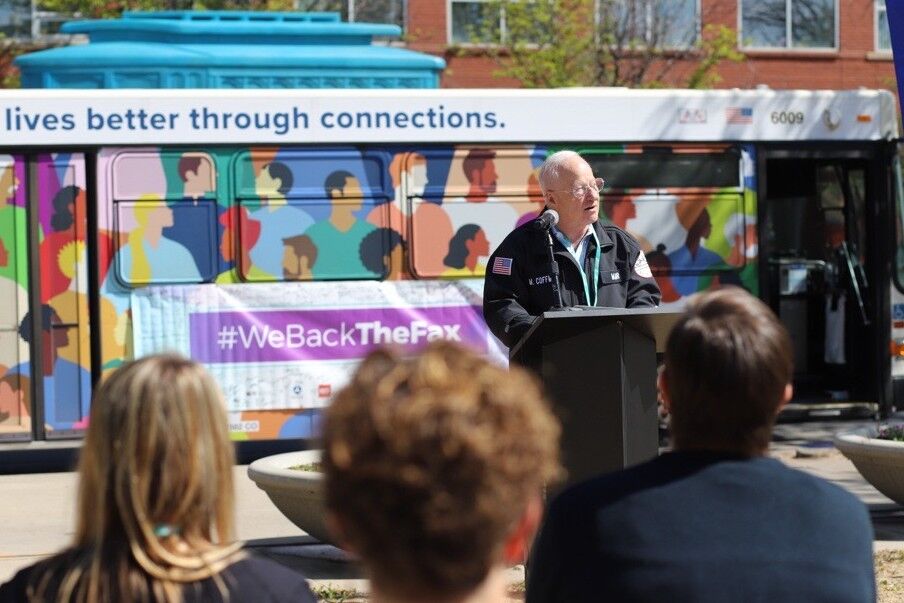
Aurora officials celebrated the start of construction on the East Colfax Avenue Bus Rapid Transit line Friday morning, kicking off the Aurora part of a project intended to make transportation more efficient.
The transit line will run through Denver between Union Station and Yosemite Street, then in Aurora from Yosemite Street to Colfax Station at I-225.
The Regional Transportation District’s Bus Rapid Transit is a bus service that incorporates elements of light-rail, including signal priority at intersections and dedicated bus lanes, to address typical causes of traditional bus service delays.
The transit line will run in dedicated center lanes from Broadway in Denver to Yosemite Street, then in mixed flow traffic, or side-running lanes, in Aurora to I-225.
Aurora Mayor Mike Coffman said Friday the groundbreaking was the “start of a new future for transportation on East Colfax.”
“Our region needs BRT service to address growing transportation demands,” Coffman said. “With BRT, this corridor will make travel between downtown Denver and I-225 in Aurora better for the long-term, improving travel time, providing more reliable service, and making it safer for people traveling along the corridor.”
Aurora officials are also working with the Denver Regional Council of Governments to consider expanding the BRT line farther east into the E-470 area, Coffman said.
The start of construction comes as the City of Aurora is making strides in creating a Downtown Development Authority to revitalize Colfax Avenue.
Aurora officials recently selected 12 candidates from 38 applicants to interview to serve on the DDA Board, which will oversee the project’s progress.
Core improvement areas for the DDA, as outlined in the Colfax Community Vision and Action Plan, are public safety, business support, housing stability, cleanliness and maintenance, arts and culture and public space.
The East Colfax BRT project is a vital element of the revitalization efforts, Coffman said.
U.S. Sen. Michael Bennet fought for the BRT project because it will make it easier to live and work in the metro Denver area, he said.
“It’s creating the infrastructure for us to build a community that’s sustainable in the Front Range … where working people know that if they come to Colorado, they’ll be able to raise their families here, have housing and transit that they can afford and rely on,” Bennet said.
Planning for the East Colfax BRT project began in 2008, when Denver officials saw a need for improvements to RTD service along Colfax, where service demand is higher than on all other RTD routes, according to the project webpage.
Officials conducted a Streetcar Feasibility Study in 2010 and a detailed analysis of transit needs in 2012, the webpage says. After six years of outreach and community feedback, officials decided on a center-running BRT, a design for which was complete in 2024.
Construction on the project in Denver began in October 2024.
Buses will arrive at stations approximately every four minutes during the day and reduce transit travel time by 15-to-30 minutes, according to the webpage.
The BRT project also brings new and enhanced transit stations and improved pedestrian and bike connections.
The project, estimated to cost $280 million, is funded through $150 million in federal grants, including a $23 million Federal Transit Administration grant, Elevate Denver bonds and Capital Improvement Program funding.
As construction continues through 2026 and into 2027, Bennet encouraged people to prioritize extra support for Colfax Avenue businesses that will be impacted.
Meanwhile, Denver businesses have already felt the impacts of construction from the East Colfax BRT project.
As of August, Denver Economic Development & Opportunity had awarded nearly 50 grants to East Colfax businesses, totaling more than $630,000 through the Business Impact Opportunity Fund.
At Shish Kabob Grill, a family-owned Mediterranean restaurant since 2004 and a Denver legacy business, the impacts began immediately when construction of the BRT started in Denver in October.
Fewer customers came in and revenues dropped by 20% in the first few months, said Obeid Kaifo, the owner’s son.
The project webpage, which lists several resources for small business owners worried about the impact of construction, encourages business owners to visit the Aurora-South Metro Small Business Development Center for assistance.
Construction is expected to finish next year.
More information about the project is available on the City of Denver’s website.
Denver Gazette reporter Bernadette Berdychowski contributed to this report.