







How it all fell apart for the Avalanche against Vegas | Evan’s take
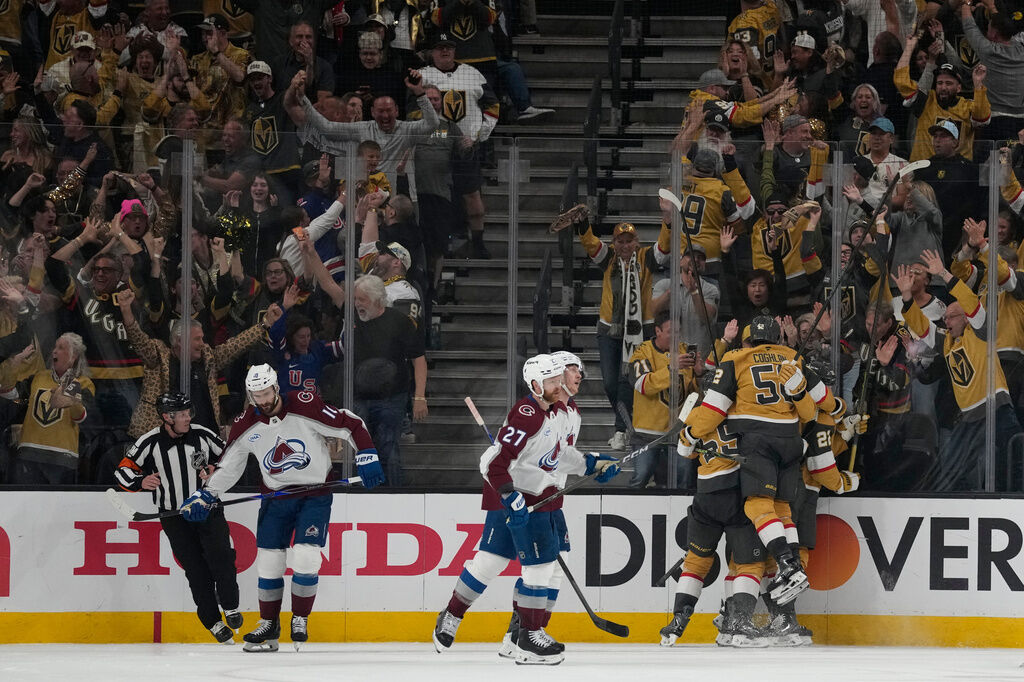
What had been the season of a lifetime ended after the week from hockey hell for the Colorado Avalanche.
The Vegas Golden Knights on Tuesday night at T-Mobile Arena completed a shocking sweep of the Avalanche in the Western Conference finals. Just one week prior, the Avalanche seemed unstoppable as heavy betting favorites to lift Lord Stanley in less than a month.
Now it’s over.
How? You don’t get swept because one or two things went wrong. A ton went wrong for Colorado. Here are the biggest items, in no particular order:
Not enough from the 3 ‘Ns’
Martin Necas, Brock Nelson and Valeri Nichushkin combined to score 88 goals in the regular season. In 13 playoff games, they combined to score just four, with only two of those coming against goaltenders.
“I thought, stylistically, the games against Minnesota benefit Marty,” coach Jared Bednar said before the series against Vegas started. “He likes to have the puck, he likes to find space, he likes to be creative. It’s when he’s at his best. It’s not that I didn’t like his series against L.A., but he didn’t create as much as he did against Minnesota. It wasn’t even close, but no one on our team did. Now we’ll see how it goes against Vegas.”
It didn’t go so well.
The bar was low against Vegas because of how little offense the Avalanche created, so Necas’ two points were tied for second most on the team. During the regular season, Necas was one of Colorado’s two main drivers offensively, creating offense not just for himself, but for his teammates. That was not the case against L.A. and Vegas, teams that clogged things up defensively.
Necas finished the Vegas series with just one point during five-on-five play and only four shots on goal. In the final two games, when the Avalanche needed him, among others, Necas did not register a single shot on goal during five-on-five play. Vegas was perfectly comfortable allowing Necas to skate the puck wide and play along the perimeter, but if he wants to succeed against good defensive teams, Necas must adjust and get to the dirty areas in the offensive zone. According to HockeyStats, Necas was ninth among 12 Avalanche forwards in total scoring chance contributions at 5-on-5.
That’s not good enough.
It was not just Necas who disappeared. At least Necas had some production throughout the playoffs, even if most of it came against Minnesota. Nelson had his scoring chances, particularly in the final two games, but he failed to do anything with them. While Bednar said earlier in the series he wasn’t sensing frustration from Nelson, his shot selection made it look like he was in his own head. In 20 playoff games with the Avalanche, Nelson has just two goals, and both went into empty nets. For someone who was a consistent producer in the postseason with the New York Islanders, his drop-off in production has been confusing, to say the least.
Nelson had a tremendous regular season and became Bednar’s matchup center. Defensively, he was good. But for the money he’s making, there just had to be more offense. And there wasn’t.
Valeri Nichushkin missed Game 4 with a lower-body injury and was sporting a noticeable limp. His offense all but disappeared down the stretch of the regular season and continued into the postseason. His goal late in Game 1 was the only 5-on-5 goal he scored in the postseason.
Where the Avalanche go from here with Nichushkin will be fascinating. He has a 12-team modified no-trade clause and has four years remaining on a deal with a cap hit of $6.125 million. If the Avalanche look to shake up the roster this summer, he could be a prime candidate to be shipped out.
MacKinnon’s worst postseason?
While the players above are vastly important to the success of the Avalanche, no one is more important than Nathan MacKinnon. A historically dominant postseason player, MacKinnon had perhaps his least impressive playoff run offensively. After scoring more even-strength points than any NHL player since Wayne Gretzky back in 1991, MacKinnon went 13 playoff games without scoring a five-on-five goal. Who could have seen that coming?
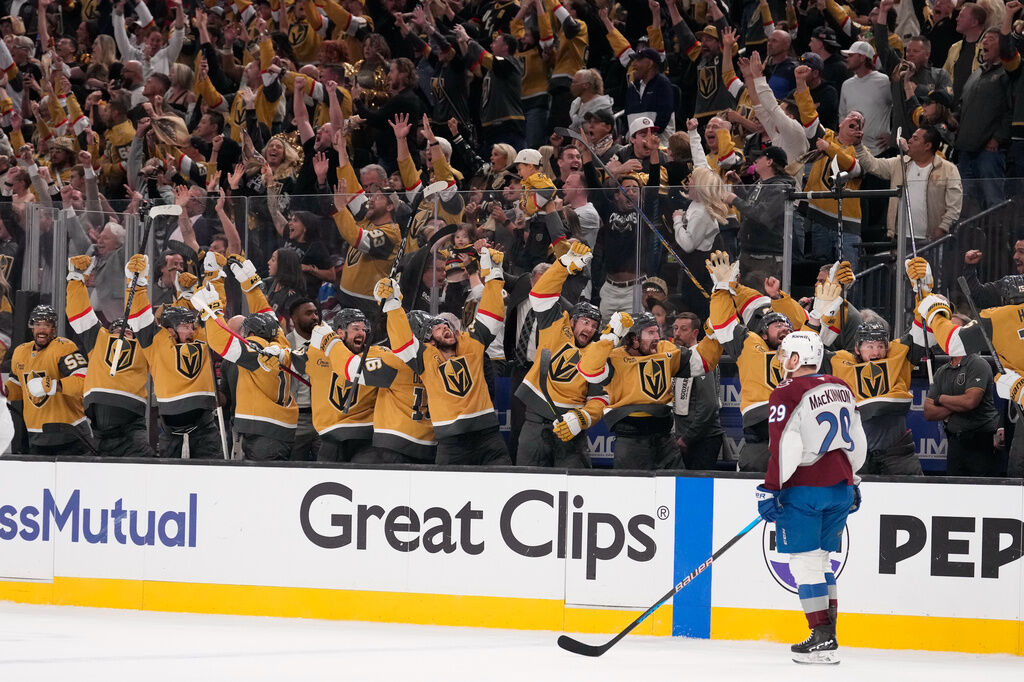
MacKinnon had his chances. HockeyStats said he generated more scoring chances than any other forward in the Vegas series at five-on-five, but none of them went in. Bad luck plays a role in some of this, but the series against the Golden Knights is the first one in MacKinnon’s NHL career where he failed to score a goal. It’s no wonder the series ended quickly.
Goaltending
The cracks started to show in the second round, when Scott Wedgewood’s game became more inconsistent and Mackenzie Blackwood had two vastly different starts. Unfortunately, that carried over into the series with Vegas.
You can’t pin the entire series on goaltending, but the reality is that Carter Hart outplayed Wedgewood in each of the first three games. Through those first three games, Hart was at a goals saved above expected of plus-3.77, while Wedgewood was at minus-1.90, according to Natural Stat Trick. Wedgewood had a tremendous regular season and earned the right to get the majority of the starts for the Avalanche in the postseason, but gave up at least one goal each game that he should have prevented. In a series where the margin for error is so small, that made a difference.
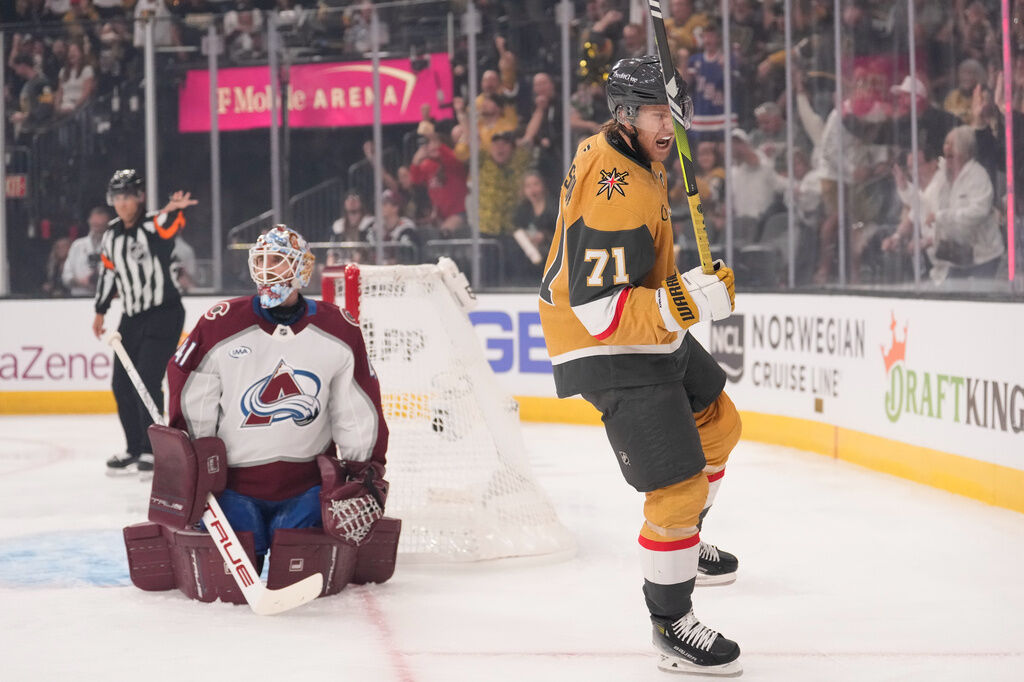
Bednar said he would rotate goaltenders when he felt the play of one was starting to dip, but did he wait too long to do it against Vegas? Blackwood sounded frustrated about the whole situation after Game 4’s loss.
“It’s freaking hard not to play for so long and come into a big game,” he said. “But you know I just said (expletive) it and go play the best I can and give them the best chance to win and just battle.”
Blackwood gave the Avalanche their best goaltending performance of the series Tuesday. Unfortunately, it was paired with 18 skaters in front of him playing their worst game of the series. And that’s why the Avalanche are out of the playoffs.
Injuries
Long playoff runs inevitably incur a beating. Each team must deal with injuries, so the Avalanche were not the only team dealing with them.
Their injuries clearly impacted the on-ice product.
Cale Makar gutted it out during the final two games, but he wasn’t close to 100%. Vegas begged him to shoot the puck, taking away all passing lanes. But he still wouldn’t shoot because of what he’s dealing with. After the game, the star defenseman struggled to untie his skates in the locker room. Bednar refused to give details on any injuries. When Joe Sakic and Chris MacFarland address media this week, they likely will. Don’t be surprised if Makar was dealing with a significant injury.

Beyond Makar, you had guys like Sam Malinski, Artturi Lehkonen and Josh Manson miss time with injuries. When they returned, they were nowhere near the players we saw prior to their injuries. Malinski and Lehkonen were a shell of themselves against Vegas.
In a long playoff run, you need to get a little lucky with injuries. The Avalanche didn’t get lucky, and that happens sometimes.
The power play
Colorado didn’t lose four straight games against Vegas solely because of their power play, but it sure didn’t help. For the second straight year, Colorado’s power play went into a coma at the most crucial time of the season. This year was far less surprising, given the power play was bad for about 70% of the season, but it doesn’t make it any less disappointing.
The killer is that not only was the power play bad, but that it failed them in crucial moments and stalled their momentum. In Game 2, when the Avalanche were leading 1-0, they had two power plays where they could have extended their lead to give themselves breathing room. They did not score. Worse yet, they failed to generate a shot on goal. In Game 3, with Vegas pushing to come back and tie the game, having already scored two second-period goals, the Avalanche had a power play that could have silenced the crowd and crushed the momentum the Golden Knights had generated. They didn’t.
Colorado fired their power-play coach after last year’s playoff exit. Can you do that two years in a row? Seems unfair to blame the coach when a lot of the same personnel is on the power play.
Uncharacteristic collapses
When the Avalanche got a lead in the regular season, it was game over. They were 41-0 in the regular season when entering the third period with a lead and 4-0 in the playoffs — until Game 2, when the Avalanche gave up three straight goals in the third period to lose at home.
Vegas completed two comebacks in the series. The Game 3 debacle was where the series really ended. When the Avalanche punched Vegas in the mouth in the first period, Vegas picked itself up and got back to work. When they punched back, the Avalanche had no answer.
“I think we let Games 2 and 3 slip away from us,” Logan O’Connor said. “Super uncharacteristic from our group to give up the leads like that, especially in consecutive games.”
It was stunning to see the Avalanche go from being automatic with a lead for over 90 games to blowing two in a row. And for the final five periods, that’s how the Avalanche looked: stunned. It was how they looked and acted in the 24 hours after Game 3 ended, and it showed in their play in Game 4.
Stubbornness and compete
Vegas was content to pack it tight near the net and allow the Avalanche to shoot from the outside, most of which got blocked or missed the net because there were no lanes. Instead of adjusting, the Avalanche stuck with that plan. It didn’t work. Vegas defended in a similar way to Dallas’ approach in recent years, so perhaps the struggles shouldn’t have been surprising.
“I felt like we were generating enough to create chances, doing enough things to find the back of the net a couple times, and yeah, it just comes down to one chance, and I felt like every game in this series was like that,” Makar said.
When something isn’t working, you must change it up. But the Avalanche were content with staying to the outside and trying to force plays that weren’t there. In 44 combined minutes of five-on-five, third-period hockey in Games 2, 3 and 4, the Avalanche were credited with just one high-danger scoring chance. It’s no wonder they couldn’t tie up those games.
Credit Vegas
Enough talk about the Avalanche. Credit Vegas. The majority of the Golden Knights’ core also won a Stanley Cup recently, and they consistently stepped up when needed.
Is it as simple as hiring coach John Tortorella to clean up the details? Unlikely. Vegas was a very good defensive team during the regular season and the best third-period team in the NHL. What they never got during the regular season was good goaltending. With Hart playing as well as he did, as well as the team returning to health, they became the total package. Give them credit.
And now the Golden Knights will play for another Stanley Cup because of it.