John Sie still seeing red, white and blue Starz at 90

SeriesFest bestows Visionary Award on a Chinese immigrant whose rise to cable-TV titan and Down syndrome advocate is the stuff of movies
John J. Sie turned 90 three weeks ago. And yet, he means it when he says the best is yet to come.
Sie is happy to be known as “The Father of Digital Television.” He’s happier to be known as the grandfather of six, including the young woman whose arrival in 2003 has since changed the lives of tens of thousands with Down syndrome.
Sie is the reason you likely own a high-definition television. He’s the reason the NFL started playing football on Sunday nights. He’s the reason you may have subscription video-on-demand of any kind. He’s the reason Denver Film has the three-screen Sie FilmCenter to host year-round independent cinema. He’s the reason the Denver Art Museum has a fancy $12 million welcome center.

And, said both Gov. Jared Polis and Sen. John Hickenlooper: He’s one of the main reasons Boulder is the new home of the Sundance Film Festival.
But ask Michelle Sie Whitten her father’s greatest accomplishment, and she will say without hesitation: “We’ve already gained about 10 years of life expectancy through our research and medical care for people with Down syndrome since 2005.”
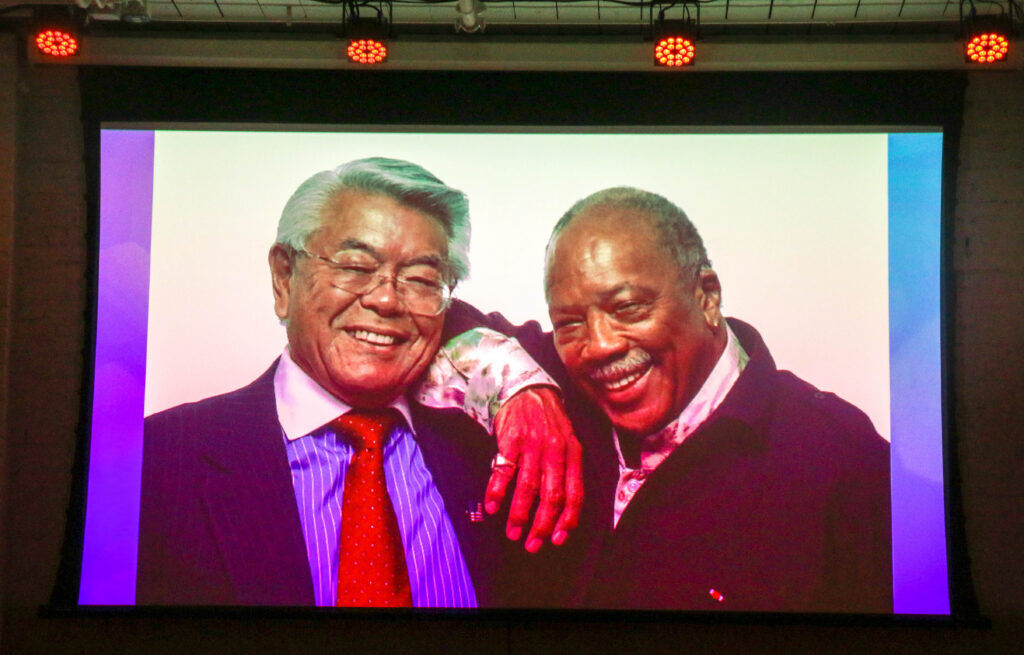
The late, legendary music producer Quincy Jones once told me he considered John Sie to be “the king of TV.” Sie, after all, was the cable TV pioneer who in 1989 had submitted the first white paper on digital high-definition television to Congress and the FCC – a crucial step in changing the television landscape.
But kings are not immune from life’s random challenges, as John and his wife, Anna, discovered when granddaughter Sophia was born. Sie’s reaction was resolute: “We were going to love and nurture this baby no matter what,” he told me.
In 2005, the Sies established the Anna and John J. Sie Foundation, which three years later became the founding donor of both the Linda Crnic Institute for Down syndrome and the Global Down Syndrome Foundation. The Crnic Institute is the first academic home for research and medical care for people with Down syndrome, historically the least-funded genetic condition in the U.S. The foundation was created to pay for that research and more, in partnership with Children’s Hospital Colorado, the University of Colorado Denver School of Medicine, the University of Colorado Boulder and others around the world. The foundation has built research institutes, medical centers and schools devoted to the cause.
“The mission,” Sie said, “is to eradicate the medical and cognitive ill deficit associated with the condition. Eradicate is a harsh word. But it draws attention to what I mean – finding a conclusive solution.”
Read more: D’Arcy Carden and the evening’s other SeriesFest Awards

On Friday, as the snazzily dressed father and daughter gathered at the hipster Asterisk Event Center in downtown Denver to accept SeriesFest’s highest honor – the Visionary Award – they joined in celebrating the festival’s mission to advance developing independent television. And they reflected on the critical role the Global Down Syndrome Foundation has played in the dramatic rise in life expectancy from roughly 25 years in the 1980s to nearly 60 years today, thanks in large part to rapidly advancing clinical trials.
“So the blessing is actually very personal,” said Michelle, whose daughter, Sophia, is now 23.
The Sies were instrumental in Denver Film’s 2010 capital campaign to help secure the organization’s first, permanent, year-round home in what was built as Neighborhood Flix in the Tattered Cover independent retail campus on East Colfax Avenue. In 2012, the Sie Family made a transformative $2.5 million contribution to Denver Film, including a $1 million low-interest loan that was forgiven in 2025, enabling Denver Film to own the building outright.
Most recently, the Sies joined another significant effort to provide $500,000 in technology upgrades “that allow us to present films exactly as filmmakers intended,” Denver Film CEO Kevin Smith said. The largest screening room is now called the Maria and Tommaso Maglione Theater – named after parents of Anna, who died of cancer in 2023.

Smith called this latest gift a gesture that “further secures the Sie family’s legacy of giving and support for Denver’s film community.”
In 2024, Sie and SeriesFest launched the Inclusive Creator Fund to support television projects featuring individuals with intellectual disabilities.
If you add up all the giving John Sie has done over his lifetime, his daughter said, “Dad’s philanthropy is over $200 million now.”
I asked them why they do it.
“I’m eternally grateful to come to this country on nothing but a vision,” said Sie. “I’m so glad to live the American dream.”
He said that again and again Friday night. And, Michelle said, he means it. He lives it. He practices it. He demands it from his loved ones.
“Dad never forgot to remind us that his success was in direct proportion to luck,” Michelle said. “So not being entitled and being grateful was always a big takeaway.”
On Friday, he outclassed every other dude in the room, dressed as the American Dream personified and realized, wearing patriotic formal wear that included a slightly glossy deep midnight blue blazer, a classic white dress shirt and vivid cherry red tie.

An immigrant’s (American) dream
His story is history, and it begins in 1936 in civil war-torn China. Just after John was born in Nanjing, his mother smuggled him and his older brother through enemy territory and into Shanghai, just before the Japanese occupation.
In 1950, with is father serving in a diplomatic role in Europe, John’s mother found secret passage for 14-year-old John and his brother to America in the belly of an empty cargo ship bound for San Francisco. But they never made it. Instead, John and his brother were sent to Mount Loretto Catholic Orphanage on Staten Island in New York City, where he remained through high school.
“The orphanage time,” Sie says simply, “was tough.”
Sie arrived in this country speaking little English, but he taught himself the language and went on to earn a master’s degree in electrical engineering from the Polytechnic Institute of Brooklyn. In 1958, he joined the RCA Defense Electronics Division, which provided top-secret equipment to the U.S. military. A few years later, he co-founded Micro State Electronics.
He took a switchboard operator named Anna Maria Maglione on her first date (with anyone!), and they were married for 56 years.
In 1977, John joined Showtime Entertainment as senior vice president of sales and marketing. In 1983, he accepted an invitation from eventual billionaire “Cable Cowboy” John Malone to move to Colorado from New Jersey and join him as a vice president at Tele-Communications Inc. (now Comcast), which they turned into a cable television giant in just a decade.
Sie’s 1989 appearance before Congress was significant because he was seen as the sole, pivotal voice advocating for a 100% digital high-definition TV standard. By steering the United States away from a potentially obsolete analog path championed by Japan, he helped the U.S. from falling behind technologically to leading the global digital revolution.
“In John’s opinion, digital was immediately right around the corner and not something way off in the future, and therefore the FCC would be making a huge mistake (by embracing analog),” Malone said in a recorded tribute to Sie. “I always joked with him that that was his revenge for the Japanese invasion of Shanghai (in 1937).”
It was Sie who first proposed the idea of a Sunday Night Football package as a way to break the network stranglehold on the NFL and to create cable-exclusive programming. “Sunday Night NFL” became one of the highest-rated programs on cable.
Then one day, Malone said, Sie came to him and said, “I think I’ve got an idea. I think there’s a big appetite for the public to watch old movies.” That led to the creation of the Starz-Encore umbrella in the early ‘90s, which in short order became a global movie powerhouse. “John was the mastermind behind the scenes of the premium partnership model,” Malone said.
For his part in all of that, Sie says simply: “I was honored to be able to play a small part in the growth of the cable television industry.”

The ‘starz’ come out
They say the true measure of a man’s impact can be taken by who shows out for him, and Friday’s SeriesFest “Soiree” gala brought out the boldest names in Colorado – not just in entertainment but in local politics. Take Polis, for example:
“John’s Sie’s legacy looms large on so many great causes across our state,” he told the Denver Gazette. “It was a great honor to get to know him and his daughter, and it’s amazing whenever I find out more about all the different organizations he has supported over the years. He’s done such good work. And he’s still plugging along at 90.”
Sen. John Hickenlooper, who sat beside Sie at SeriesFest’s table of honor on Friday, said what he loves most about Sie is that the man is an incurable optimist. “No matter how tough the going is, he brings people along with him,” Hickenlooper said.
“John is the foundation of so much of what we take for granted. Look at Sundance. Look at the Sie Film Center. Look at the Denver Art Museum. He’s done so much of it. He creates a social conscience where sometimes there was just a stone.”

And there’s Colorado Attorney General Phil Weiser, who hopes to succeed Polis as governor:
“When you think about Colorado’s impact as a creative hub and the cable industry, John Sie is in the pantheon,” Weiser said. “We in Colorado played an extraordinary role in the birth of cable television. John’s vision was path-making, and he did it here in Colorado, where he has continued to be an incredible leader in this community. We’re so fortunate for his leadership. For his family’s philanthropy.’ The Sie Film Center is here because of his commitment to making us a creative hub. You can look at SeriesFest, Sundance and all the rest – and there is a direct line from all of it to John Sie’s leadership.”
Sie doesn’t talk politics. Asked what shows he binges on the cable platform that he created, he says deftly: “CNN and Fox News.” (“He is always watching the news,” his daughter confirmed.)
To her, the dual legacies of his life – the achievements in business and philanthropy – are inextricably tied.
“I feel like dad’s cable TV industry days were almost a means to an end,” Michelle said. “John Malone, Bob Magness, all these mavericks, they did great things. They revolutionized an industry. But my dad and my mom gave back in so many spectacular ways through their philanthropy. And they couldn’t have done any of that without the money they raised in the cable TV industry. So one is the reason for the other.”
I asked Sie what lesson we should take from his life, based on how it began and what he has accomplished since.
“Be very, very positive in anything you do, and don’t let people sideline you,” he said. “If you believe what you say, you can continue to realize the American dream. I’m just so very grateful to come to this country.”
John Moore is the Denver Gazette’s Senior Arts Journalist. Email him at [email protected].